All about this insurance: Buildings insurance
Is buildings insurance mandatory in Germany?
Insurance broker / Insurance questions / Buildings insurance
In short
Yes. Water escaping from pipes, called Leitungswasser in German policies, is part of the basic cover of every buildings insurance. It pays for burst and frozen pipes inside the house, finding and opening up the leak, drying and repairing walls and floors. An average claim costs more than EUR 4,000. Rain, groundwater, sewage backflow and often pipes outside the house are not covered.
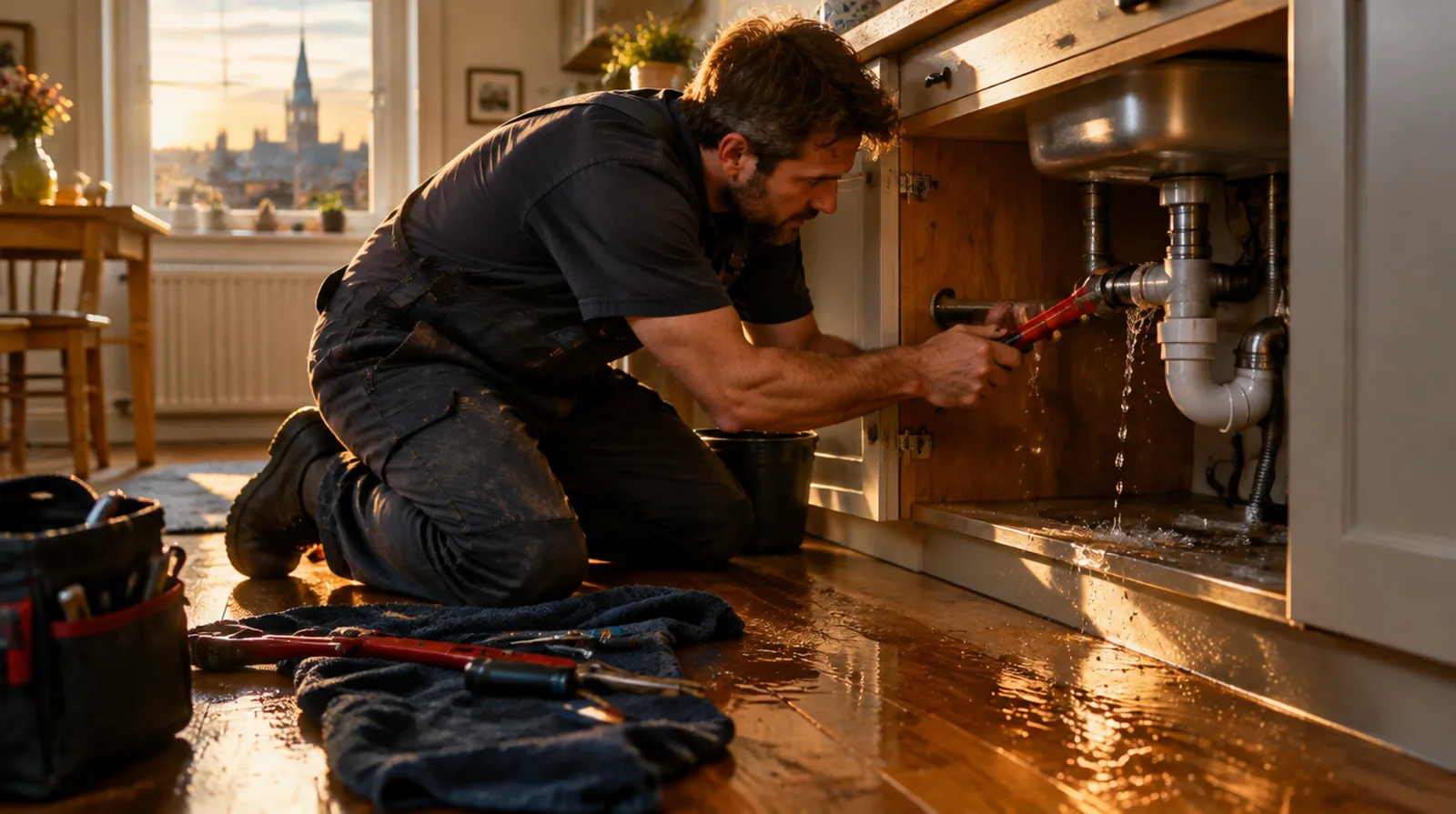
What pipe water damage costs in Germany, based on published industry figures and trade prices, 2026.
| Example | Typical range |
|---|---|
| Average pipe water claim on a residential building | around EUR 4,300 (EUR 4.9 billion for about 1.13 million claims) |
| Leak detection, depending on method | about EUR 200 to 600 |
| Building drying, small area up to 20 square metres | about EUR 400 to 800 |
| Building drying, medium area up to 50 square metres | about EUR 1,000 to 1,500 |
| Electricity for one drying unit | about EUR 2.80 to 16 a day |
Guide values as of September 2026 from industry statistics and published trade prices. The average is calculated from total claims cost and number of claims. The screed and tile costs in the example are guide values from our quoting practice.
Worked example
A corroded hot water pipe in the wall breaks. Water runs unnoticed into the screed of the bathroom and hallway.
| Leak detection with thermal imaging | about EUR 300 |
| Open the wall, replace the pipe section, close it again | about EUR 800 to 1,200 |
| Screed drying, about 25 square metres, three weeks | about EUR 1,000 to 1,500 |
| New tiles and flooring | about EUR 2,000 to 3,500 |
| Deductible, if agreed | for example EUR 500 |
Total damage about EUR 4,100 to 6,500. The insurer pays it minus the deductible. Replacing the other old pipes in the house is your own cost.
Covered is water that escapes unintentionally from fixed installations: drinking water and waste water pipes inside the house, the heating system, taps and connected appliances such as washing machines or dishwashers. Breakage and frost damage to the pipes themselves are included too.
The insurer pays to repair the broken section, to locate and expose the leak, to dry the building and to restore screed, plaster, tiles and floors. Your furniture and belongings are not part of buildings insurance. They fall under contents insurance (Hausratversicherung).
| Damage | Does buildings insurance pay? |
|---|---|
| Burst pipe inside a wall | yes, including detection, opening up and drying |
| Frozen pipe inside the house | yes, if you heated the house or drained the pipes |
| Burst washing machine hose | yes for walls and floor, usually not for the hose itself |
| Leaking silicone joint in the shower | usually no, it is treated as wear |
| Waste pipe under the garden | only if drainage pipes on the plot are included |
| Water from heavy rain or backflow | no, only with natural hazard cover |
| Water from an aquarium or waterbed | yes, in most newer policy wordings |
Pipes outside the building are the most common gap. Supply pipes on the plot are often included, drainage pipes in the ground only in better tariffs and sometimes only up to a fixed amount. Digging up a waste pipe under the driveway easily costs several thousand euros.
Mould after a leak is not always covered, especially if the leak dripped unnoticed for a long time. Replacing old, corroded pipes throughout the house is not an insurance benefit either. The insurer pays for the damaged spot, not a full renovation.
In Germany, building, belongings and liability are three separate policies. If you rent, the landlord's buildings insurance pays for walls and floors, your contents insurance for your furniture, and your personal liability insurance (Privathaftpflicht) if water from your flat damages a neighbour's flat.
If you own a house, you must heat it in winter or shut off and drain the water pipes while it stands empty. Report the damage at once, and agree drying and repair with the insurer where possible. In an emergency you may act immediately to limit the damage.
More than half of all claims costs in German buildings insurance come from pipe water. Many houses still have pipes from the 1960s and 1970s, so insurers ask about the year of construction and any renovation and charge noticeably more for old installations.
After several pipe claims an insurer may cancel or insist on a high deductible. If you buy an older house, have the pipes checked before the first leak happens.
Questions and answers
Yes, if an insured pipe burst is behind it. Some tariffs cap the costs for searching and opening up, so check the limit in your policy.
Walls and floors are paid by the landlord's buildings insurance, your furniture by your contents insurance. If you caused the damage and a neighbour's flat is affected, your personal liability insurance pays.
Usually yes, as part of the claim. Note the meter reading before and after drying.
No. Rain through a hole caused by a storm falls under storm cover. Backflow and heavy rain are only covered with natural hazard cover.
No. It pays for the broken section and the damage it caused, not a full renovation of old pipes.
Yes, after a claim both sides may cancel. With several pipe claims in a short time this happens, and often a higher deductible is asked for instead.
NAMMERT insurance broker
We compare several insurers and come back with a proposal. Free for you; the insurer pays our fee. You can write in English.
Thank you, we have your request.
We will be in touch within one working day. If it is urgent: +49 3375 29 12 77.
All about this insurance: Buildings insurance
Is buildings insurance mandatory in Germany?
What does buildings insurance cover in Germany?
Buildings insurance (Wohngebäudeversicherung) pays to repair or rebuild your house after fire, escaping tap water, sto …
NAMMERT Assekuradeur GmbH, insurance broker licensed under section 34d(1) of the German Trade Regulation Act, broker register no. D-C08Q-TOSD4-37. For boat and yacht insurance we act as underwriting agency, not as broker. Statutory disclosure (German) · Updated