01
Included in buildings cover
Fire, storm, hail and water only, no lost income, no operating errors.
Home / Insurance broker / Personal
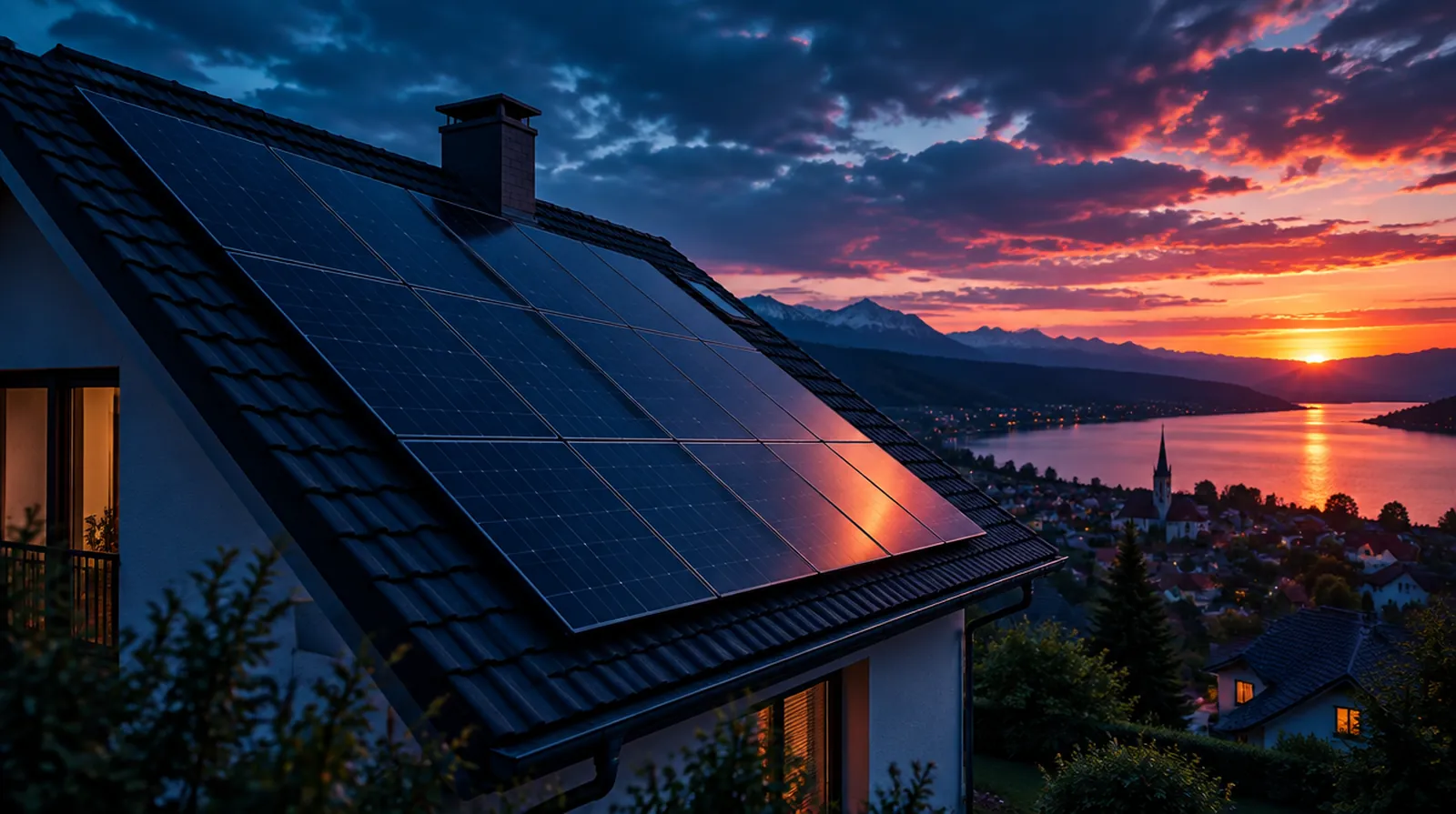
Rooftop solar panels in Germany are often covered by your buildings insurance, but only against fire, storm, hail and escaping water. A dedicated Photovoltaikversicherung adds short circuits, power surges, operating errors, animal bites, theft and lost income. Small balcony systems usually fall under contents insurance.
The question almost everyone asks first
Often yes, if you have told the insurer about them, but only for the perils in the policy: typically fire, lightning, storm, hail and escaping water. It usually does not pay for inverter failures, power surges from the grid, martens chewing cables, operating errors, theft or the electricity you lose while the system is down. For that you need a dedicated solar policy or an all-risks add-on. There is no legal requirement to insure a system.
A German buildings policy only pays when one of its listed perils strikes. Many common solar losses fall outside that list: a surge that is not caused by a direct lightning strike, a short circuit in the inverter, martens gnawing cables under the panels, snow load, stolen modules, damage during cleaning.
Dedicated solar policies are usually written on an all-risks basis. Anything sudden and unforeseen is covered unless it is expressly excluded. That shifts the burden of argument in your favour, which is the real value of the product.
Since Germany's Solarpaket I, plug-in solar devices with up to 800 W inverter output and 2,000 W of panels benefit from simplified rules. They must be registered with the Federal Network Agency's market master data register (Marktstammdatenregister). Since late 2023 the model contents conditions of the German insurers' association treat them as household contents if they are not permanently fixed to the building.
Since October 2024, tenants have a statutory claim under § 554 of the Civil Code (BGB) to their landlord's permission for such a device, which the landlord can only refuse if it is unreasonable. If a panel falls and damages a car below, your personal liability policy is the one that pays.
If the inverter fails in May and a replacement takes six weeks, you lose production in the best weeks of the year and buy more expensive grid electricity. Good solar policies pay a daily amount for downtime, either a flat rate per kilowatt peak or based on proven yield.
Home batteries are often a large part of the investment and sit in the basement or garage. Make sure the policy names the battery and its value. Some policies also include the wallbox and heat pump, which avoids disputes about where the solar system ends and the building begins.
Wheel of misfortune
Six things that really happen. The wheel picks yours and shows who pays.
Cost:
The premium depends on the system's value, the battery and the lost income cover you choose. Because systems differ widely, we do not quote sample prices. Compare the extra cost with what your buildings policy already covers.
No sample prices, because they vary by system. Your premium is only fixed in the quote.
01
Fire, storm, hail and water only, no lost income, no operating errors.
02
Dedicated policy with all-risks cover, surge, animal bites and theft, plus some months of lost income.
03
Adds battery, wallbox, heat pump and longer lost income periods.
| Criterion | Minimum standard | Strong policy | Why it matters |
|---|---|---|---|
| Type of cover | named perils | all risks | The most frequent solar losses are not named perils. |
| Lost income | none | from day one, at least six months | A summer outage hits the highest-yield period. |
| Battery | not mentioned | expressly covered at replacement value | It is often one of the most expensive components. |
| Power surge | lightning only | any surge | Surges also come from the grid, not only from lightning. |
| Animal bites | excluded | included with consequential damage | Martens nesting under panels are a common problem in Germany. |
| Scaffolding and refitting | limited | included | Access costs can exceed the price of the damaged panel. |
Solar cover in Germany is sold either as part of buildings insurance or as a separate all-risks policy. This list shows property insurers offering at least one of the two.
| Insurer | Background |
|---|---|
| Allianz | solar as part of buildings cover, agents and brokers |
| AXA | dedicated solar policy, agents and brokers |
| Gothaer | dedicated solar policy, agents and brokers |
| Helvetia | German company of the Swiss Helvetia group |
| VHV | broker-focused insurer based in Hanover |
| Alte Leipziger | mostly broker distribution |
| Ammerländer | mutual, brokers only |
From the BaFin register
155
155 insurers supervised by BaFin, the German regulator, are licensed for this class of insurance. (Feuer, Hagel-, Frost- und sonstige Sachschäden)
Source: BaFin company database, retrieved 18 September 2026. Insurers from other EU countries selling through a branch or without a German office are not included.
Extends the buildings policy to cover the system, sometimes with all risks and lost income.
All-risks cover for panels, inverter and battery, independent of your buildings insurer.
For systems not covered by personal liability, such as on someone else's roof or on open land.
Plug-in devices treated as household contents, against the contents perils.
Myth or truth
Five things people say about this insurance. Guess first, then see the answer.
German firefighters will not tackle a burning house with solar panels.
This is false.
Not true. They fight the fire from a safe distance because panels stay live in daylight. A sign at the meter cabinet helps them plan.
Certified solar panels are tested to survive hail.
This is true.
Yes, the standard test fires ice balls of 25 mm at the glass. Larger hailstones in severe storms can still break them.
Plug-in balcony solar does not need to be registered anywhere in Germany.
This is false.
Wrong, it has to be entered in the Federal Network Agency's register. The grid operator no longer needs a separate notice, which is where the confusion comes from.
A marten can shut down a whole solar system.
This is true.
Yes, martens nest under panels and gnaw through DC cables. The fault may go unnoticed for weeks, which is why yield monitoring and all-risks cover both matter.
A buildings policy pays for lost feed-in income after hail.
This is false.
No, it pays for the damaged panels, not the electricity you did not produce. Income loss cover exists only in dedicated solar policies.
Questions and answers
For a system on the house you live in, liability is often included in personal liability or homeowner's liability insurance. Check the wording, especially if you feed power into the grid. Systems on other people's roofs or on land need their own operator liability cover.
Usually yes, if it is not permanently fixed to the building. Devices up to 800 W inverter output are the typical case. Damage it causes to others falls under your personal liability policy.
Yes, hail is covered by both buildings and dedicated solar policies. What matters is replacement at new value and whether scaffolding and refitting are included, as those drive the cost.
Only in limited cases. Since October 2024, § 554 of the German Civil Code gives tenants a right to the landlord's consent for plug-in solar devices, unless the specific installation is unreasonable for the landlord. Details such as placement can still be discussed.
Only if the policy names it or covers the system as a whole. Give make, capacity and price when asking for a quote. Batteries are sensitive to surges and moisture.
The electricity the system does not produce after an insured loss until it is running again, either as a flat daily rate per kilowatt peak or based on proven yield. Check whether self-consumption counts, not just feed-in.
No. During installation the installer is responsible and should carry their own liability and installation cover. Your insurance normally starts when the system is commissioned.
NAMMERT insurance broker
We obtain quotes and come back with a comparison. Free of charge and without obligation: the insurer pays our commission. You can write in English.
We will be in touch within one working day. If it is urgent: +49 3375 29 12 77.
Is buildings insurance mandatory in Germany?

Is flood insurance included in German home insurance?

Do I need contents insurance as a renter in Germany?

Do I really need personal liability insurance in Germany?
Ten life situations, sorted honestly
Find your case, see which policy pays
What we would talk you out of
Boat or yacht? Here we are not the broker but the underwriting agency, with our own policies and our own claims handling.
Boat insuranceNAMMERT Assekuradeur GmbH, insurance broker licensed under section 34d(1) of the German Trade Regulation Act, broker register no. D-C08Q-TOSD4-37. For boat and yacht insurance we act as underwriting agency, not as broker. Statutory disclosure (German) · Updated