All about this insurance: Solar panel insurance
Does my German buildings insurance cover my solar panels?
Insurance broker / Insurance questions / Solar panel insurance
In short
It replaces the lost solar yield while your system is down after an insured damage. Loss of income cover (Ertragsausfallversicherung) usually pays EUR 2 to 2.50 per kWp and day in summer and EUR 1 to 1.50 in winter, after a 1 to 2 day waiting period and up to the agreed cover period. Without damage, for example when the grid operator curtails your system or a summer is cloudy, it pays nothing.
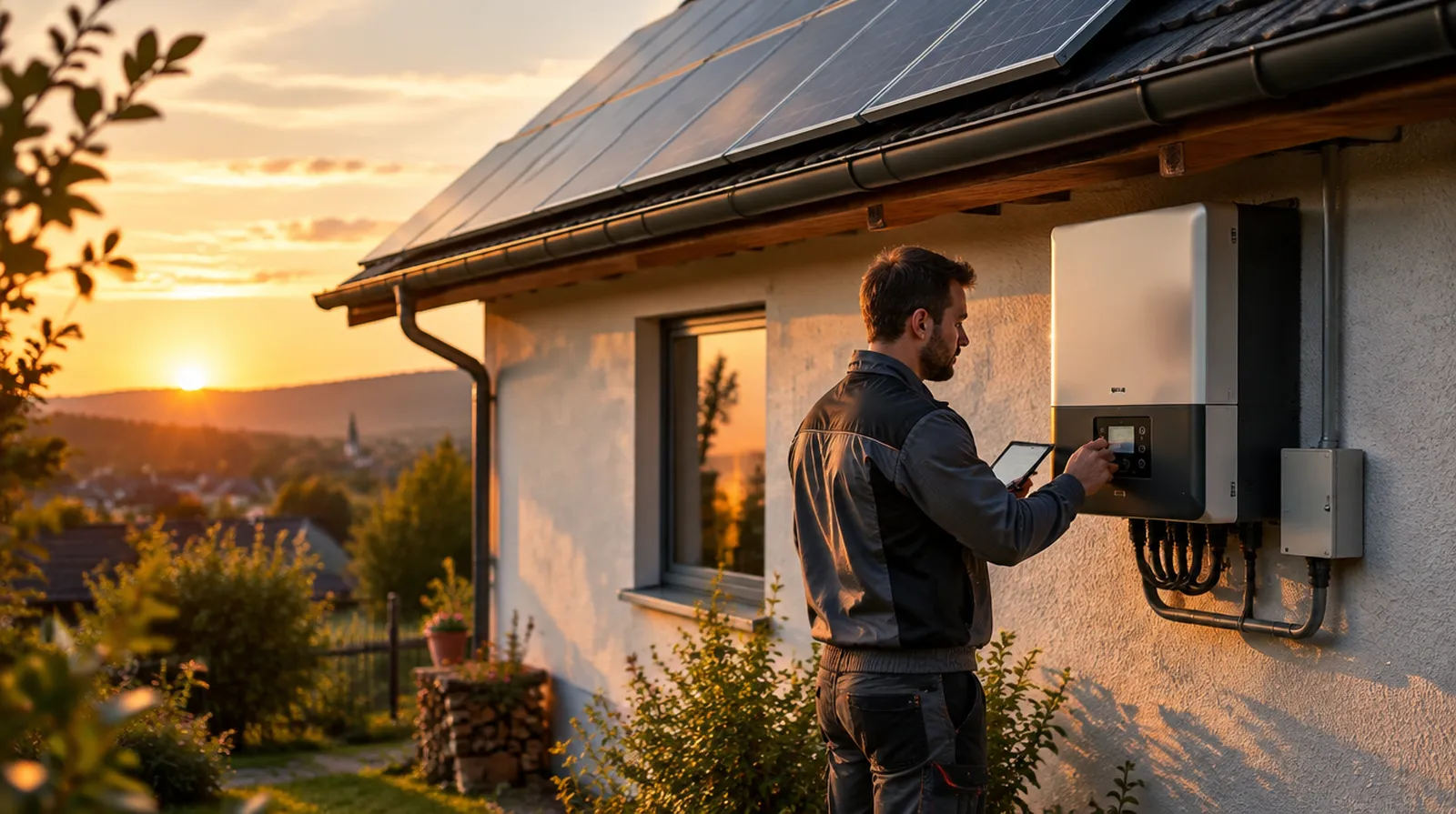
Guide figures from published tariff descriptions and official feed in rates, September 2026.
| Example | Typical range |
|---|---|
| Daily rate in summer per kWp | about EUR 2 to 2.50 |
| Daily rate in winter per kWp | about EUR 1 to 1.50 |
| Extra premium, cover period up to 12 months | about EUR 20 to 40 a year |
| Extra premium, cover period up to 24 months | about EUR 35 to 60 a year |
| Feed in tariff, new system up to 10 kWp, partial feed in, from August 2026 | 7.70 cents per kilowatt hour |
| Feed in tariff, new system up to 10 kWp, full feed in, from August 2026 | 12.22 cents per kilowatt hour |
Guide figures, September 2026, from published tariff descriptions and the feed in rates under the EEG. The yield of about 5 kilowatt hours per kWp on a summer day, the power price of about 35 cents, self consumption of one third and inverter delivery times are guide figures from quoting practice. Daily rate, waiting and cover period are in your policy; we obtain the exact quote for you.
Worked example
Replacement takes 35 days, the waiting period is 2 days, the summer rate EUR 2 per kWp. This is the difference between a flat payment and proven loss.
| Downtime minus waiting period | 33 days |
| Flat daily rate (10 kWp × EUR 2) | EUR 20 per day |
| Flat payout (33 × EUR 20) | EUR 660 |
| Real loss at about EUR 0.80 per kWp and day | about EUR 260 |
| New inverter and fitting | paid by the property cover, not by loss of income |
Depending on the policy you receive about EUR 260 to 660 for the downtime. Without the add-on you bear the loss of about EUR 260 yourself.
Loss of income cover is an add-on to solar insurance (Photovoltaikversicherung). It pays when the system produces no power because of insured damage, for example hail breaking panels, lightning destroying the inverter or a marten biting through cables.
It pays for each day the system is down until it is repaired. Most policies use a fixed daily rate per kilowatt peak, kWp, the rated output of your system. Some pay this rate as a flat amount, others only the proven loss up to that limit. Your terms say which.
Whether the electricity you now have to buy from the grid is also covered varies. With high self consumption that is often the larger part of the loss.
| Term | Meaning | Usual value |
|---|---|---|
| Daily rate | amount per kWp and day of downtime | summer EUR 2 to 2.50, winter EUR 1 to 1.50 |
| Waiting period | first days without payment | 1 to 2 days |
| Cover period | longest payment period | 3 to 24 months |
| Trigger | insured physical damage | hail, storm, lightning, fire, theft, animal bites |
The cover does not make up for a poor yield, only for downtime after damage. Without insured damage there is no money, and that applies to more situations than many expect.
| Situation | Paid? | Why |
|---|---|---|
| Cloudy summer | no | no damage |
| Grid operator curtails the system | no | no damage to the system |
| No feed in payment during negative market prices | no | legal rule, not damage |
| Panels lose output over the years | no | wear is excluded |
| Snow on the panels for a week | no, as long as nothing is damaged | no physical damage |
| Inverter destroyed by a power surge | yes, after the waiting period | insured damage |
| Hail breaks panels, replacement takes weeks | yes, up to the cover period | insured damage |
The usual daily rates date from a time when solar power earned 30 to 40 cents per kilowatt hour. New systems up to 10 kWp with partial feed in have received only 7.70 cents under the Renewable Energy Sources Act (EEG) since August 2026.
A system in Germany produces about 5 kilowatt hours per kWp on a good summer day. If you use a third yourself and would have to buy it for about 35 cents, and feed in the rest at 7.70 cents, you lose about EUR 0.80 per kWp on such a day. Across the year it is much less.
If your policy pays only the proven loss, you get far less than the maximum rate. If it pays a flat rate, the payout can exceed your real loss. For older systems with a high feed in tariff, rate and loss are close.
It pays off for older systems with a high feed in tariff, for systems over 10 kWp, with high self consumption from a heat pump or electric car, and whenever a loan is repaid from the income. Six weeks of downtime in summer can cost several hundred euros there.
It hardly pays off for a small new system with a low tariff that you paid for without a loan. A month of downtime then often costs less than two years of premium for the add-on. Drop it in that case, but keep the cover for the system itself.
A waiting period of more than two days and a cover period of only three months make the add-on nearly worthless. After storms, inverters have had delivery times of several weeks.
Questions and answers
Usually not, or only with a tight limit. It is typically part of a separate solar policy and often optional there.
No. Curtailment, grid failure or no payment during negative prices are not physical damage to your system.
Then payment is usually proportional to the failed output in kWp. Inverter data helps prove it.
Only if the policy counts such defects as damage, for example short circuits in all risks cover. Pure wear is always excluded.
If your system is treated as a business for tax purposes, the payment replaces income. Many small systems are now tax free; check your case with a tax adviser.
NAMMERT insurance broker
We compare several insurers and come back with a proposal. Free for you; the insurer pays our fee. You can write in English.
Thank you, we have your request.
We will be in touch within one working day. If it is urgent: +49 3375 29 12 77.
All about this insurance: Solar panel insurance
Does my German buildings insurance cover my solar panels?
How much does solar panel insurance cost in Germany?
Budget roughly EUR 3 to 9 per year for every EUR 1,000 of system value. A 10 kWp array insured for about EUR 15,000 co …
Do you need insurance for a solar PV system in Germany?
No, it is not compulsory. For a normal rooftop system on your own home, adding it to your building insurance (Wohngebä …
Is a home battery covered by insurance in Germany?
Not automatically. Many buildings policies (Wohngebäudeversicherung) do not count a battery, and some solar policies i …
Does buildings insurance cover solar panels in Germany?
Only if your insurer has expressly added the system to the policy. A panel array mounted on top of the roof (Aufdachan …
NAMMERT Assekuradeur GmbH, insurance broker licensed under section 34d(1) of the German Trade Regulation Act, broker register no. D-C08Q-TOSD4-37. For boat and yacht insurance we act as underwriting agency, not as broker. Statutory disclosure (German) · Updated
Was this useful?