Boat insurance: Everyone aboard? So are we.
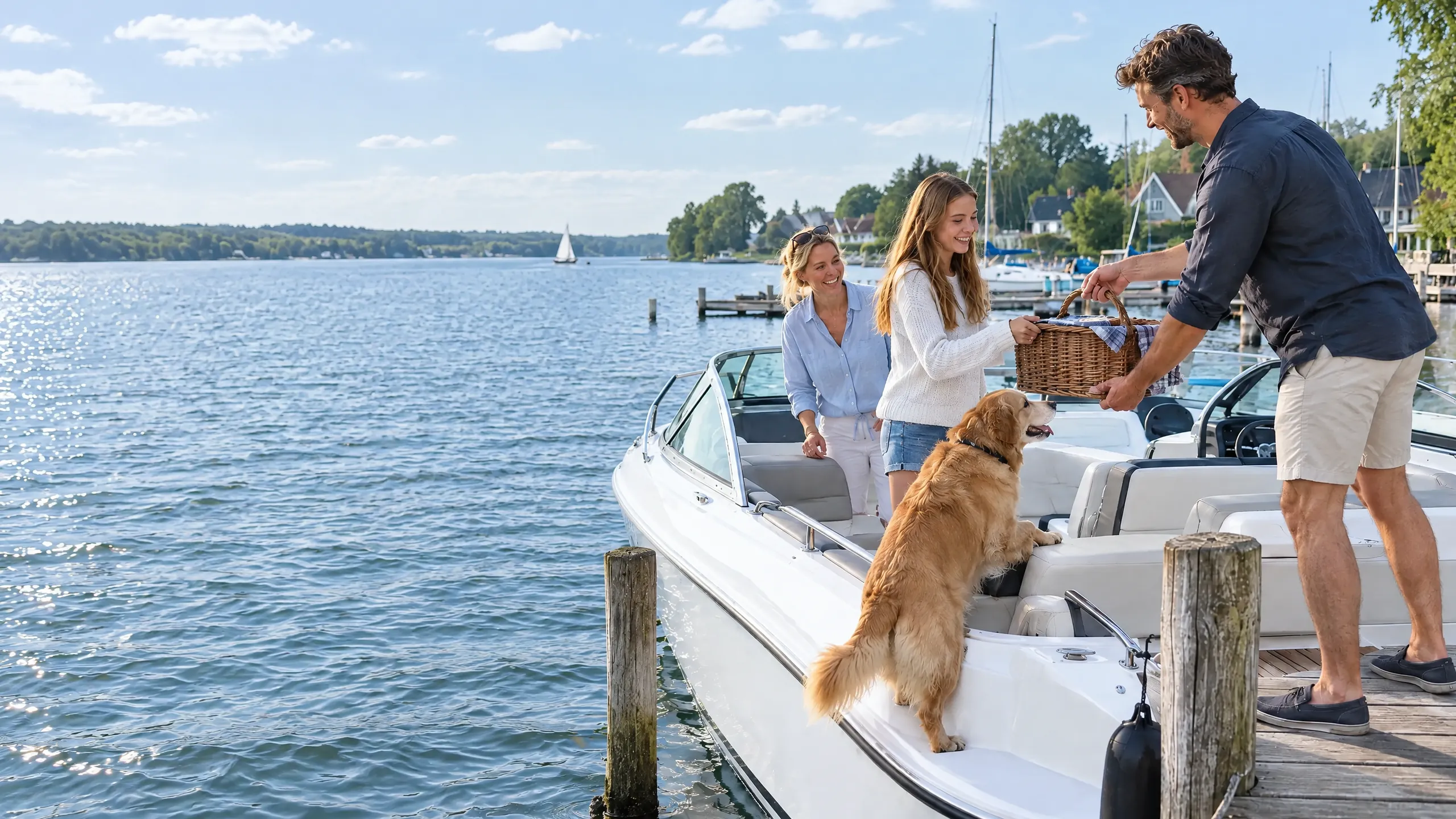
Everyone aboard, the dog first, and off you go. We are coming too: a premium in about a minute, a real person on the phone and claims handled under our own roof.
- Cover concept and claims under one roof
- Policy usually issued the same day
- Offices in Salzburg and Palma
Paperwork, waiting, hold music
Three steps and you can cast off
Pick your boat, slide the value
Motorboat, sailing boat, jet ski or yacht: choose the type, set the value and your premium appears. No paperwork marathon.
Same day, usually
Happy with the figure? Go ahead online and the policy is usually issued the same day. Unusual boat or waters? We ask first.
One building, one answer
The people who write your cover also take up your claim, in the same building, and file it in full with the insurer.
Plain numbers, no small print
What does your happy place cost a day?
Tap your type of boat, slide the value and see what a day on the water costs. Six boat types, one honest figure from our tariff.
What do you sail or drive?
How much backup would you like?
€25m liability plus full hull cover
The price of a good feeling
€1.22a day
€444 a year, paid annually
Less than a scoop of ice cream on the pier.
Example for a boat worth €20,000, tariff as of 3 October 2026.
Arranged by NAMMERT as underwriting agency and insurance broker.
This is what it is for
Every boat has its moment
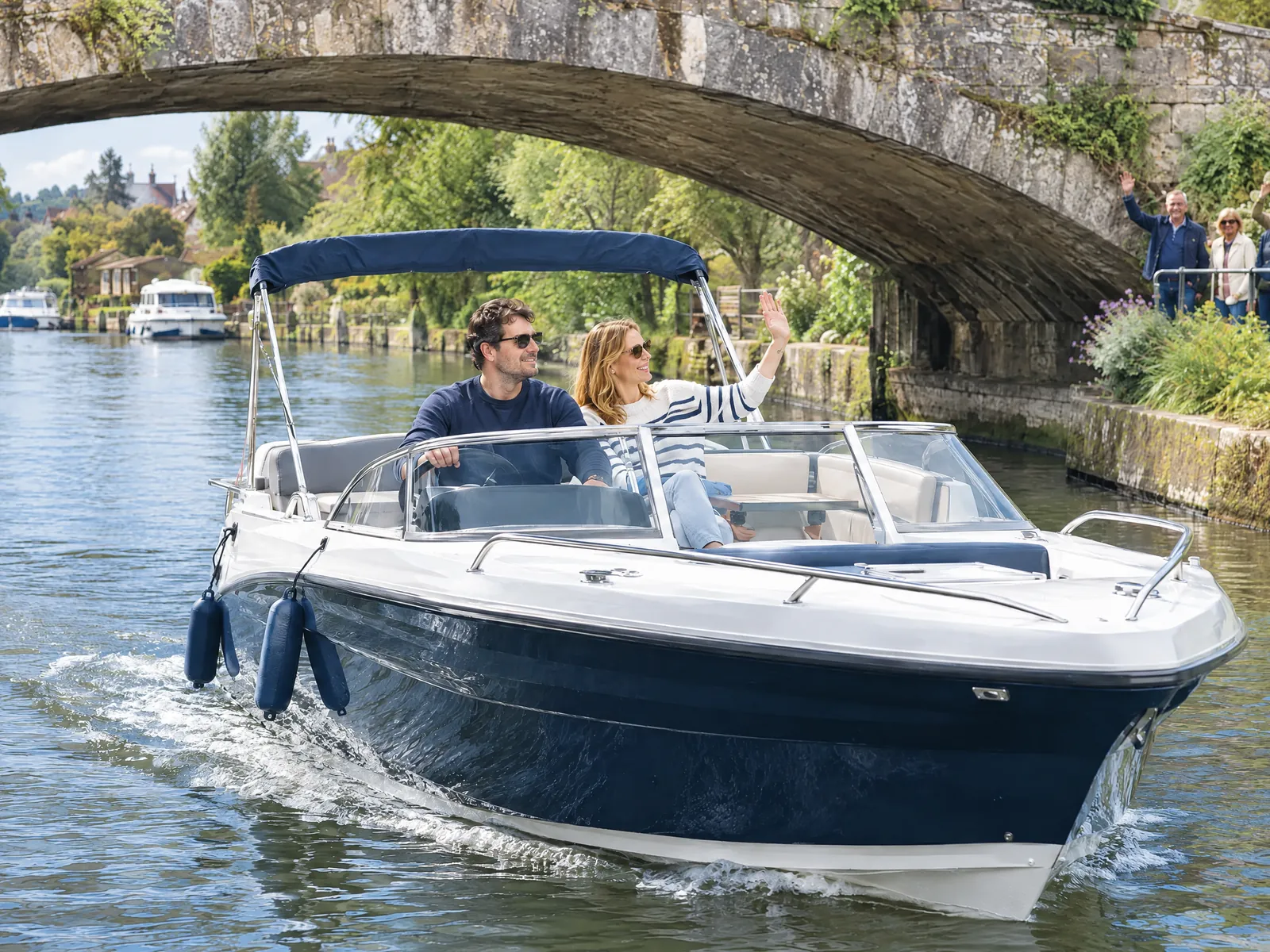
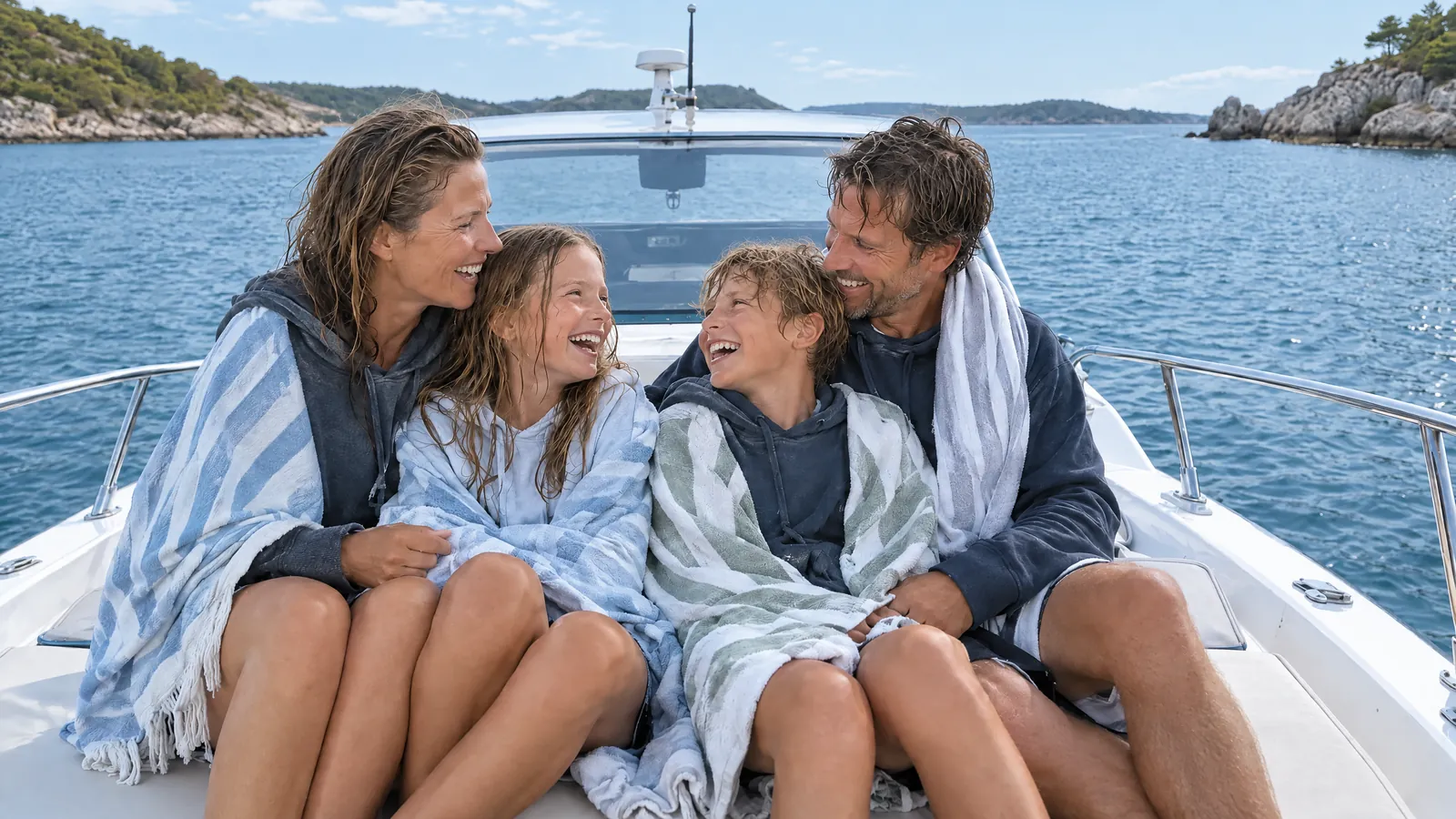
Under the old bridge in the morning, wet hair and giggles in the bay by lunchtime. Whatever you sail or drive, the paperwork is ours.
Good to know
The people who prepare your cover also handle your claim
NAMMERT is an underwriting agent, not a broker who passes you on. The people who assess the risk also prepare the policy and handle claims, in the same building. For a boat kept abroad that is the difference between an answer today and a file that travels.
Cover by boat type
Ten types where the wording differs enough to deserve a page of its own.
Classic, wooden, home-built or over 24 metres? The twelve boat classes with rules of their own
Six clauses worth checking
Check them in any quote you receive, not only in ours. They are the lines that decide a claim.
Agreed value, not market value
From Basis-Plus the sum agreed in writing is what gets paid on a total loss: in Premium at any age, in Basis-Plus up to five years or while the current value still reaches half the sum. No argument about what the boat is worth on the day it sinks.
Gross negligence waived
Up to 25 % of the sum insured from Basis-Plus and 50 % in Premium; as a percentage, not a fixed cap in euros. It is a common reason payments get cut.
Salvage paid on top
Salvage and wreck removal ordered by the authority come in addition to the settlement, not deducted from it: up to the sum insured in Basis, 1 million euros in Basis-Plus, 2.5 million in Premium.
No hurricane exclusion
No blocked season, no obligation to move the boat, no storm excess. Many wordings in our own comparison have one; ours does not.
Ashore and in winter storage
The months on the hard, lifting out and launching are inside partial and full hull cover, in a foreign yard too. Damage while craning counts as an accident and needs full cover.
Trailer and tender in the liability
The trailer rides in the liability at no extra premium from Basis-Plus once named in the application with its value, uncoupled and while manoeuvring as well. You add it to the hull cover for a premium. From Basis-Plus the tender is included in the liability, even with its own outboard.
Two questions about the tariffs
Three tariffs
Your own policy wording governs. Premium tax follows your country of residence.
The two things owners ask before they choose a tariff. The question about a boat kept abroad is answered further down.
What is the difference between third party, partial and full cover?
Third party liability pays for damage you cause to others. Partial cover adds losses that come from outside without your involvement: storm, fire, theft of the whole boat. Full cover adds accidents and your own mistakes, so grounding, collision, sinking and handling errors, plus theft of parts and vandalism. For a boat that is actually used, full cover is the normal choice.
How quickly is a policy issued?
Usually the same day. We prepare the policy in house. For boats of unusual value or in unusual waters the insurer is asked first, which adds a day.
How much is the premium per year?
Third party liability starts at around 39 euros a year, regardless of boat length. Hull cover is rated on the sum insured: partial cover starts at 199 euros, full cover at 219 euros a year. Only the quote with your own figures is binding, and it takes about five minutes.
How high is the deductible?
For hull cover you agree 500 or 1,000 euros, nothing more; there are no hidden extra deductions and no scales by type of loss. In Basis PLUS and Premium the deductible does not apply to total loss and theft, in Premium for theft only if the craft was kept locked away or on enclosed premises. After five claim-free years it is halved there for the first claim; in Basis the agreed amount always applies.
Are my own handling errors covered?
With full cover, yes: grounding, collision and handling errors are included. Even in cases of gross negligence the insurer waives its defence, up to 25 percent of the sum insured in Basis PLUS and up to 50 percent in Premium, unless theft, alcohol or drugs caused the loss. Only intent is always excluded. Partial cover does not carry your own errors.
Are storm, theft and vandalism covered?
Storm, fire, lightning and theft of the whole boat are covered already under partial cover. Sinking, theft of parts including the outboard and vandalism come with full cover from Basis-Plus. This applies in winter storage and on the trailer as well, except under a seasonal policy. Salvage is paid on top when the authority orders it: up to the sum insured in Basis, up to 1 million euros in Basis-Plus and up to 2.5 million in Premium.
New value or current value: what is paid on a total loss?
In Premium the agreed value, the amount you and the insurer fixed when the policy started, with no deduction for the age of the boat and no argument after the loss. In Basis-Plus the same applies up to five years of age, or later while the current value still reaches half the sum insured, once replacement is shown; otherwise the current value is paid. In Basis, the partial cover, the current value is paid, meaning what the boat was worth immediately before the loss, less a scaled age deduction after three years.
Does the cover apply in the Mediterranean and on the high seas?
Yes, as soon as the cruising area in your policy includes the waters: European inland waters, North Sea and Baltic, the Mediterranean or worldwide, for liability and hull alike. Worldwide cover comes without surcharge and without time limit, Atlantic crossing and Caribbean included. Premium also covers six weeks a year outside the agreed cruising area.
Is boat insurance required by law?
Not in Germany, with one exception: on the Swiss part of Lake Constance liability cover is compulsory, as on all Swiss waters. Italy, Spain, Croatia from 15 kW, Greece and Denmark require it too. Regardless of the law, most marinas, clubs and winter storage yards ask for proof of liability cover before they let you a berth.
Can a German insurer cover my boat abroad?
The question we are asked most
Within the EU and the EEA, yes; insurance is a service that crosses borders under the freedom to provide services. We insure owners resident in Germany, Austria or Spain and boats under one of those flags, wherever the boat lies, with offices in Salzburg and Palma de Mallorca.
What matters in practice is not the flag on the policy but three things: whether the certificate is accepted at your marina, whether the cruising area in the contract matches where the boat actually lies, and who picks up the phone when something happens in a language you do not speak. The certificate comes in ten languages, the cruising area is yours to choose, and the correspondence with yard and harbour office is ours to handle.
What decides is your residence or the flag, not where the boat lies: owners living in Germany, Austria or Spain, or with a boat under one of those flags, can be insured. Owners outside these three countries, United Kingdom included, cannot.
Talk to a person
Tell us where the boat lies.
Type, length, value, home port and where you plan to sail. That is enough for a real answer.
What actually decides a claim in Europe
Written for owners from abroad
Insuring a boat in Europe from abroad turns on three documents, and none of them is the policy. The first is proof of VAT status: a boat traded inside the European Union should be able to show that import VAT has been paid, through a customs receipt, the original invoice or an unbroken chain of previous owners. Without it, customs can hold the boat and claim the tax from whoever owns it at the time, including a buyer acting in good faith.
The second is proof of liability cover. Germany does not require it, but Italy, Spain, Croatia (from 15 kW), Greece and Denmark do, as do Swiss waters, each with its own minimum sum (legal position checked 1 August 2026), and marinas ask for the certificate rather than the policy. Our International Certificate of Insurance sits in your account in ten languages at no extra charge, and it is the document harbour offices actually accept.
The third is the agreed cruising range. It is a common reason a claim fails; not an exclusion, but a range drawn too narrowly when the contract was written and never revised. Range is agreed with us in advance and can be extended by telephone in minutes; what it cannot do is cover yesterday. If your plans change mid-season, call before you leave, not after you arrive.
On the cover itself, two clauses decide the outcome of a total loss. An agreed value means the sum in the policy is paid without a deduction for age; but only within the limits of German insurance law, which recognises an agreed value so long as it does not substantially exceed the real value of the boat. And salvage and wreck removal ordered by the authority are paid in addition to the indemnity in our tariffs, not deducted from it, up to a limit set by tariff: after a total loss the authority orders removal against the owner, whatever the policy says.
A word on how we work, because it differs from a broker. We are an underwriting agency: we design the cover, take up your claim ourselves and file it in full with the insurer, which decides on payment. That means one named contact throughout. We answer in English and Spanish, we have offices in Germany, Austria and Mallorca, and we publish our claims record, 231 files including the declined ones, with the reasons they were refused. Read them before you buy a policy from anyone.
The three questions you actually have
Before you sign
Not “what does it cost” for your boat; you can work that out yourself in a minute. These are the three nobody asks an insurer out loud. Here they are, with the answers we can back up.
“Will they actually pay?”
As your broker we handle the claim with you, your boat included: one report to us, then we arrange the surveyor and one of more than 2,000 partner yards and follow it through to payment. The yard invoices directly; you pay the deductible and nothing else.
What happens in the first 48 hours →“Who picks up the phone?”
A family firm since 1989, now in its second generation, with three of its own offices: Königs Wusterhausen near Berlin, Salzburg and Palma de Mallorca. No call centre, no franchise. You get a named contact for your boat from the first hour; and after office hours, a number somebody answers.
Out of hours: +49 3375 29 28 95 →“And if I choose wrong?”
Find the same cover for your boat cheaper elsewhere and we make up the difference. Our comparison sets seven providers against the same criteria; including the segments where somebody else comes out ahead of us, and the one where we are the most expensive in the field.
Price guarantee →When we are not the right fit →Questions from owners
Your question: Boat insurance
No question has been answered on this page yet. The first one goes here.
Answers come from us, not from other readers.
Thank you, we have your question.
The answer comes by email and, if you agreed, appears here as well.
For the Owner's Letter, please confirm the link in our email.
Is it about your own policy or a claim? Please call: +49 3375 29 12 77

Get out there. We are one call away.
Cheaper elsewhere? We pay the difference.
Find the same cover for a lower premium somewhere else and we make up the difference, for the term of the policy, up to one year. Read the guarantee and its limits
Or call us now: +49 3375 29 12 77