Skip to content

Startseite / Toolbox

Sixty calculators for the boating day

The numbers you need on the pontoon or when fitting out, with the standard formulas of seamanship and no sign-up. Every calculator has a page that explains what the result means when a contract is read later.

What boat insurance costs Seamanship

The calculators themselves run in English. Where a page quotes German figures or German rules, it says so.

Engine and running What the engine will give you, how far the tank goes and when the service is due. 7 calculators Hull speed Hull speed is the point beyond which a displacement boat cannot usefully go any faster: 2,43 times the square root of the waterline length in metres. Range and Reserve One third of the tank for the way out, one third for the way back and one third in reserve: that is the seaman's rule of thirds. Maintenance by engine hours Oil and oil filter usually every 100 hours, fuel filter and gearbox oil every 200, impeller and spark plugs every 300, a major service every 500. Revs and speed Engine revs divided by the gearbox reduction ratio, times the pitch, give the theoretical speed, less slip, which on displacement boats runs at 20 to 30 per cent. Engine power At displacement speed, four to six PS per tonne are enough; planing needs several times that. Displacement and payload Displacement can be estimated roughly from length and beam; the payload comes to around twenty per cent. Payload Deduct eighty kilograms per person from the maximum permitted load, and what is left is for equipment, water and fuel.
Navigation and planning Distances, passage times, visibility and the water under the keel. 13 calculators Visibility to the horizon The distance to the horizon is 2,08 times the square root of your height of eye in metres, with the result in nautical miles. Passage time Distance divided by speed over ground gives the passage time; a foul current comes off your speed, not off the distance. Speed conversion One knot is one nautical mile per hour, that is 1,852 km/h. Ten knots is 18,5 km/h and 5,1 metres per second. Units on the water A nautical mile is 1,852 metres, one minute of arc on a great circle. A cable is a tenth of that, a fathom 1.829 metres. Safe water depth Draught plus half the wave height plus half a metre in reserve: that is the minimum depth of water you need. Lock transit time Allow twenty to forty minutes of transit per lock, plus waiting time outside the gates. Bridge clearance Subtract your height above the waterline from the bridge headroom; you should still have half a metre in reserve. Turning circle A displacement boat turns within roughly three boat lengths with the helm hard over, and considerably tighter with a bow thruster. Tidal calculation The rule of twelfths spreads the tidal range over six hours in the proportion 1-2-3-3-2-1. Keel clearance Charted depth minus draught gives your keel clearance; below half a metre it becomes critical. Range before nightfall Hours until sunset times your speed over ground, keeping one hour in reserve for the harbour entrance. VHF radio range VHF only reaches as far as the radio horizon: 2.5 times the sum of the square roots of both aerial heights, in nautical miles. Compass course Variation plus deviation gives the total compass error; it is subtracted from the true course.
Anchoring and mooring Chain, anchor weight, warps and fenders in the right size. 5 calculators Anchor chain As a rule of thumb, veer three times the water depth in calm weather, five times under normal conditions and seven times in strong winds, in each case the depth plus the height of the bow above the water. Anchor weight and chain diameter As a rule of thumb, about 1,6 kilograms of anchor weight per metre of boat length, and a chain diameter of 6 to 12 millimetres depending on the size of the boat. Mooring lines and fenders Bow and stern lines about the length of the boat, springs twice that, fender diameter around two centimetres per metre of boat length. Swinging circle The radius is the length of chain you have veered plus the boat's length, and the diameter is twice that. Towline The breaking load should be at least twice the displacement, and the length grows with the weight.
Onboard systems and supplies Power, gas and water: how long does what last for how many people. 8 calculators Battery requirement Consumption in watt hours divided by 12 volts gives the Ah requirement; with lead-acid it doubles, because only half the capacity is usable. Water and stores Reckon on twelve litres per person per day; five is possible if you are careful with it, and with a shower on board it becomes twenty. Gas supply A burner uses about 160 grams of gas an hour. An 11-kilo bottle therefore lasts around 69 burner hours. Provisions and person-days Person-days are crew size times cruise duration, the basis for water, gas and provisions. Charging time Divide the capacity you need to put back by the charging current; with lead-acid, add around twenty per cent for losses. Solar yield Multiply the panel output by the hours of sunshine and by seventy-five per cent for efficiency. Bilge pump As a rule of thumb, around five hundred litres per hour for every metre of boat length, spread across at least two pumps. Onboard power consumption Refrigeration, navigation and lighting together make up the continuous load, times twenty-four hours, divided by twelve volts.
Weather and safety Wind forces, wave heights and the kit the crew needs. 8 calculators Beaufort and wave height In policy wordings a storm normally means wind force 8, a weather-related movement of air of at least 62 km/h. Safety gear for the crew One lifejacket per person, plus safety harnesses, a lifebuoy, hand flares and a first aid kit; what is required depends on the waters and the flag state. Seasickness From about one metre of significant wave height it affects anyone prone to it, and from two metres most people who are not used to being at sea. Speed in poor visibility Divide the visibility by your speed and that is how long you have before you reach an obstacle that has only just come into sight. Wavelength In deep water the rule is: wavelength is 1,56 times the period squared, in metres. Survival time in water At ten degrees your ability to act is gone within a few minutes, long before survival time runs out. Liferaft The raft must never be too small for the crew actually aboard, one place short is one person too many in the water. Reefing The first reef at five Beaufort, the second at six, and the old rule still holds: if you are thinking about reefing, you should already have reefed.
Care and berth Antifouling, winter storage and what a season costs. 7 calculators Antifouling needed The wetted area is worked out from length, beam and draught; the calculation allows about ten square metres of coverage per litre and two coats. Winter storage or afloat Storage in a shed costs roughly 45 to 90 euros per metre, in the open 20 to 45, staying afloat 12 to 30, plus craning and winterising. Berth size The berth area is length times beam; for manoeuvring and fenders add about half a metre in each direction. Hook load when craning Allow for the displacement plus around thirty per cent for equipment, tank contents and water. Antifreeze For protection down to minus twenty-five degrees, you should reckon on a mix of roughly forty per cent concentrate. Berthing fees Reckon on two to four euros per metre per night, depending on the cruising area and the facilities on offer. Slipping The force pulling everything back down the ramp is the weight of trailer and boat times the gradient in per cent, and from fifteen per cent upwards you need four-wheel drive.
Premium and policy The numbers that turn up in the insurance contract itself. 12 calculators Sail area and premium What counts is the upwind sail area: mainsail plus the largest headsail. Spinnakers and gennakers are not included. PS, kW and the boat licence One kilowatt is 1,36 PS. Above 15 PS you need the inland licence, the SBF Binnen, on inland waters and the sea licence, the SBF See, on maritime waters. Depreciation and the agreed value Where cover is on a market value basis, the settlement falls as the boat gets older. With an agreed value the insurer pays the sum agreed, whatever the age. Deductible versus premium Divide the additional deductible by the annual premium saving; the result is the number of claim-free years it takes to break even. What a year of boating costs As a rule of thumb, running costs come to ten to fifteen per cent of the boat's value a year, and insurance is the smallest item among them. Sum insured The sum covers the boat and permanently installed equipment; personal effects are covered separately, included at no extra premium up to three per cent and freely agreed above that for an additional premium. The premium in proportion to value Around one per cent of the boat's value a year is typical, depending on type, waters and tariff level. Premiums and claims risk Multiply your annual premium by the number of claim-free years and that is what you have paid in to date. Charter deposit The premium is usually around nine per cent of the deposit lodged. Seasonal policy Cover applies from 1 April to 31 October only; in return the premium goes down, the policy term stays one year. Cost per nautical mile Divide your annual costs by the nautical miles you have logged: that is the most honest cost figure there is in running a boat. Cover gap The boat's value minus the sum insured is the amount you carry yourself in a total loss.

Why an insurer publishes calculators

Because most arguments after a loss are not about the contract but about numbers nobody worked out beforehand. Anyone who knows how much water has to stay under the keel runs aground less often, and running aground is the most frequently reported cause of loss in leisure boating.

Other numbers sit in the contract itself: sail area sets the rating class for a sailing boat, engine power the premium for a motor boat, and in several countries the licence you need. Knowing them is what makes two offers comparable at all.

And some of them make the difference between a claim and a maintenance job visible. The service planner is one: a documented oil change moves the discussion after an engine failure away from the question of wear and towards the question of what actually happened.

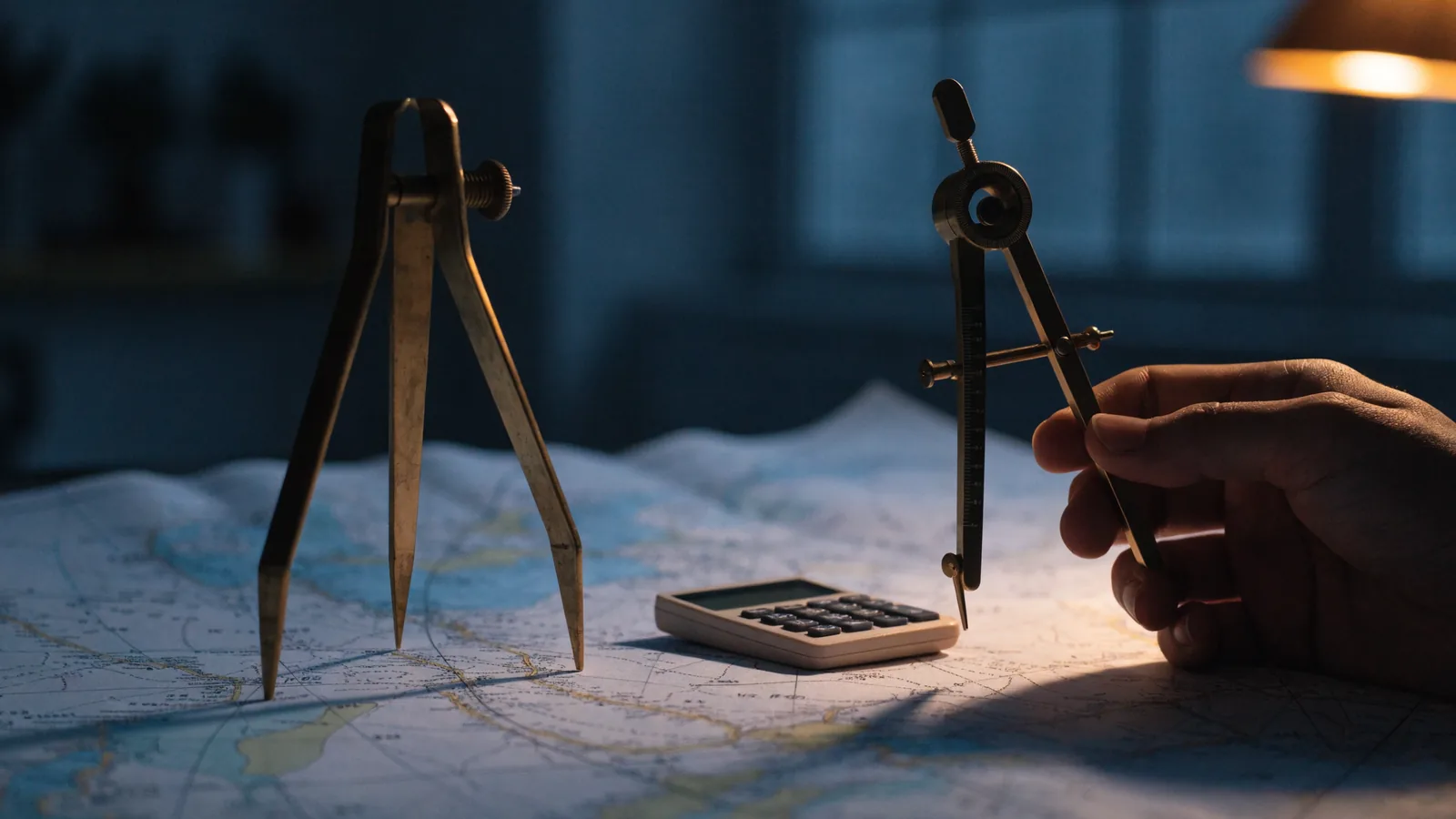
Dividers, a compass and a calculator lying on a nautical chart