Insurance for diving schools and dive centres in Germany
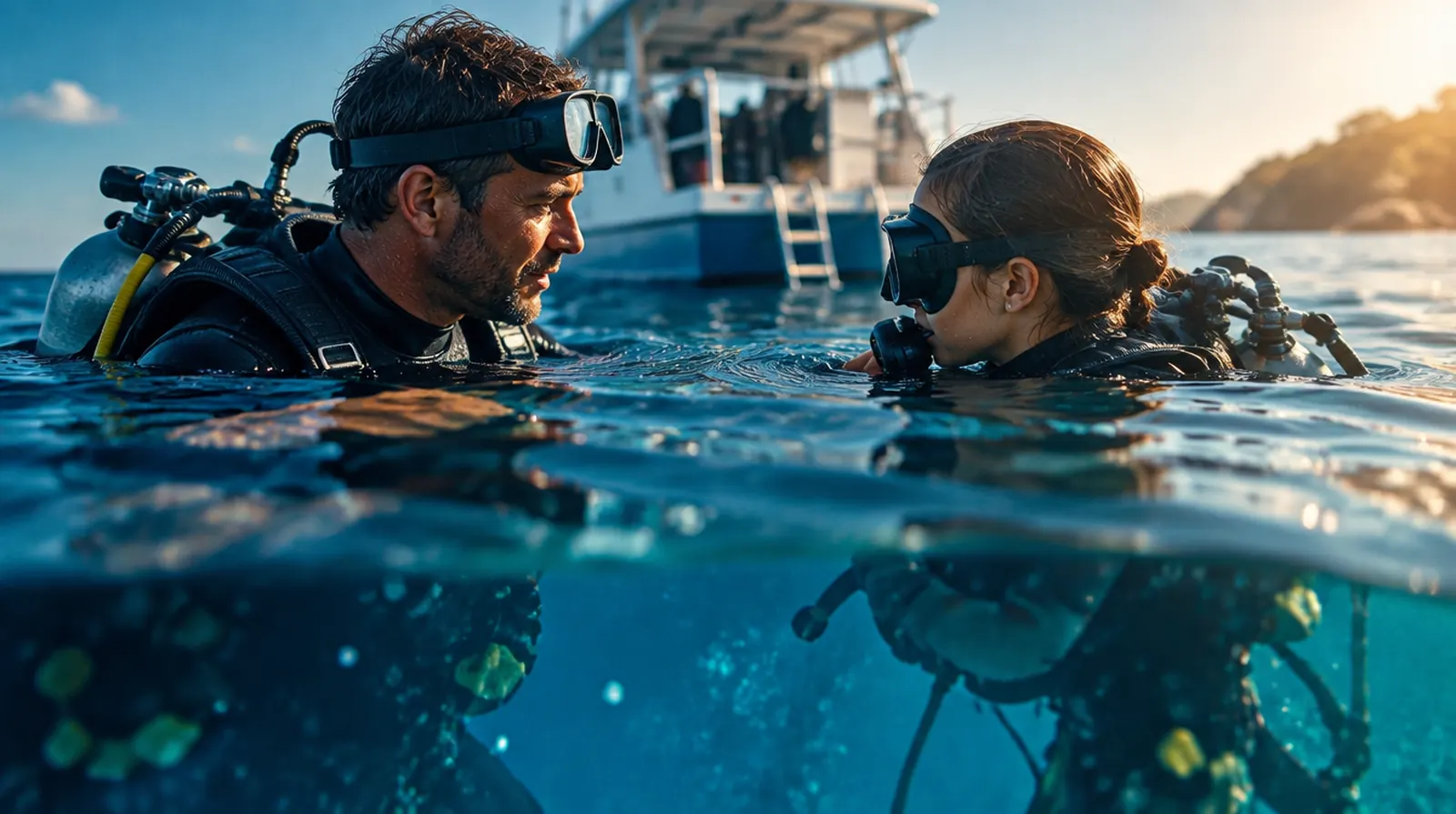
On the same day at a German diving school, someone goes underwater for the very first time while someone else sits their instructor exam. PADI, CMAS or VDST courses run in the pool and in open water, the dive boat carries the group out to a wreck or reef, and the compressor fills tank after tank. The boat and the equipment belong in their own contracts, and the training and hire business on land needs its own liability cover.
Are our dive boat and compressor covered under an ordinary policy?
No. A private boat policy excludes commercial diving trips with paying guests, and private contents cover does not extend to a compressor used commercially. The dive boat needs a rate that names training runs, guided dives and changing divers on board, one contract per boat. We designed this cover ourselves and handle claims in house. The compressor and hire equipment belong in the business contents policy.
What goes wrong in this trade
01
Decompression sickness
An ascent that is too fast or a miscalculated dive time can trigger decompression sickness. If the school is blamed for a gap in the briefing, treatment costs and a long legal dispute can follow quickly.
02
Incidents in open water
Current, poor visibility or panic underwater: beginners on an open water course run into trouble faster than in a controlled pool, and the instructor is responsible for the whole group.
03
Students without accident cover
Course participants are not covered by statutory accident insurance during a trial dive or training. After a serious diving accident, what matters is what the school has arranged voluntarily.
04
Compressor failure
Without a working fill station the business stops dead, often right in the middle of the season. Repair or replacement usually takes longer than bookings can wait.
05
Dive boat on site
Anchoring over sensitive ground, touching bottom while tying up to a mooring buoy, collisions with other boats at the dive site: the boat is out daily with changing guests on board.
06
Equipment on hire
Regulators, buoyancy vests, suits and tanks pass through many hands every day. Theft from the base container or damage from careless returns adds up over a season.
Covers training, open water practice, pool sessions and equipment hire on land, including claims of a poor briefing. Liability from operating the dive boat itself sits in its own boat policy.
The largest item is the dive boat itself. We quote it in our own commercial rate per boat, based on value, boat type and waters. The examples below cover the training and hire business quoted alongside it.
Insurance
Example
Typical range
Business liability
Diving school with pool and open water training, up to five instructors
roughly 200 to 450 euros a year
Group accident insurance
Course participants and trial divers, around 300 people a year
roughly 200 to 450 euros a year
Business contents
Compressor, tanks and hire equipment worth 40,000 euros
roughly 250 to 550 euros a year
Business interruption
Loss of profits cover for up to six months, taken alongside contents cover
roughly 150 to 400 euros a year extra
Occupational disability
Instructor, age 35, monthly benefit of 1,500 euros
roughly 1,200 to 2,400 euros a year
For comparison: Liability and accident cover for participants together cost about as much per year as one full open water course including equipment hire.
Guide prices excluding insurance tax, as of September 2026,
drawn from publicly quoted rates for comparable businesses and our own quoting practice.
We calculate the dive boat premium once we have your boat list.
Six things that really happen on land during a single dive trip. Damage to the dive boat itself is handled in house under its own boat policy; here is what the training and hire business has to carry alongside it.
Damage so far€59,200
The compressor at the fill station breaks down, not a single set can be filled for the early trip.
€8,500 · Paid by: Business contents
A beginner on the open water course ascends too fast and is flown to a decompression chamber with suspected decompression sickness.
€18,000 · Paid by: Business liability
A trial diver slips on the wet jetty at the base and breaks their wrist.
€7,000 · Paid by: Group accident insurance
Six buoyancy vests and four regulators are stolen from the equipment container overnight.
€6,200 · Paid by: Business contents
The online booking system holding participants' health questionnaires is hacked and data leaks out.
€7,500 · Paid by: Cyber insurance
Without a working compressor, the course programme stops for a week right in the middle of the season.
€12,000 · Paid by: Business interruption
Which package would you have had?
Paid by insurance: €0
Out of your own pocket: €59,200
Illustrative amounts before any excess.
What is paid depends on the policy terms.
Practical tips from your broker
Insure the dive boat under a rate that explicitly names training runs, guided trips and changing divers on board, one contract per boat.
Take out group accident cover for course participants and trial divers: they are not covered by statutory accident insurance.
Keep a dive log with visibility, health checks and briefings. It helps if a duty of care question comes up later.
List the compressor as its own item on the contents policy, since losing it hits hardest during high season.
Record every instructor's certification and have the insurer confirm it, which speeds up claims handling.
Use our free training pack with forms and calculators for your lessons, even if you are not yet a client of ours.
Why NAMMERT for your business
Dive boats on our own tariff
For boats we have our own cover concept and our own rate for training runs, guided trips and changing divers on board. You get cover directly from the party that also decides claims.
We handle claims in house
After a difficult trip you talk to us, not to a distant claims department. We know the yards, the surveyors and the kind of losses that come up in diving operations.
We know the training side
Diving schools and clubs use our free training pack of forms and calculators at no charge. We know what your course and trip schedule actually looks like.
A broker for everything on land
For liability, participant accident cover, the compressor and your own disability cover, we act as broker and obtain quotes from several insurers, matched to the boat policies. A family business since 1989.
Frequently asked questions
Questions and answers
Does a diving school in Germany have to be insured?
There is no statutory requirement.
Dive bases, harbour operators and bodies such as PADI almost always ask for proof of liability
cover,
and without insurance for the dive boat every trip would be a gamble.
Are course participants covered if a diving accident happens?
Not under statutory accident insurance.
If the participant has no personal accident policy,
only the school's own group accident cover or a liability claim against the school for a training
error can help.
Who is liable for a case of decompression sickness after a course?
If the school is accused of guiding dive times or ascent rates incorrectly,
its business liability policy responds.
We work the case through with the insurer as soon as it is reported.
What happens if the compressor breaks down?
The property damage to the compressor runs through the contents policy,
the lost income through business interruption cover.
Take both together, especially ahead of the season.
Can we use a hired boat for dive trips?
Yes, but only if the hired boat's own policy covers commercial diving trips with changing guests.
Clarify this before the first trip, or the use is not covered.
What does insurance for a diving school cost?
Liability and accident cover for participants usually costs around 200 to 450 euros a year.
The dive boat is added on top depending on size and engine power,
and we calculate that premium from your boat list.
NAMMERT insurance broker
Request quotes for Diving school
The recommended covers are ticked.
Change what does not fit; we compare quotes, in English.
Thank you, we have your request.
We will be in touch within one working day. If it is urgent: +49 3375 29 12 77.