Business liability
Covers product liability for clothing, home textiles and leather, plus damage to goods clients give you to work on.
Insurance broker / Business types / Manufacturing
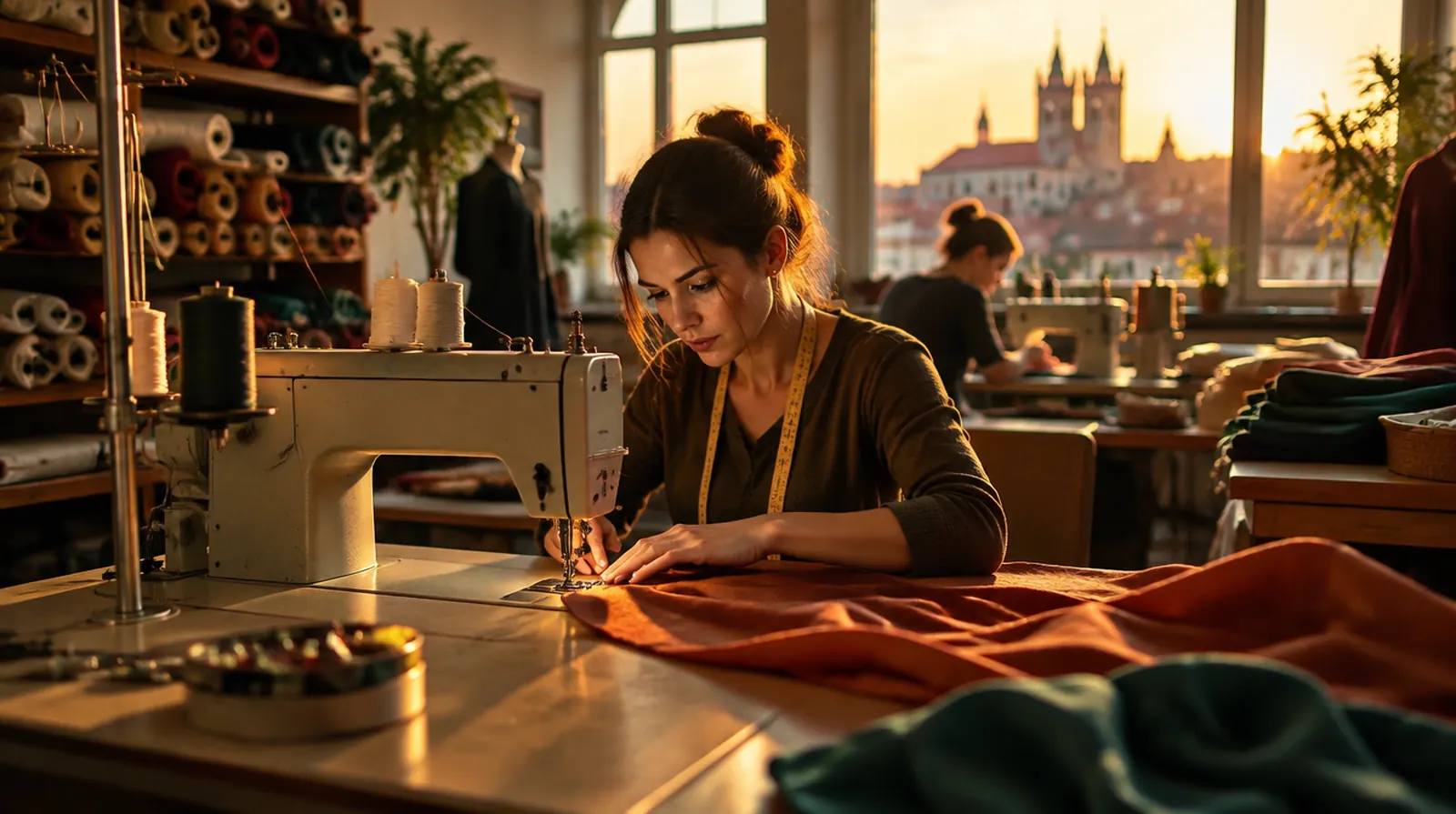
Fibres, bales of fabric and dust burn fast, dye works handle chemicals and waste water, and children's clothing must not have one cord or one harmful substance too many. Weaving mill, sewing workshop, knitting firm or tannery: this page shows the insurance textile and leather businesses in Germany need and what it costs.
The question almost everyone asks first
Yes, if someone's health is harmed as a result, for example a skin reaction to dyes. Product liability pays for that. If the goods are merely taken off the shelves without anyone being harmed, the issue is recall costs. Those are only covered with a separate building block.
Lint gathers on machines, lamps and in extraction ducts. One spark is enough and the fire runs through the hall.
Dyes, bleaches and tanning agents reach the waste water or the soil through leaks.
Contract manufacturers work with their clients' fabric and leather. If the goods are spoiled or burn, you are liable.
Cords, buttons, harmful substances or inadequate protection lead to accidents and recalls.
Weaving looms, knitting machines and stenter frames are expensive and often custom built. A breakdown means a long stoppage.
Branded goods, leather and yarn are easy to sell and are stolen to order.
Compared with other trades, 1 low to 5 high.
Essential
Covers product liability for clothing, home textiles and leather, plus damage to goods clients give you to work on.
Replaces machines, yarn, fabric and finished goods after fire, burst pipes, storm and burglary.
Strongly advised
Secures wages and contribution margin when seasonal goods cannot be delivered on time after a fire.
For weaving, knitting, embroidery and sewing machines and dyeing plant, which can take months to replace.
Depends on the business
Insures fabric and finished goods on the way to and from contract workshops, retailers and trade fairs.
Online shop, pattern data and stock control are vulnerable to attacks and data loss.
For disputes with suppliers, clients and trading partners over quality and delivery dates.
The premium depends mainly on the process. Sewing workshops and studios are inexpensive; spinning mills, weaving mills and dye works pay considerably more because of fire load and chemicals.
| Insurance | Example | Typical range |
|---|---|---|
| Business liability | Small sewing workshop or studio with up to three staff | around €150 to €450 a year |
| Business liability | Weaving mill or dye works with 25 staff, with environmental blocks | around €1,500 to €4,500 a year |
| Business contents | Machines, yarn and goods worth €600,000 | around €1,000 to €3,000 a year |
| Machinery breakdown | Knitting and weaving machines with a new value of €500,000 | around €1,500 to €4,000 a year |
| Business interruption | Business interruption for twelve months added to contents insurance | around €400 to €1,500 a year |
For comparison: Liability and contents cover for a small sewing workshop cost roughly as much a year as the material for 20 made to measure shirts.
Guide figures excluding German insurance tax, as of September 2026, from published tariff examples for small businesses and our own quoting. Because of the fire load, insurers charge higher rates in the textile industry; we obtain the exact quote for you.
01
For: Tailors, sewing workshops and small labels with their own workroom
Together around €350 to €1,000 a year
Request this package02
For: Knitting firms, weaving mills and contract workshops with a machine park
Together around €3,500 to €10,000 a year
Request this package03
For: Manufacturers with their own label, online shop and retail customers
Together around €7,000 to €18,000 a year
Request this packageSix losses that really happen in textile and leather firms, put together on one Wednesday in the busy season. Tap through the day.
A valve in the dye works leaks, and dye liquor runs into the ground beneath the hall.
The wrong cutting layout is used for a client's order. 400 metres of designer fabric are ruined.
The control unit of the circular knitting machine burns out after a power surge.
A customer has an allergic reaction to the dye in a blouse. Medical costs and damages.
Lint in the extraction system catches fire. The store with yarn and the autumn collection burns out.
The autumn goods cannot be delivered, retailers cancel and wages keep running.
Which package would you have had?
Illustrative amounts before any excess. Whether and how much is paid depends on the policy terms.
Processing damage and clients' goods are the typical points of dispute. We compare exactly these clauses across several insurers.
As an underwriting agency for boats we settle claims ourselves. We know how to prove stock values and lost seasonal sales after a fire.
We look after production, online shop, vehicles and your private cover together, and explain the German terms in plain English.
One fixed contact instead of a hotline. Our work costs you nothing; the insurer pays our commission.
Questions and answers
General liability that includes processing damage to customers' clothing, and contents insurance for machines and fabric. Together they usually cost €350 to €1,000 a year.
Only if processing damage to third party property is included. Many standard policies exclude exactly that.
Fibres and fabric burn quickly and dust collects in machines. Insurers expect larger losses and ask about extraction and fire protection.
If you dye, bleach, coat or tan, yes. You then store substances hazardous to water and are liable for damage in waste water and soil.
For textiles and clothing it is BG ETEM; for tanneries and leather making it is BG RCI. Both are statutory accident insurers.
Only with a recall cost block. Product liability only pays once a child has actually been injured.
NAMMERT insurance broker
The recommended covers are already ticked. Change what does not fit; we obtain quotes and come back with a comparison. You can write in English.
We will be in touch within one working day. If it is urgent: +49 3375 29 12 77.
Is my stock insured if someone walks out of the shop with it?

Small manufacturing and crafts
Is my customer's violin covered if my workshop is burgled?

Does my insurance pay if a garment is ruined during cleaning?
This page covers the following classes of the German WZ 2025 (identical to NACE at four digits):
Source: Federal Statistical Office of Germany (Destatis), WZ 2025. All business types
Boat or yacht? Here we are not the broker but the underwriting agency, with our own policies and our own claims handling.
Boat insuranceNAMMERT Assekuradeur GmbH, insurance broker licensed under section 34d(1) of the German Trade Regulation Act, broker register no. D-C08Q-TOSD4-37. For boat and yacht insurance we act as underwriting agency, not as broker. Statutory disclosure (German) · Updated