All about this insurance: Car insurance
Can I use my no-claims bonus from abroad in Germany?
Insurance broker / Insurance questions / Car insurance
In short
With the second car rule, German insurers usually start a second car in no-claims class SF 1/2 instead of SF 0, and some go up to SF 4 for experienced drivers. For a compact car, liability then drops from roughly EUR 690 to EUR 420 a year. It only gets cheaper if a relative hands over their no-claims class or you never drive both cars at once and use a shared plate.
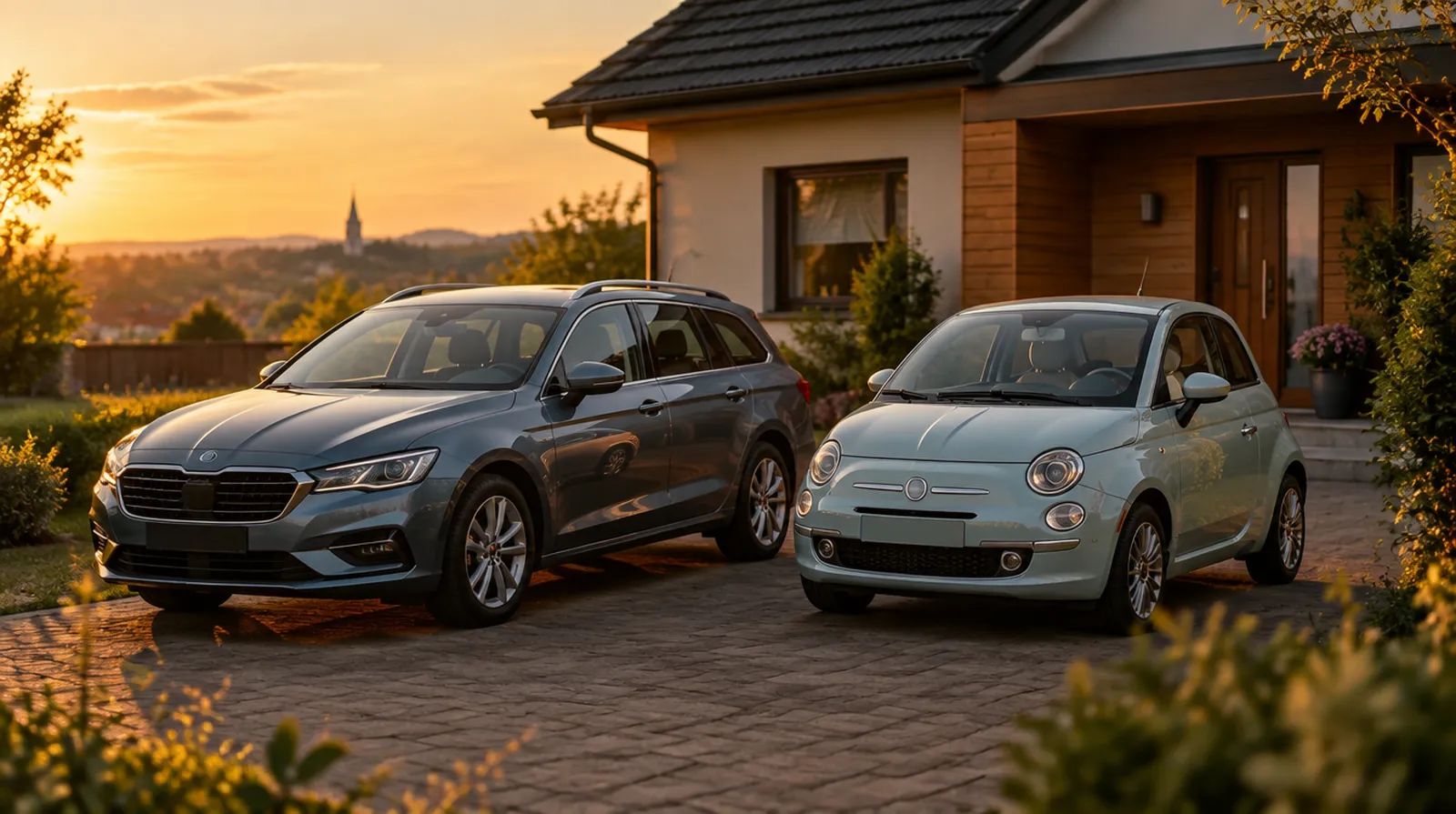
Published example premiums for a VW Golf and typical shared plate discounts, 2026.
| Example | Typical range |
|---|---|
| VW Golf, liability, SF 0 without second car rule | about EUR 690 a year |
| VW Golf, liability, SF 1/2 with second car rule | about EUR 420 a year |
| VW Golf, comprehensive, SF 0 compared with SF 1/2 | about EUR 1,150 compared with EUR 700 a year |
| Discount for a shared plate | usually about 10 to 25 percent |
Guide values as of September 2026 from published examples. Rates per no-claims class differ a lot between tariffs; the worked example uses guide values from our quoting practice. We obtain the exact quote.
Worked example
Both over 30, the partner uses the second car to get to work. This is what the rating changes.
| Liability without history, SF 0 | about EUR 550 to 700 |
| Liability with second car rule, SF 1/2 | about EUR 330 to 450 |
| Partial cover for the small car | about EUR 80 to 150 |
| Driver under 23 on the policy | often plus 50 to 100 percent |
With the second car rule and partial cover about EUR 410 to 600 a year instead of EUR 630 to 850. Calculated with guide values.
A new contract without history starts in no-claims class SF 0 (Schadenfreiheitsklasse) and is expensive. If you or your partner already insure a car in Germany, most insurers rate the second car better, often SF 1/2 or SF 1. The first car does not have to be with the same insurer.
This is a tariff rule, not a legal right. Typical conditions: the second car is registered to you, your partner or a child living with you, all drivers are at least 23 or have held a licence for some years, and it is not a company car.
| Route | Rating | When it fits |
|---|---|---|
| No history | SF 0 | only if nothing else works |
| Second car rule (Zweitwagenregelung) | usually SF 1/2, sometimes up to SF 4 | a first car is already insured in the household |
| Transfer from a relative | up to your years of holding a licence | someone gives up their car for good |
| Shared plate (Wechselkennzeichen) | one class for both cars | the two cars are never on the road together |
| Seasonal plate (Saisonkennzeichen) | normal rating, premium only for the season | convertible, classic car or camper |
If your first car is insured on the basis of a no-claims letter from abroad, many insurers still accept it as the first car. Ask before you sign, because some only count a German contract.
Your foreign claim-free years do not carry over to the second car. The second car rule is usually the fastest way to avoid SF 0.
With a shared plate two cars of the same vehicle class use one number plate, and only one may be on the road. Insurers usually give about 10 to 25 percent off, but they are not obliged to.
Vehicle tax is still due in full for both cars. If you regularly need both cars at the same time, this option does not work.
Name everyone who drives the car regularly. A driver under 23 or 25 adds a clear surcharge and may rule out the better rating. Leaving someone out can lead to a contractual penalty after a claim that costs far more than the honest premium.
Questions and answers
No. Most insurers accept a first car insured elsewhere. A small multi-policy discount is sometimes possible with the same insurer.
Usually not. Both cars are separate contracts, only the one the claim runs through is downgraded.
Not directly. It may help rate your first car, and that car then qualifies you for the second car rule.
When a parent or partner gives up their car for good. Taking over their no-claims class usually gives a much better rating than SF 1/2.
NAMMERT insurance broker
We compare several insurers and come back with a proposal. Free for you; the insurer pays our fee. You can write in English.
Thank you, we have your request.
We will be in touch within one working day. If it is urgent: +49 3375 29 12 77.
All about this insurance: Car insurance
Can I use my no-claims bonus from abroad in Germany?
Can I transfer my no-claims class in Germany?
Yes, to a spouse or registered partner, children, grandchildren and, depending on the insurer, parents or siblings. Th …
How does the no-claims class (SF-Klasse) work in Germany?
The no-claims class (Schadenfreiheitsklasse, SF) counts your claim-free years. Each year without a claim moves you up …
How much does car insurance cost in Germany?
On average drivers in Germany pay about EUR 256 to 290 a year for liability only, about EUR 450 with partial cover and …
How can new drivers pay less for car insurance in Germany?
With their own policy, 18-year-olds in Germany pay on average about EUR 1,150 to 1,650 a year. The biggest saving is t …
NAMMERT Assekuradeur GmbH, insurance broker licensed under section 34d(1) of the German Trade Regulation Act, broker register no. D-C08Q-TOSD4-37. For boat and yacht insurance we act as underwriting agency, not as broker. Statutory disclosure (German) · Updated
Was this useful?