All about this insurance: Private pension
Should I take out a German private pension if I might leave Germany?
Insurance broker / Insurance questions / Private pension
In short
Often yes for families with children and a modest income, usually not for single people on a good salary. The state adds EUR 175 a year plus up to EUR 300 per child, which is a lot when your own share stays small. On a middle income, costs and cautious pension calculations eat up most of the benefit. New contracts on the old model are only possible until the end of 2026.
Legal values for 2026 and guide figures from published analyses.
| Example | Typical range |
|---|---|
| Basic allowance | EUR 175 a year |
| Child allowance, child born before 2008 | EUR 185 a year |
| Child allowance, child born from 2008 | EUR 300 a year |
| Minimum own contribution | 4 percent of last year's gross income, at least EUR 60 a year |
| Maximum tax deduction | EUR 2,100 a year, up to EUR 4,200 for couples |
| Effective costs of many contracts | up to about 1.5 percent a year |
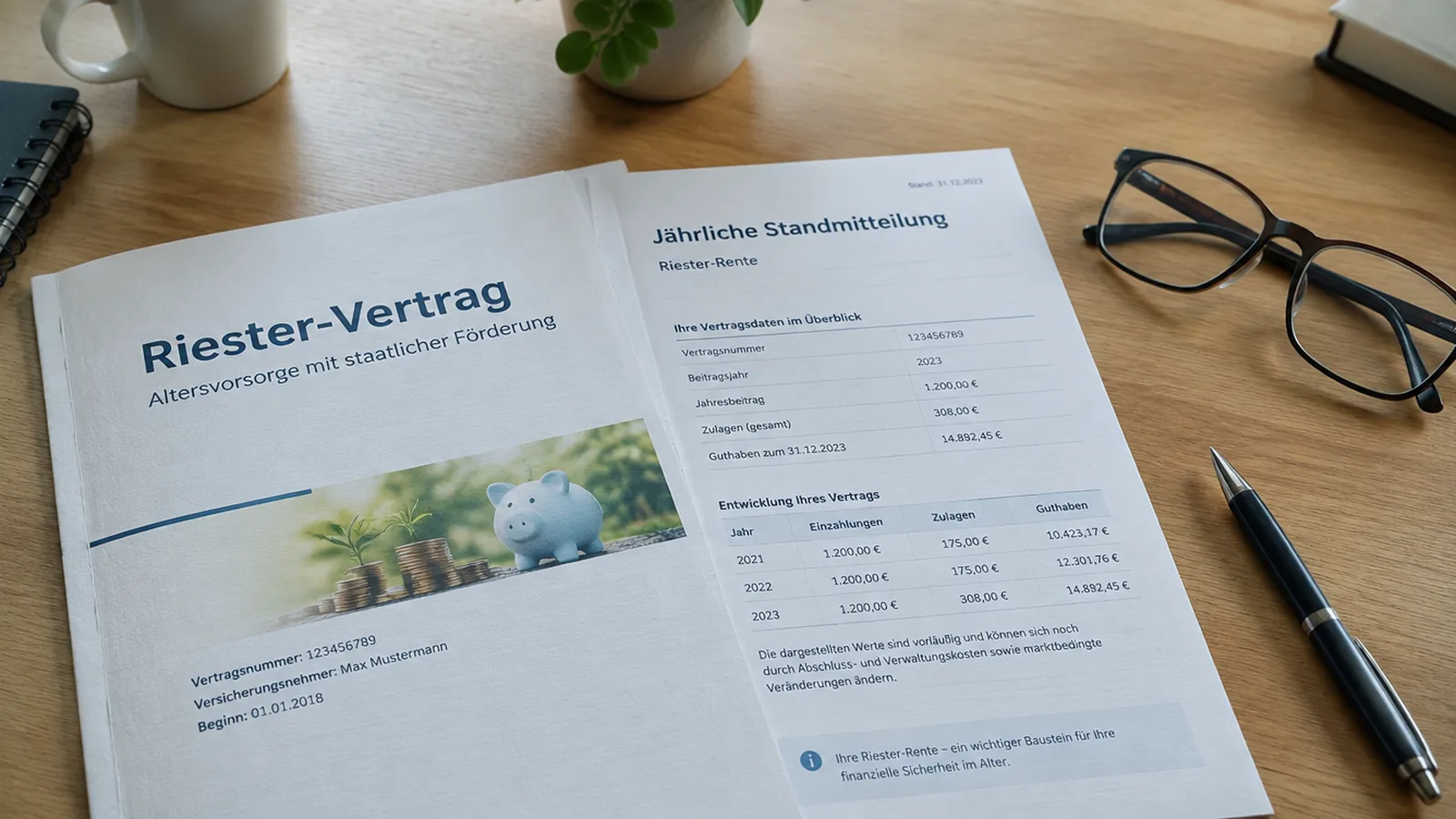
Allowances and limits are set by law, as of September 2026. Costs are guide figures from published analyses and differ by contract; the figures for your contract are in the annual statement (Standmitteilung). Rules for moving abroad depend on your case, this is not tax advice.
Worked example
This is how small your own share gets when child allowances are involved.
| Gross income last year | EUR 30,000 |
| 4 percent of that | EUR 1,200 |
| Basic allowance and two child allowances | EUR 775 |
| Your own contribution per year | EUR 425 |
Of EUR 1,200 going into the contract, you pay EUR 425 yourself. As long as the child allowances run, that is hard to beat. When they stop, or if you plan to leave the EU, calculate again.
Riester is a state-subsidised private pension for people who pay into the German statutory pension, such as employees. You get EUR 175 a year, plus EUR 185 per child born before 2008 and EUR 300 per child born from 2008. To get the full amount, 4 percent of your previous year's gross income must go into the contract, at most EUR 2,100.
The allowances count towards those 4 percent. Your own share is only the rest, but at least EUR 60 a year. That is why Riester is strong for families on a low income and weak for single people with a good salary.
| Case | Allowances per year | Your own contribution |
|---|---|---|
| EUR 20,000 gross, three children born from 2008 | EUR 1,075 | EUR 60 |
| EUR 30,000 gross, two children born from 2008 | EUR 775 | EUR 425 |
| EUR 35,000 gross, one child born from 2008 | EUR 475 | EUR 925 |
| EUR 45,000 gross, no children | EUR 175 | EUR 1,625 |
Many international employees do not know whether they will stay. If you move to another EU or EEA country, the allowances you already received are generally safe, but new ones usually stop once you no longer pay into the German statutory pension.
If you move outside the EU and EEA, you may have to pay the allowances and tax benefits back, in particular once the pension starts. The rules have changed several times, so ask the provider and the central allowance office (Zentrale Zulagenstelle) before you move. If your stay in Germany is likely to be short, Riester is rarely the right choice.
Single people on a middle or high income only get the basic allowance but carry the full own contribution. Published calculations often show only about one percentage point of extra return compared with unsubsidised saving.
Two more brakes: the pension is fully taxed in retirement, and providers calculate with a very long life expectancy, which lowers the monthly payout. Effective costs of around 1.5 percent a year are common and cost a lot over decades.
The German parliament passed the reform of subsidised private pensions on 27 March 2026. The new products start on 1 January 2027, and new contracts on the old Riester model are no longer planned after that.
The plan is an allowance linked to what you save: 50 cents per euro up to EUR 360 own contribution a year and 25 cents per euro on further contributions up to EUR 1,800, together up to EUR 540. Existing contracts keep running, switching is voluntary and may cost fees. Do not cancel anything in a hurry.
Questions and answers
Usually yes, if you pay into the German statutory pension. Your nationality does not matter. Self-employed people outside the statutory pension are usually not eligible themselves.
Within the EU and EEA, allowances already paid are generally safe. Outside the EU and EEA they may have to be repaid. Ask your provider before you move.
Usually not much. You only get the EUR 175 basic allowance but pay the full own contribution. On an average income, published calculations often show only about one percentage point of extra return.
Yes, fully at your personal tax rate in retirement. In return, contributions and allowances stay untaxed while you save.
Cancelling means repaying allowances and tax benefits. Check first whether stopping payments or switching to the new subsidy from 2027 suits you better.
It keeps running with its existing rules. Switching to the new subsidy is voluntary and may cost fees.
NAMMERT insurance broker
We compare several insurers and come back with a proposal. Free for you; the insurer pays our fee. You can write in English.
Thank you, we have your request.
We will be in touch within one working day. If it is urgent: +49 3375 29 12 77.
All about this insurance: Private pension
Should I take out a German private pension if I might leave Germany?
What happens if I cancel my Riester contract?
Cancelling with a payout counts as harmful use (schädliche Verwendung). You repay all allowances and the tax benefits …
Who is the Rürup pension worth it for?
Mainly self-employed people with a high tax rate who plan to stay in Germany. In 2026 contributions are 100 percent de …
Is private pension insurance worth it in Germany?
As your only retirement savings, often not. Costs of about 0.4 to over 1.3 percent a year and a guaranteed interest ra …
Pension insurance or ETF savings plan in Germany: which is better?
For building wealth, the ETF savings plan usually wins: about 0.05 to 0.50 percent fund costs a year against often mor …
NAMMERT Assekuradeur GmbH, insurance broker licensed under section 34d(1) of the German Trade Regulation Act, broker register no. D-C08Q-TOSD4-37. For boat and yacht insurance we act as underwriting agency, not as broker. Statutory disclosure (German) · Updated
Was this useful?