All about this insurance: Private pension
Should I take out a German private pension if I might leave Germany?
Insurance broker / Insurance questions / Private pension
In short
For building wealth, the ETF savings plan usually wins: about 0.05 to 0.50 percent fund costs a year against often more than 1 percent effective costs in a policy. The policy wins if you want an income that never stops. If you might leave Germany, the ETF is also easier to take with you, because an early exit from a policy often costs money.
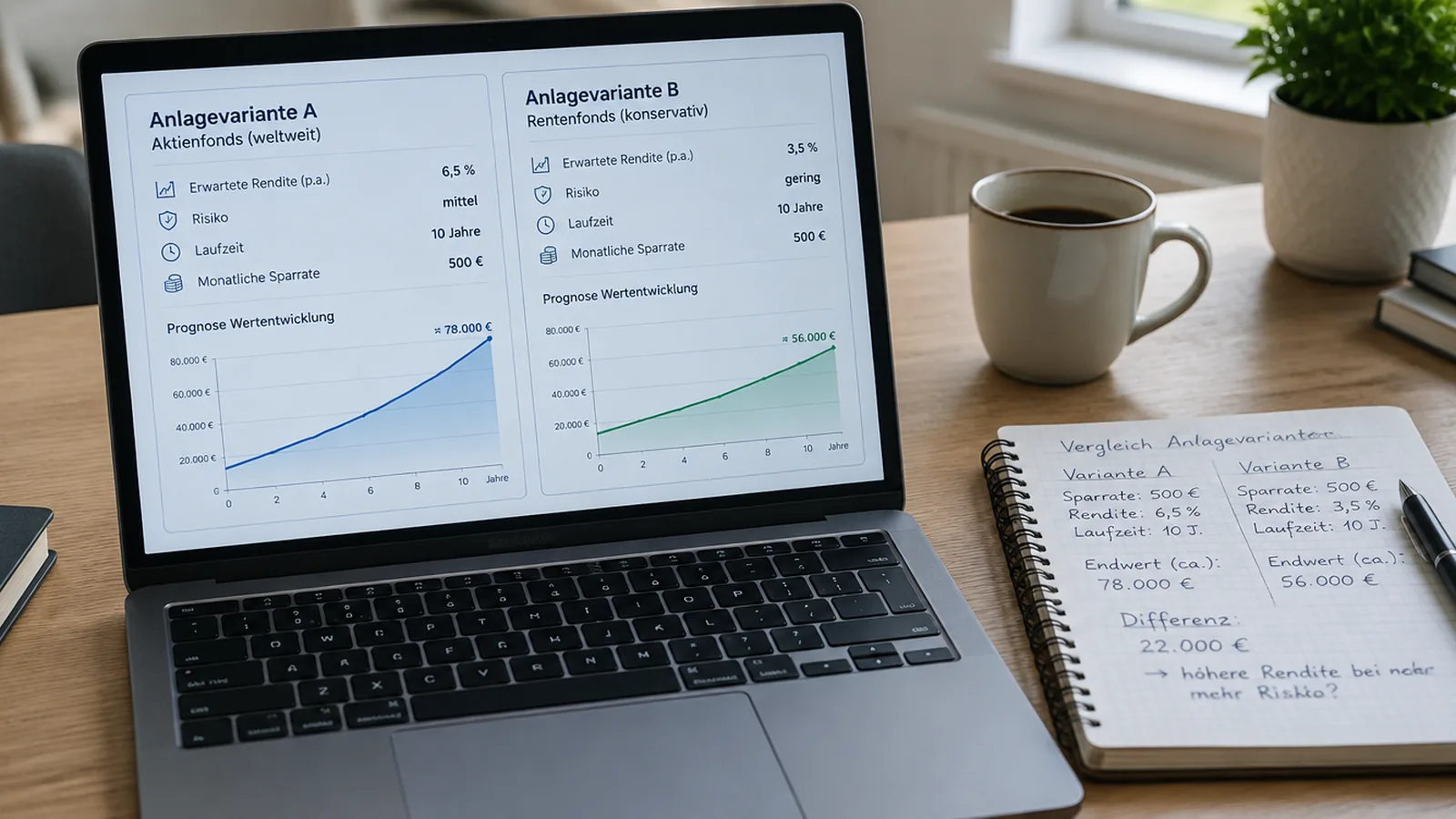
Figures from published fund data, current German tax rules and consumer information.
| Example | Typical range |
|---|---|
| Fund costs of a broad world ETF | about 0.05 to 0.50 percent a year, commonly 0.20 percent |
| Effective costs where it gets critical | 1 percent a year can eat the whole return in weak years |
| Effective costs of 2 percent at 5 percent return | cost about 50 percent of the return |
| Flat tax in a German depot | 25 percent plus 5.5 percent surcharge, together 26.375 percent |
| Partial exemption for equity funds | 30 percent of the gain stays tax free |
| Saver's allowance | 1,000 euros a year, 2,000 euros for married couples |
| Taxable share of a pension starting at 67 | 17 percent |
| Guaranteed interest on new policies since 2025 | 1 percent |
Guide values, September 2026. Tax rates and the base rate apply in Germany and change over time; the range of effective costs between low cost net tariffs and expensive commission tariffs is a guide value from our quoting practice. Your result depends on term, tariff and personal tax rate; we obtain the exact offer. No tax advice.
Worked example
Assuming 5 percent return before costs. Tax is not yet included, this only shows the effect of running costs.
| Paid in over 30 years | 36,000 euros |
| Depot with 0.2 percent costs a year | about 78,800 euros |
| Policy with 1.2 percent costs a year | about 66,200 euros |
| Difference from costs alone | about 12,600 euros |
About 12,600 euros ahead for the depot before tax. The tax advantage of the policy has to make up this gap first.
A broad equity ETF costs between 0.05 and 0.50 percent a year. Many German banks and brokers run savings plans with no order fee.
A unit linked pension policy (fondsgebundene Rentenversicherung) carries the same fund costs plus acquisition and administration costs. The German consumer advice centre shows that 1 percent effective costs a year can wipe out the whole return when markets are weak, and 2 percent can eat about half of a 5 percent return.
Compare offers only by the effective costs (Effektivkosten) in the product information sheet. A low administration fee means nothing if the acquisition costs are high.
| Item | ETF savings plan | Unit linked policy |
|---|---|---|
| Fund costs a year | about 0.05 to 0.50 percent | about 0.05 to 0.50 percent |
| Cost of the wrapper | none | effective costs, often above 1 percent |
| Exit in the first years | order fee only | often less back than paid in |
| Switching funds | sale, tax is due | usually free and tax free inside the policy |
In a German depot you pay 25 percent flat tax plus 5.5 percent solidarity surcharge, together 26.375 percent, plus church tax if you are registered. For equity funds 30 percent of the gain stays tax free, so 70 percent is taxed. The first 1,000 euros of investment income a year, 2,000 euros for married couples, are free.
Accumulating funds trigger a small yearly advance lump sum tax (Vorabpauschale), based on a base rate of 2.53 percent for 2025 and 3.20 percent for 2026.
Inside the policy there is no tax during the saving phase. Take a lump sum after age 62 and at least 12 years, and only half of the gain is taxed at your personal rate. Choose the lifelong pension starting at 67, and only 17 percent of each payment is taxable.
| Moment | ETF in a German depot | Pension policy |
|---|---|---|
| While saving | Vorabpauschale each year | no tax |
| Switching funds | gain taxed at once | tax free |
| Lump sum payout | 26.375 percent on 70 percent of the gain | half the gain at your personal rate |
| Paid as a pension | no special benefit | 17 percent of each payment when starting at 67 |
| Annual allowance | 1,000 euros usable | does not apply |
Many people who come to Germany for work do not know yet whether they will stay. An ETF depot can usually be moved to a broker in your new country or simply kept. A pension policy can also continue, but paying from abroad, and how your new country taxes the payouts, needs checking before you sign.
Cancelling a policy in its first years almost always returns less than you paid. If there is a real chance you leave within ten years, that alone often decides in favour of the ETF. US citizens should get tax advice first, because European funds are treated unfavourably under US rules.
When you want to build wealth and decide later how much to withdraw. When your savings rate may vary or pause. When you might need the money before retirement, or want to leave everything to your heirs.
Also while your annual 1,000 euro allowance is not used up: the depot is then ahead on tax as well.
When you want an income that does not stop, because you might live to 95. When you do not want to manage withdrawals in old age. When you expect a high personal tax rate in retirement.
Four conditions: effective costs below 1 percent a year, a guaranteed annuity factor (Rentenfaktor), a free choice of low cost funds and the option to pause premiums. If one is missing, the ETF is the more honest answer.
Many people combine both: a lean lifelong pension for the basics, everything else in a depot. Keep an emergency fund of three to six months of expenses outside both.
Questions and answers
For building wealth usually the ETF, because it costs less and stays flexible. For an income that never ends, the policy. Many people do both.
Look at the effective costs in the product information sheet. Below 1 percent a year is good; well above that it is hard to catch up with a depot.
For accumulating funds the Vorabpauschale applies, based on 2.53 percent for 2025 and 3.20 percent for 2026. The 1,000 euro allowance usually covers it for smaller depots.
You can usually keep it or transfer it. Germany may tax unrealised gains on large holdings when you move away, so check this before a move.
Usually yes, but check payment from a foreign account and how the new country taxes the payouts. Cancelling early often returns less than you paid.
Yes. Cover the basics with a lifelong pension and build everything above that in a depot.
NAMMERT insurance broker
We compare several insurers and come back with a proposal. Free for you; the insurer pays our fee. You can write in English.
Thank you, we have your request.
We will be in touch within one working day. If it is urgent: +49 3375 29 12 77.
All about this insurance: Private pension
Should I take out a German private pension if I might leave Germany?
Is private pension insurance worth it in Germany?
As your only retirement savings, often not. Costs of about 0.4 to over 1.3 percent a year and a guaranteed interest ra …
How much state pension will I get in Germany?
Your German state pension (gesetzliche Rente) is your pension points times the pension value. Since July 2026 one poin …
How is a private pension taxed in Germany?
From a private pension contract you only pay tax on the so called income share, the Ertragsanteil. It depends solely o …
Should I cancel my German pension insurance or make it paid up?
Making the contract paid up (beitragsfrei stellen) is usually the calmer choice. The contract stays, your savings keep …
NAMMERT Assekuradeur GmbH, insurance broker licensed under section 34d(1) of the German Trade Regulation Act, broker register no. D-C08Q-TOSD4-37. For boat and yacht insurance we act as underwriting agency, not as broker. Statutory disclosure (German) · Updated
Was this useful?