All about this insurance: Private pension
Should I take out a German private pension if I might leave Germany?
Insurance broker / Insurance questions / Private pension
In short
From a private pension contract you only pay tax on the so called income share, the Ertragsanteil. It depends solely on your age when payments start: 22 percent of the annual pension at 60, 18 percent at 65, 17 percent at 67. That rate then stays fixed for life. Subsidised Rürup and Riester pensions are taxed almost in full instead.
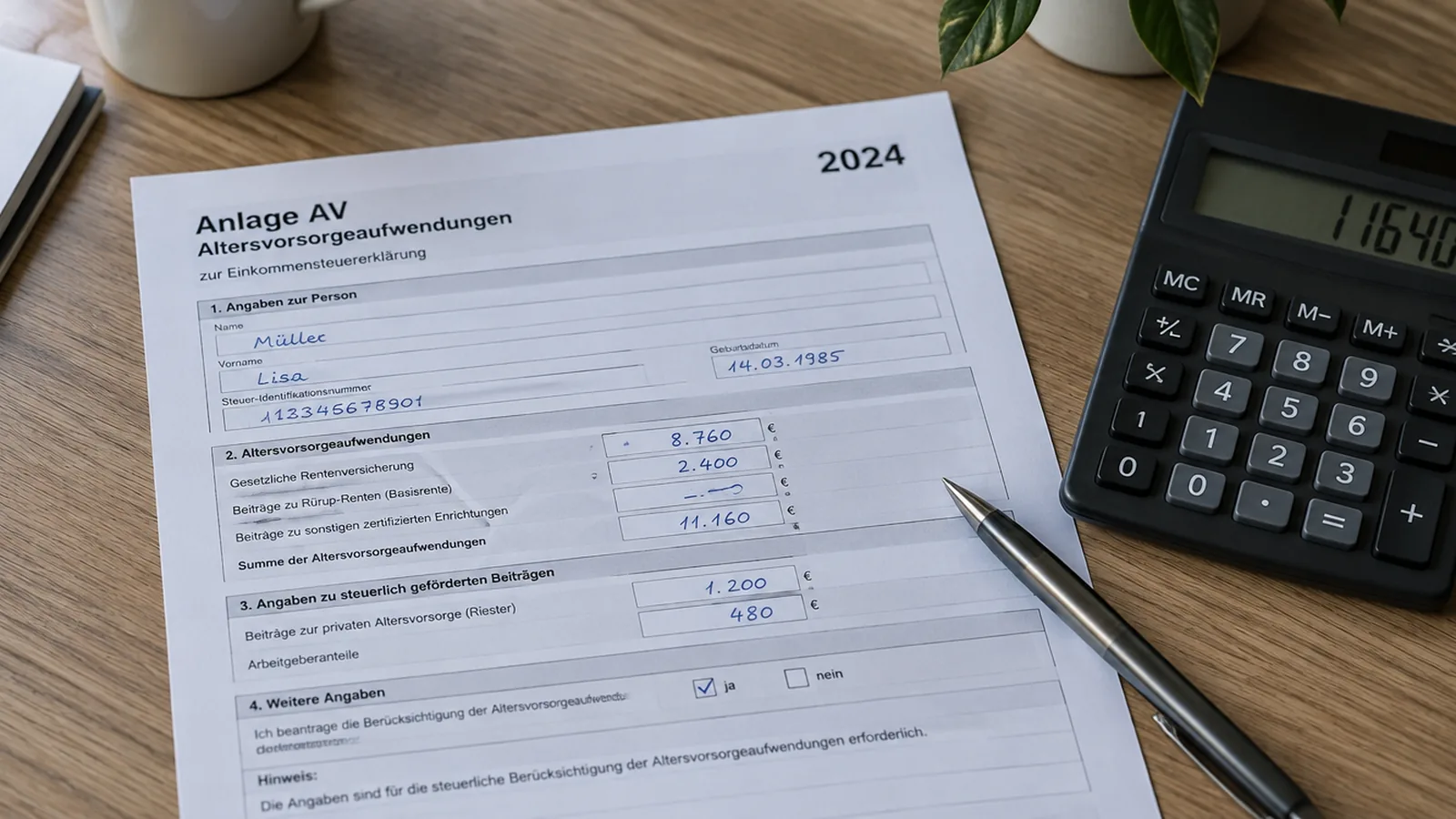
Taxable shares under the German Income Tax Act, as of September 2026.
| Example | Typical range |
|---|---|
| Lifelong pension starting at 60 | 22 percent of the annual pension taxable |
| Lifelong pension starting at 65 | 18 percent of the annual pension taxable |
| Lifelong pension starting at 67 | 17 percent of the annual pension taxable |
| Lump sum from 62, contract ran 12 years | 50 percent of the gain at your personal rate |
| Fund linked contract, lump sum | 15 percent of fund returns tax free first |
| Rürup pension starting in 2026 | 84 percent of the pension taxable |
These percentages are set by law and are the same with every provider. How much tax you actually pay depends on your personal rate and other income. This is general guidance, not tax advice.
Worked example
How a large looking percentage turns into modest tax.
| Annual pension (12 × 500 euros) | 6,000 euros |
| Income share when starting at 65 | 18 percent |
| Taxable amount per year | 1,080 euros |
| Personal tax rate of 25 percent | about 270 euros tax |
| Permanently tax free | 4,920 euros a year |
Of 6,000 euros you keep about 5,730 euros. The same pension starting at 60 would have 1,320 euros taxable, about 330 euros in tax.
You paid your contributions out of income that was already taxed. So the state only taxes the part of each payment that comes from interest and investment returns. The law puts a fixed number on that part, the Ertragsanteil.
The number comes from a table in the Income Tax Act and depends only on the age you have reached when the pension starts. Start earlier, and the pension is expected to run longer, so a larger share counts as return.
Once set, the share never changes. If your pension later rises through profit participation, the same percentage keeps applying.
| Age when payments start | Taxable share of the pension |
|---|---|
| 55 | 26 percent |
| 60 | 22 percent |
| 62 | 21 percent |
| 63 | 20 percent |
| 65 | 18 percent |
| 67 | 17 percent |
Many contracts let you choose a one off payout instead of a lifelong pension. Then a different rule applies: the taxable amount is the payout minus the total of your contributions.
If the money is paid after your 62nd birthday and at least twelve years after you signed, only half of that gain is taxable. For contracts signed before 2012, age 60 is enough.
That half is taxed at your personal income tax rate, not at the flat 25 percent capital gains rate. In fund linked contracts, 15 percent of the fund returns are tax free first.
Miss either condition, age or term, and the full gain is taxable. Cancelling in year eleven can therefore cost real money.
With a Rürup pension you could deduct contributions from your taxable income while saving. In return, the pension is taxed almost in full. If it starts in 2026, 84 percent is taxable and the rest stays tax free as a fixed euro amount for life.
A Riester pension received state bonuses and tax relief, so every payout is fully taxable, whether pension or partial lump sum.
Subsidised is not automatically better. What matters is whether your tax rate in retirement is lower than today.
| Type of contract | How the pension is taxed |
|---|---|
| Private pension without subsidy | only the income share, 18 percent at 65 |
| Rürup or basic pension | 84 percent for a 2026 start, rising by year of retirement |
| Riester pension | fully taxable |
| Company pension | fully taxable, plus health insurance contributions |
Many international employees retire somewhere else. Where a private pension is taxed after a move depends on the double tax treaty between Germany and your new country of residence. Often the new country gets the right to tax it, but not always.
The German insurer keeps paying either way. Before you move, ask the tax office or an adviser in both countries which rules apply, especially if you plan to take a lump sum.
Taxable does not mean you pay tax. If your total income stays below the basic tax free allowance, the income share costs nothing. Always add up your state pension, rent and interest.
Small contracts involve small sums. 200 euros a month from age 67 give 408 euros of taxable income a year, which rarely means more than 100 euros in tax. Planning pays off mainly for large lump sums and when several pensions start in the same year.
Questions and answers
Yes, in the tax return form Anlage R. The insurer does not withhold tax but reports the pension to the tax office.
Starting at 65, 18 percent of 12,000 euros is taxable, so 2,160 euros. At a 25 percent tax rate that is about 540 euros a year.
Often yes for tax, if you are over 62 and the contract ran twelve years. In exchange you carry the risk of outliving the money.
On an unsubsidised private pension usually not, if you are in statutory health insurance as a compulsory member. Company pensions are different.
Old endowment policies with at least twelve years term and five years of contributions are usually paid out completely tax free.
The same gain rules apply. If age or term is not met, the whole gain is taxable.
NAMMERT insurance broker
We compare several insurers and come back with a proposal. Free for you; the insurer pays our fee. You can write in English.
Thank you, we have your request.
We will be in touch within one working day. If it is urgent: +49 3375 29 12 77.
All about this insurance: Private pension
Should I take out a German private pension if I might leave Germany?
Is private pension insurance worth it in Germany?
As your only retirement savings, often not. Costs of about 0.4 to over 1.3 percent a year and a guaranteed interest ra …
Who is the Rürup pension worth it for?
Mainly self-employed people with a high tax rate who plan to stay in Germany. In 2026 contributions are 100 percent de …
Should I cancel my German pension insurance or make it paid up?
Making the contract paid up (beitragsfrei stellen) is usually the calmer choice. The contract stays, your savings keep …
How much state pension will I get in Germany?
Your German state pension (gesetzliche Rente) is your pension points times the pension value. Since July 2026 one poin …
NAMMERT Assekuradeur GmbH, insurance broker licensed under section 34d(1) of the German Trade Regulation Act, broker register no. D-C08Q-TOSD4-37. For boat and yacht insurance we act as underwriting agency, not as broker. Statutory disclosure (German) · Updated
Was this useful?