All about this insurance: Natural hazard cover
Is flood insurance included in German home insurance?
Personal
Personal liability Contents insurance Buildings insurance Natural hazard cover Solar panel insurance Self-build insurance Car insurance Bicycle and e-bike Travel insurance Drone insurance Dog and horse liability Pet health insurance Legal expenses insurance Accident insurance Occupational disability Term life insurance Funeral insurance Private pension Private health insurance Supplementary health Dental insurance Long-term careBusiness
Business liability Professional indemnity D&O insurance Business legal expenses Business contents Commercial buildings Business interruption Electronic equipment Machinery breakdown Contractors all risks Cargo insurance Fleet insurance Cyber insurance Trade credit insurance Company pension (bAV) Company health insurance Group accident insurance By type of businessGuides
Which insurance do I need? Who pays for the damage? Insurance you may not need Cancellation deadlines Insurance questions Compare the wordings of all tariffsInsurers
German insurers A to Z Austrian insurers Spanish insurers Complaints rankingContact
+49 3375 29 12 77 Contact Customer loginLanguage
Deutsch Österreich Español Boats and yachtsInsurance broker / Insurance questions / Natural hazard cover
In short
What should I do first after a flood in Germany? Stay safe: do not enter a flooded basement while power may be on. Then photograph everything, report the claim to your insurer straight away and do what keeps the damage small, as § 82 VVG requires. Pumping out a basement often costs EUR 600 to 2,500. Only natural hazards cover (Elementarschutz) pays for flood damage to your home.
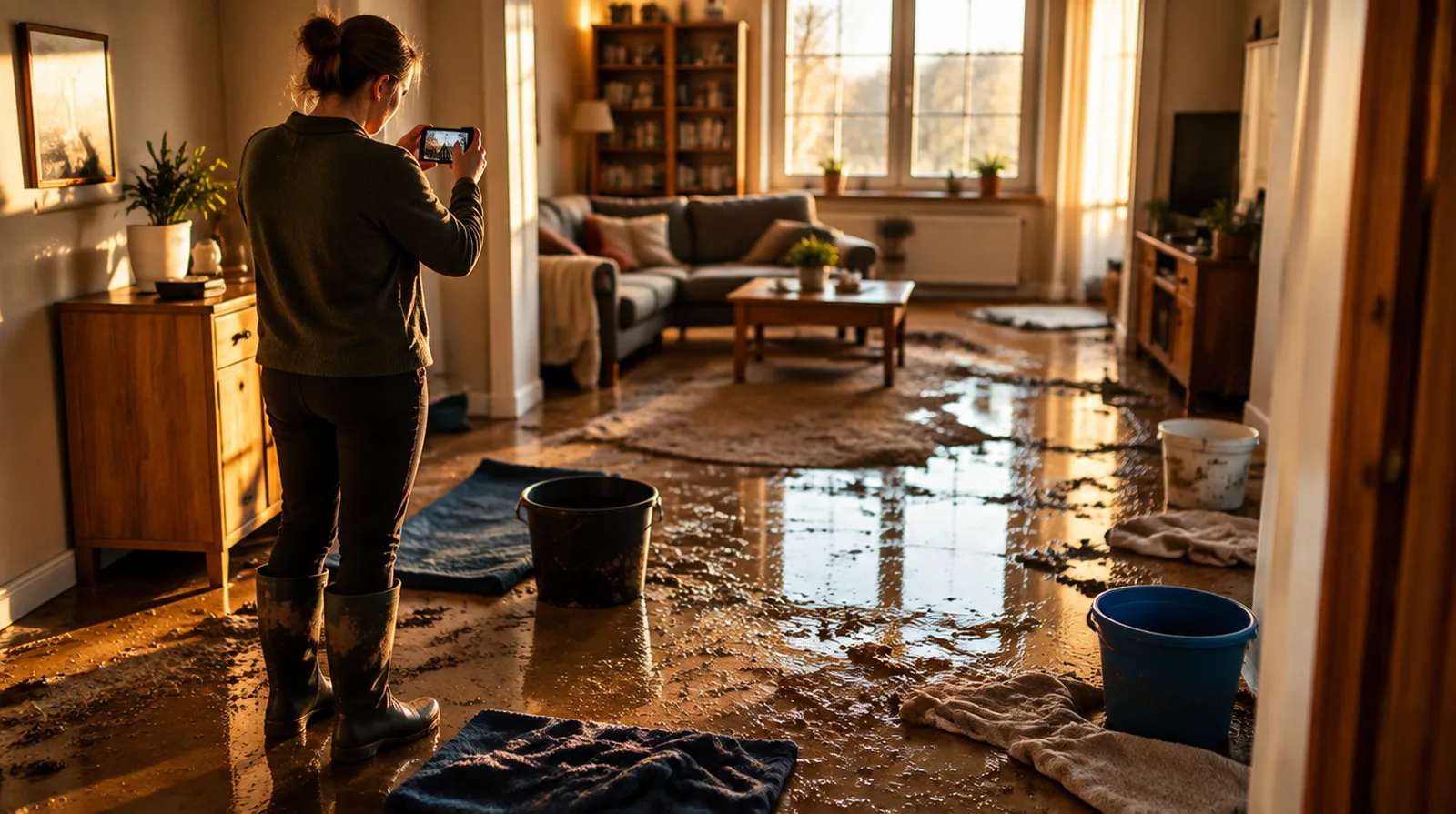
Published costs in Germany for pumping, drying and repairs after a basement has flooded, as of 2026.
| Example | Typical range |
|---|---|
| Pumping out a basement of up to 50 square metres | about EUR 600 to 2,500 |
| Basement heavily silted or contaminated with heating oil | up to about EUR 4,000, plus hazardous waste |
| Drying after a flood | about EUR 3,000 to 15,000 |
| Repairing a flooded basement of 60 to 100 square metres | about EUR 8,000 to 18,000 |
| Dehumidifier from a specialist rental firm | about EUR 6 to 15 a day plus VAT |
| Electricity per dehumidifier | about EUR 3 to 7 a day |
Guide values as of October 2026, from published tradesman and rental prices in Germany.
After large floods, firms and equipment are scarce and prices can be higher.
The deductible in the example is a guide value from our quoting practice.
Worked example
Detached house with natural hazards cover. The owners wait for the water level to fall before pumping, photograph everything and report the claim the next morning.
| Pumping out and removing mud | about EUR 800 to 2,500 |
| Three dehumidifiers for four weeks, rent and electricity | about EUR 760 to 1,850 |
| Renewing screed, plaster and floors in the basement | about EUR 8,000 to 18,000 |
| Deductible in the natural hazards add-on | for example EUR 500 |
The damage comes to about EUR 9,560 to 22,350. With natural hazards cover the insurer pays everything except the agreed deductible, as far as the costs are covered by the policy. Without the add-on, the owners pay it all themselves.
A flooded basement can be live. Switch off the fuses only if you can reach the fuse box with dry feet. If the box itself is under water, call the fire brigade (112) or your local grid operator.
Wait with pumping until the flood has drained away and the groundwater has dropped. If you pump too early, water pressing from outside can crack walls and lift the floor slab, and the structural damage becomes bigger than the water damage. Follow the advice of your municipality (Gemeinde).
If you smell heating oil or see a film on the water, call the fire brigade. Have the electrics, oil tank and heating checked by professionals before you switch anything back on.
Photograph every room before you carry anything out: the water mark on the wall, floors, furniture, heating and appliances. Hold a folding rule against the highest water line. A short video per room helps as well.
Report the claim as early as possible, separately to your building insurance (Wohngebäudeversicherung) and your contents insurance (Hausratversicherung). Ask whether an assessor will come and what you should do until then. Note the date, time and the name of the person you spoke to. A short email in English is fine; keep a copy.
Keep damaged items until the insurer has seen them or allowed disposal. Spoiled food and heavily soiled upholstery may go earlier for hygiene reasons; photograph and list them first.
Under § 82 (1) of the Insurance Contract Act (VVG) you must, as far as possible, avert or reduce the damage once a loss has occurred. You follow the insurer's instructions where reasonable and ask for them if the situation allows (§ 82 (2) VVG).
If you breach this duty on purpose, you lose your claim; with gross negligence the insurer may reduce payment in proportion to the severity of your fault (§ 82 (3) VVG). Leaving the basement wet for weeks until mould grows can count.
The cost of these measures, for example pumps, dehumidifiers and electricity, must be reimbursed by the insurer under § 83 (1) VVG, even if they fail, as far as you could consider them necessary. On request the insurer must pay the amount needed in advance.
| Measure | When |
|---|---|
| Have the power switched off | immediately, if safe |
| Photos and video of all rooms | before clearing up |
| Report the claim, ask for instructions | the same or the next day |
| Pump out water, remove mud | once the groundwater has dropped |
| Have wet insulation, carpets and plasterboard checked | after agreeing with the insurer |
| Set up dehumidifiers, note the meter reading | as early as possible |
| Have electrics, heating and oil tank checked | before switching back on |
Building insurance only pays for floods with the natural hazards add-on (Elementarschadenversicherung). In the model conditions of the German insurance industry, flooding means the plot is covered by considerable amounts of surface water from a river bursting its banks, from rain, or from groundwater rising to the surface for that reason. Groundwater that only seeps in from below through the wall is not covered.
Furniture, clothes and appliances are paid by contents insurance, again only with the natural hazards add-on. A flooded car is usually covered by partial cover (Teilkasko). Depending on the policy, natural hazards cover can also include clearing up, moving and protecting belongings, and a hotel if the house cannot be lived in, each up to the agreed limits.
Without natural hazards cover, the building insurance pays nothing for the flood. Ask your municipality about emergency aid, keep all receipts anyway and add the cover for the future.
You may order emergency work such as pumping, sealing and drying right away. For larger work, such as removing screed or plaster, talk to the insurer first so the assessor can still see the condition.
Have the moisture measured before re-plastering or laying new floors. Wet insulation under the screed often needs weeks. Closing it up too early leads to mould and to arguments about the follow-on damage.
Be careful with pumps and dehumidifiers sold for prepayment in unknown online shops. Fake sellers appear after big floods.
Questions and answers
For emergency work such as pumping and drying, yes;
that is part of your duty to keep the damage small.
Agree larger demolition work with the insurer first.
With a covered loss it counts as a cost of reducing the damage,
which the insurer reimburses under § 83 VVG.
Read the meter before setting up and after removal.
Not for everything.
Document thoroughly and start pumping and drying.
If you do nothing for weeks, the insurer may cut payment because of the follow-on damage.
Not for flood damage to the building or your belongings.
A flooded car is usually covered by partial cover (Teilkasko).
Ask your municipality about aid.
Tell your landlord at once; the building is their responsibility.
Your own furniture is paid by your contents insurance if it includes natural hazards cover.
Do not pump it out yourself; call the fire brigade.
Have the tank checked by a specialist afterwards.
Yes.
For the costs of reducing the damage,
the insurer must pay the necessary amount in advance if you ask, under § 83 (1) VVG.
NAMMERT insurance broker
We compare insurers and come back to you, in English.
Free; the insurer pays our fee.
Thank you, we have your request.
We will be in touch within one working day. If it is urgent: +49 3375 29 12 77.
All about this insurance: Natural hazard cover
Is flood insurance included in German home insurance?
What counts as natural hazard damage in Germany and what is covered?
Elementarschaden covers seven natural perils: flooding and sewer backflow, earthquake, ground…
Does insurance pay for heavy rain and flooding in Germany?
Only if you have the natural hazard add-on (Elementarschutz). Standard building and contents…
Is groundwater damage covered by insurance in Germany?
Only in one case: groundwater rises to the surface, floods your plot and runs into the house…
How high is the deductible for natural hazard insurance in Germany?
How high the deductible (Selbstbeteiligung) is depends on the policy. A common model for…
Updated
Was this useful?