All about this insurance: Natural hazard cover
Is flood insurance included in German home insurance?
Insurance broker / Insurance questions / Natural hazard cover
In short
Only in one case: groundwater rises to the surface, floods your plot and runs into the house from there. Then natural hazards cover (Elementarschadenversicherung) pays. If it seeps through the floor slab or basement wall while the garden stays dry, usually nobody pays. Sealing the basement is then the owner's job and easily costs more than EUR 15,000.
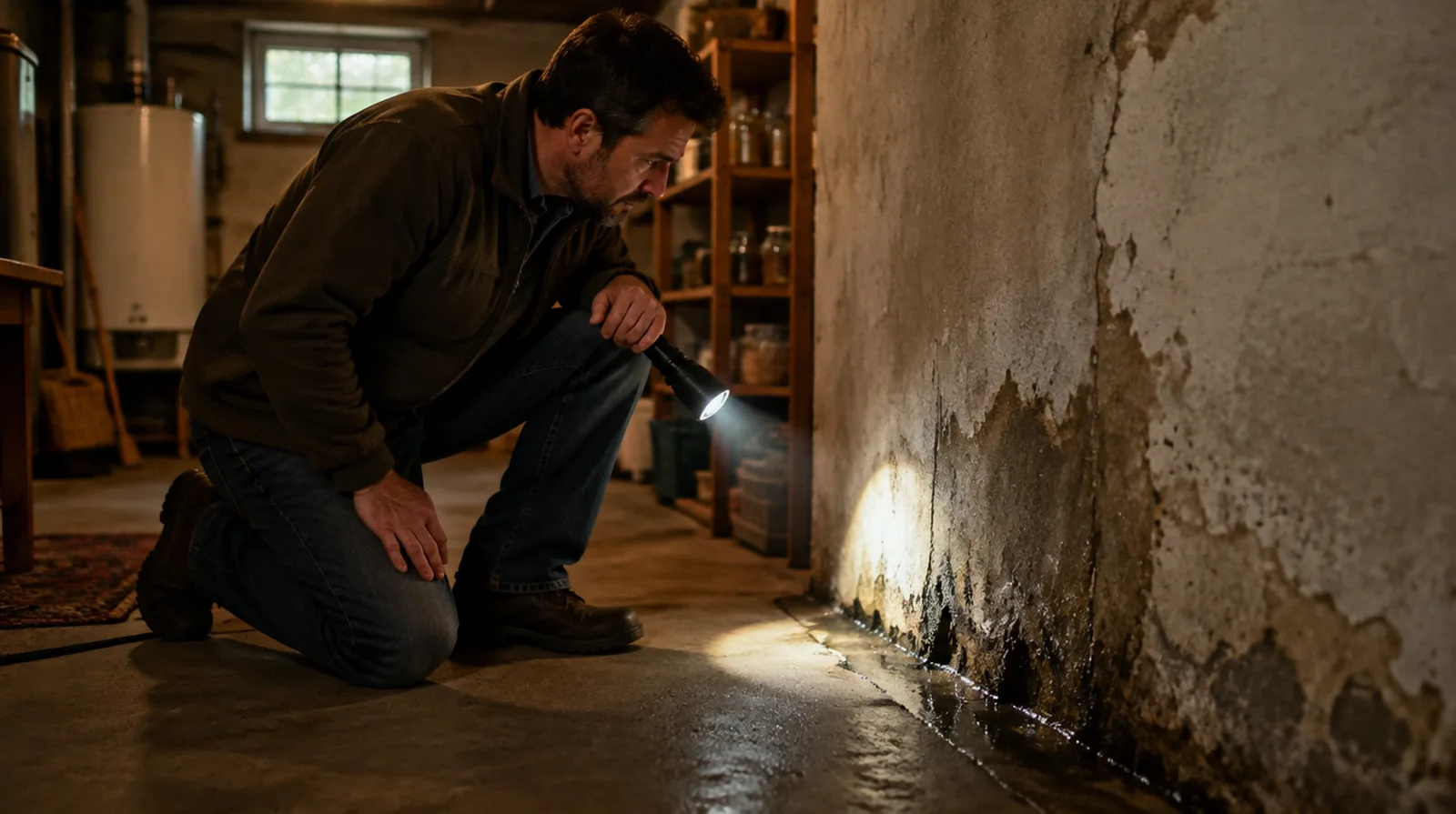
Costs of natural hazards cover and of sealing a basement when no insurance pays.
| Example | Typical range |
|---|---|
| Natural hazards add-on for contents, hazard zones 1 and 2 | around EUR 18 to 27 extra a year |
| Natural hazards add-on for buildings, hazard zone 1 | on average around EUR 92 extra a year |
| Sealing a basement from outside, without excavation | about EUR 150 per square metre |
| Retrofitted horizontal damp barrier in the masonry | about EUR 236 to 286 per running metre |
| Full basement renovation with excavation, drying and sealing | from about EUR 15,000 |
| Renovating a basement floor with groundwater pressure | about EUR 10,000 to 30,000 |
As of September 2026, from published tariff and trade prices. Sealing costs vary widely with soil type, depth and access; a surveyor on site gives the reliable figure.
Worked example
After weeks of rain there are 5 centimetres of water in the basement. The lawn outside is wet, but no water is standing anywhere. It comes in through joints in the floor slab.
| Drying the basement, 60 m² at about EUR 25 | EUR 1,500 |
| Washing machine, dryer and shelving | EUR 1,800 |
| Sealing and renovating the floor | EUR 10,000 to 30,000 |
| Paid by natural hazards cover | EUR 0, because the plot was not flooded |
The owner pays everything, around EUR 13,000 to 33,000. Had the water first run visibly across the plot, buildings and contents insurance with natural hazards cover would have paid.
German natural hazards cover pays for flooding (Überschwemmung). In the policy wording this means that the surface of your plot is covered with a considerable amount of water. That water can come from a river, from heavy rain or from the ground, if the water table rises so high that water comes out at the surface.
If groundwater seeps underground through the basement wall or floor slab and nothing can be seen outside, insurers treat it as a construction issue. A basement has to be watertight against the groundwater level at its location. If it is not, that is a building defect, not a natural event.
| Situation | Does natural hazards cover pay? |
|---|---|
| River bursts its banks, water runs across the garden into the basement | yes |
| Groundwater rises, stands visibly on the lawn and runs into the house | yes |
| Damp basement after days of rain, everything dry outside | no |
| Water pushes up through cracks in the floor slab | no |
| Water backs up from the sewer through the floor drain | only if backflow (Rückstau) is included |
| Water seeps sideways through the basement wall | usually no |
As an owner you carry the risk of groundwater pressure yourself. Buildings insurance (Wohngebäudeversicherung) usually does not pay for it, even with natural hazards cover. Your protection is a watertight building, in new builds often a waterproof concrete basement known as a white tank (weiße Wanne).
As a tenant, your contents insurance with natural hazards cover pays for your belongings if the basement was flooded. If groundwater seeps in, that is a defect of the rented property and your landlord has to deal with it; a rent reduction may be possible. Do not store valuable things directly on the basement floor.
Even if seeping groundwater stays excluded, flooding from heavy rain, a stream or groundwater coming out at the surface is the bigger risk in many areas. That is exactly what the add-on covers.
You do not need it for your contents if you live on an upper floor, do not use a basement storage room and the house is not in a dip or near water. For the building it is different, because heavy rain can hit anywhere.
Whether the insurer pays often depends on whether water stood outside. Photograph or film the garden, driveway, basement window wells and street straight away, ideally with a time stamp. Neighbours as witnesses help too.
Pump out the water and ventilate to limit the damage. Report the claim even if you are not sure it is covered. The insurer decides how to classify it, and a late report only hurts you. If your German is not strong, write the report in simple sentences or let us help you.
Questions and answers
Not without natural hazards cover. With it, only if groundwater came to the surface and flooded the plot.
Groundwater standing so high that it presses on basement walls and floor from outside. If the basement is not built for it, water seeps in. That is almost never insured.
Hardly for private customers. Some tariffs extend cover, but with limits. The effective protection is a sealed basement.
For your belongings, contents insurance with natural hazards cover only if the plot was flooded. If water seeps in, it is a defect your landlord has to fix.
With photos and videos with a time stamp, neighbours as witnesses, fire brigade reports and official water level data.
No. It stops sewer water flowing back into the house. Against water pressing through walls only sealing helps.
NAMMERT insurance broker
We compare several insurers and come back with a proposal. Free for you; the insurer pays our fee. You can write in English.
Thank you, we have your request.
We will be in touch within one working day. If it is urgent: +49 3375 29 12 77.
All about this insurance: Natural hazard cover
Is flood insurance included in German home insurance?
What counts as natural hazard damage in Germany and what is covered?
Elementarschaden covers seven natural perils: flooding and sewer backflow, earthquake, ground subsidence, landslide, s …
Does insurance pay for heavy rain and flooding in Germany?
Only if you have the natural hazard add-on (Elementarschutz). Standard building and contents policies do not pay for h …
Do I need natural hazard insurance as a tenant in Germany?
As a tenant you do not buy a separate natural hazard policy. You add the natural hazard module (Elementarschaden) to y …
Is sewage backflow covered by insurance in Germany?
Yes, backflow (Rückstau) is covered by almost every natural hazard add-on (Elementarschadenversicherung), but only whe …
NAMMERT Assekuradeur GmbH, insurance broker licensed under section 34d(1) of the German Trade Regulation Act, broker register no. D-C08Q-TOSD4-37. For boat and yacht insurance we act as underwriting agency, not as broker. Statutory disclosure (German) · Updated
Was this useful?