All about this insurance: Natural hazard cover
Is flood insurance included in German home insurance?
Insurance broker / Insurance questions / Natural hazard cover
In short
Only if you have the natural hazard add-on (Elementarschutz). Standard building and contents policies do not pay for heavy rain (Starkregen), flooding or sewage backflow (Rückstau). In quiet locations the add-on costs around EUR 92 a year for the building and about EUR 18 for the contents. Around 41 percent of homes in Germany still do not have it.
Surcharge for the natural hazard add-on on top of an existing policy, from published German market studies.
| Example | Typical range |
|---|---|
| Building, hazard class 1 | around EUR 92 extra a year on average |
| Building, hazard class 2 | just under EUR 200 extra a year on average |
| Building, hazard class 4, model house of EUR 500,000 with an EUR 500 deductible | more than EUR 2,000 extra a year on average |
| Contents, hazard classes 1 and 2, base premium around EUR 77 | around EUR 18 to 27 extra a year |
| Spread between insurers within the same risk class | from EUR 19 to more than EUR 3,193 a year |
Guide values as of September 2026 from publicly quoted market studies for Germany. Your premium depends on the location, the rebuild value, the deductible and previous claims; we obtain the exact quote for you. The repair and drying costs in the text are published guide figures from the trades.
Worked example
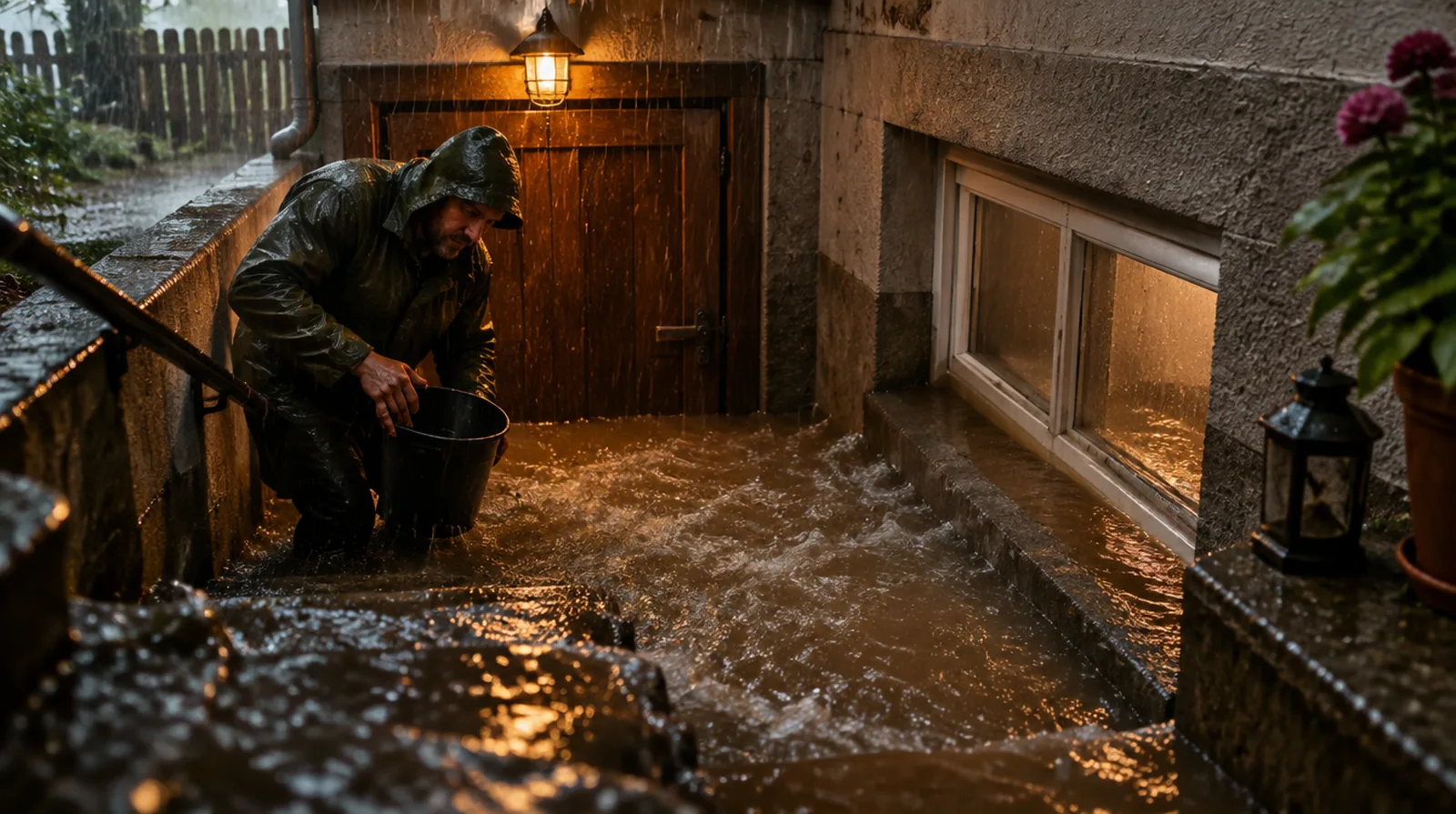
A storm drops 45 litres per square metre in one hour. The street is flooded and water runs through the light well into the 80 square metre cellar.
| Pumping out and disposal | about EUR 600 to 2,500 |
| Drying, around 20 days of equipment power | about EUR 2,000 to 4,000 |
| Repairing a full cellar of 60 to 100 square metres | about EUR 8,000 to 18,000 |
| Rebuilding the boiler room | about EUR 5,000 to 12,000 |
| Natural hazard add-on in hazard class 1 | about EUR 92 a year |
Without the add-on you pay around EUR 15,000 to 36,000 yourself. With it you pay only the agreed deductible, usually EUR 500 to 1,000. Ten years of premium cost less than one week of drying.
Building insurance (Wohngebäudeversicherung) covers only fire, tap water from burst pipes, storm from wind force 8 upwards and hail. Contents insurance (Hausratversicherung) covers the same perils for your belongings plus burglary. Water that arrives from outside across the ground is in neither of them.
For that there is a separate module called Elementarschutz or Elementardeckung, the natural hazard add-on. It is booked onto an existing policy, once for the building and once for the contents. If you rent, the building is your landlord's problem, but everything in your flat and your cellar compartment is yours.
| Event | Who pays |
|---|---|
| Storm from wind force 8 and hail | standard building and contents cover |
| Burst pipe inside the house | standard building and contents cover |
| Heavy rain floods the plot and the cellar | only with the natural hazard add-on |
| A river or stream bursts its banks | only with the natural hazard add-on |
| Sewage backflow into the cellar | only with the add-on, and usually only with a backflow valve |
| Groundwater pressing up through the floor slab | usually nobody, this is excluded |
| Rain coming through a roof window left open | usually nobody, the ground was not flooded |
Since May 2022 the industry model wording says, in plain terms: a flood (Überschwemmung) is the flooding of the ground of the insured plot, or of directly adjoining ground, roads, footpaths and cycle paths, with substantial amounts of surface water.
That sentence sounds harmless and causes most of the disputes. It is not enough that it rained hard. The water must have stood on the ground first and then entered the building from there.
If the rain ran straight off the roof into the light well, collected on your balcony or pushed through a leaky window while the ground around the house stayed dry, that element is missing. Many insurers refuse to pay in that case, even with a cellar full of water.
This is why a photo of the flooded yard or of water standing in the street is often worth more than any description you give weeks later.
Rückstau means the public sewer is full, water runs backwards through your own pipes and comes out of floor drains, toilets or the laundry room. It often happens without a single drop of surface water on your plot.
Backflow is not automatically part of the add-on. Some policies name it expressly, others only in a limited way. Look for the word Rückstau in your policy document.
Almost all policies also require a working backflow valve (Rückstauklappe) in rooms at risk, plus maintenance. That is a contractual duty, an Obliegenheit. If the valve is missing or jammed, the insurer may reduce the payment or refuse it entirely.
Groundwater (Grundwasser) is covered only if it reaches the surface and floods the ground. If the water table rises after days of rain and presses up through the floor slab or the cellar wall, it is excluded.
In practice this becomes a question of proof, decided by a loss adjuster weeks later in a dry cellar. If you did not take photos on the day, you are in a weak position.
So mark the highest water level on the wall with tape or a pen before you pump anything out, and record whether water was standing outside as well.
Safety first: switch off the electricity for the cellar before you go down, and do not step into standing water while a cable could be lying in it.
Then document: photos and a short video inside and outside, of the yard, of the street, of the water line on the wall. Only after that start pumping and clearing.
Report the claim at once. German policy wording requires notification without undue delay (unverzüglich). Only order what is needed to limit the damage, and keep every receipt.
Leave the drying to a specialist firm. Published guide figures put concrete at 21 to 42 days of drying, and the electricity for the equipment costs EUR 100 to 200 a day. Do not close up a wall while the moisture readings are still high.
A backflow valve costs around EUR 1,500 to 3,500 to install, with EUR 50 to 150 a year for maintenance. Both are required if your policy asks for the valve.
Light wells can be raised above ground level with a kerb (Lichtschachtaufkantung) and fitted with tight covers. This is the cheapest measure with the biggest effect, because the light well is the usual way water gets in.
Add pressure-tight cellar windows, a step in front of the cellar door, ground sloping away from the house, and the boiler, fuse box and technical equipment lifted off the floor. Documents and valuables do not belong in a cellar.
The German weather service warns of significant weather from 15 to 25 litres per square metre in one hour and calls more than 40 litres in one hour extreme weather. Those cells sit wherever the thunderstorm sits and do not ask about the nearest river.
Sewer systems are designed for far less. That is why cellars fill up on slopes, in new estates and in the middle of cities.
There are cases where the add-on does little for you. If you rent on an upper floor with no cellar compartment, your belongings are hardly exposed. And in the highest hazard class the surcharge averages more than EUR 2,000 a year, with a high deductible and few insurers willing to quote. Then weigh premium, deductible and building work against each other openly.
Questions and answers
Only with the natural hazard add-on. Without it, furniture, electronics and stored goods in the cellar are not replaced, however good the rest of the policy is.
Often not. The wording requires the ground itself to be flooded. If water ran straight off the roof or through the light well, that element is missing, so photos of the yard and street are decisive.
No. Rückstau must be named in the policy, and almost all insurers require a working, serviced backflow valve. Without it they may reduce or refuse payment.
Only if the groundwater reached the surface and flooded the ground. If it presses up through the floor slab or the wall, it is normally excluded.
As quickly as possible. German policy wording requires notification without undue delay, and the later you report, the harder the proof becomes.
There is no entitlement to it. Relief programmes are decided case by case after major events and rarely cover the full loss.
Usually yes. Heavy rain falls wherever the storm sits, and in quiet locations the building add-on costs around EUR 92 a year.
Usually not. Some insurers offer English service, but the German wording is what counts in a claim, so ask us when a clause is unclear.
NAMMERT insurance broker
We compare several insurers and come back with a proposal. Free for you; the insurer pays our fee. You can write in English.
Thank you, we have your request.
We will be in touch within one working day. If it is urgent: +49 3375 29 12 77.
All about this insurance: Natural hazard cover
Is flood insurance included in German home insurance?
What counts as natural hazard damage in Germany and what is covered?
Elementarschaden covers seven natural perils: flooding and sewer backflow, earthquake, ground subsidence, landslide, s …
Is natural hazard insurance worth it in Germany?
For most homeowners, yes. Heavy rain can hit any location, even far from a river, and in safe areas natural hazard cov …
NAMMERT Assekuradeur GmbH, insurance broker licensed under section 34d(1) of the German Trade Regulation Act, broker register no. D-C08Q-TOSD4-37. For boat and yacht insurance we act as underwriting agency, not as broker. Statutory disclosure (German) · Updated