All about this insurance: Natural hazard cover
Is flood insurance included in German home insurance?
Insurance broker / Insurance questions / Natural hazard cover
In short
Elementarschaden covers seven natural perils: flooding and sewer backflow, earthquake, ground subsidence, landslide, snow pressure and avalanches, and volcanic eruption. Storm and hail are not part of it, they are already in the basic cover. You can only buy this as an add-on to buildings or contents insurance, and it usually starts after a waiting period.
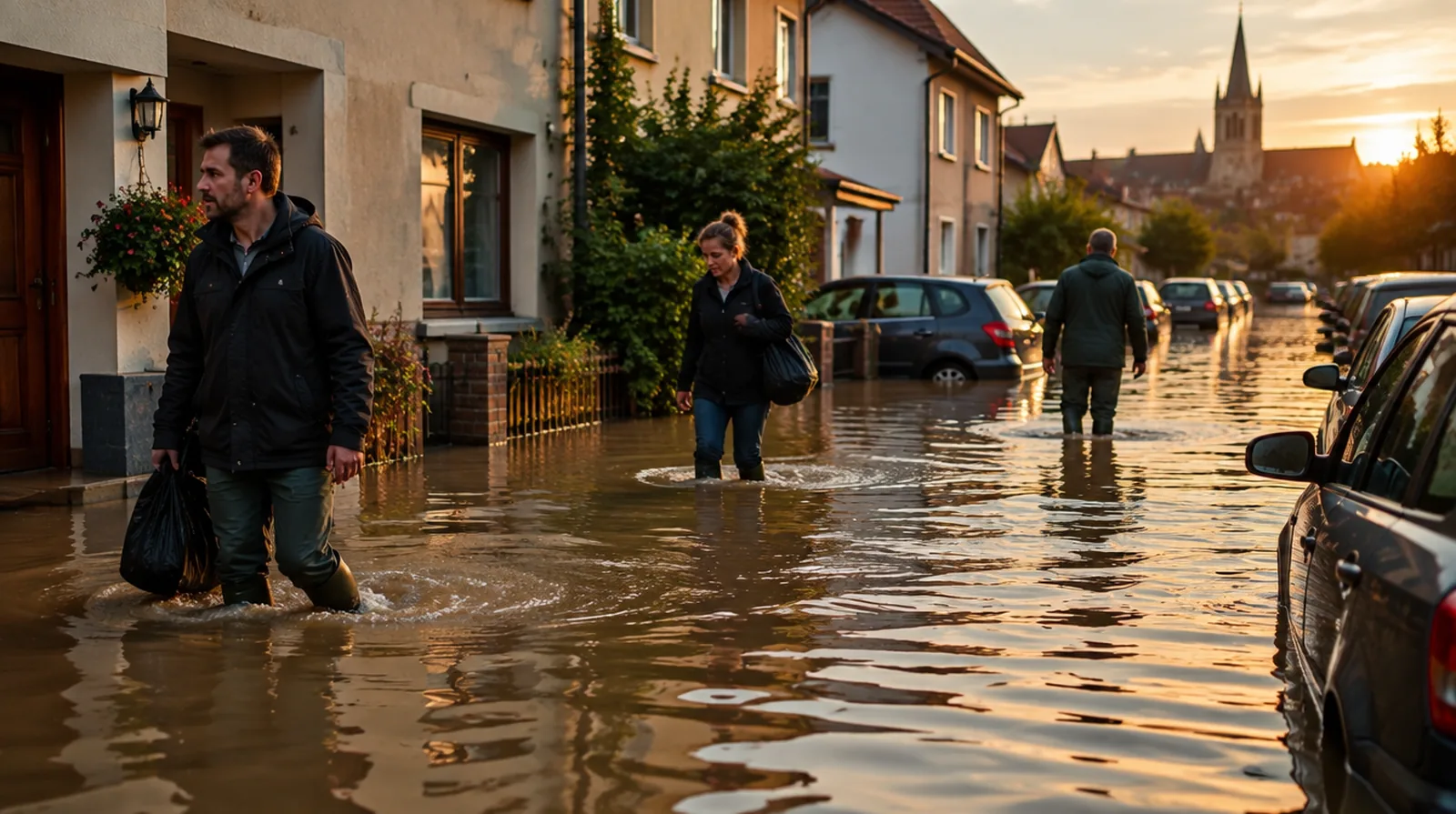
Premiums from a published German market analysis for contents and buildings cover, basic cover and basic cover with the natural hazard add-on.
| Example | Typical range |
|---|---|
| Contents cover in ZUERS zone 1 | just under EUR 77 basic premium, about EUR 95 a year with the add-on |
| Contents cover in ZUERS zone 2 | about EUR 104 a year with the add-on |
| Buildings cover in ZUERS zone 1 | just over EUR 241 basic premium, about EUR 92 more a year with the add-on |
| Buildings cover in ZUERS zone 2 | close to EUR 200 extra a year |
| Detached house in a high hazard class | about EUR 300 to over EUR 1,000 a year for the add-on alone |
Guide values as of September 2026 from publicly quoted German market analyses. The loss amounts in the worked example are guide values from our quoting practice. Your premium depends on the address, the hazard class, the deductible and the cover; we obtain the exact quote for you.
Worked example
A thunderstorm leaves 40 centimetres of water in the cellar. Here is the bill with and without the add-on.
| Damage to the building: screed, plaster, doors, heating, drying | about EUR 30,000 |
| Damage to contents: furniture, washing machine, tools, bikes | about EUR 8,000 |
| Payout without the natural hazard add-on | EUR 0 |
| Payout with the add-on in both policies, EUR 500 deductible each | about EUR 37,000 |
| Extra premium for both add-ons in zone 1 | about EUR 110 a year |
Without the add-on you pay around EUR 38,000 yourself. With it you carry EUR 1,000 in deductibles for about EUR 110 more a year. Worked example with guide values.
German insurers call this group Elementarschaden, literally elemental damage. It is the set of natural perils that normal buildings and contents policies leave out. You cannot buy it as a separate policy, only as an add-on to one you already hold.
Most policy wordings list the perils below. Flooding and sewer backflow are often treated as one peril, snow pressure and avalanches as well.
| Peril | What it means | Everyday example |
|---|---|---|
| Ueberschwemmung (flooding) | water stands on your plot because a river bursts its banks or heavy rain cannot drain away | after a thunderstorm the cellar fills through the light shafts |
| Rueckstau (sewer backflow) | water is pushed back into the house through the drain pipes because the sewer is overloaded | waste water comes up out of the cellar toilet |
| Erdbeben (earthquake) | a natural shaking of the ground | cracks in the brickwork after a quake in the Upper Rhine area |
| Erdsenkung (subsidence) | the ground sinks over a natural cavity | the floor slab drops over a sinkhole |
| Erdrutsch (landslide) | earth or rock slides down for natural reasons | after days of rain the slope pushes against the garage |
| Schneedruck und Lawinen (snow pressure and avalanches) | the weight of snow and ice, or sliding masses of snow and ice | the carport roof collapses under the snow load |
| Vulkanausbruch (volcanic eruption) | solid, liquid or gaseous matter thrown out by a volcano | very rare in Germany, but it is in the wording |
Storm from wind force 8 upwards and hail are already in the basic cover of your buildings and contents policy. You do not need the natural hazard add-on for those, and this is the point most people get wrong.
Storm surge (Sturmflut) is excluded almost everywhere in the natural hazard add-on. If you live right on the coast, only very few providers offer anything for it.
Groundwater is only covered once it reaches the surface and runs into the building from there. Damp that creeps through a cellar wall from below is nobody's claim.
Subsidence and landslide have to be natural. If the ground sinks because of mining or the building site next door, the add-on does not apply. A burst pipe inside the house is not a natural hazard either, that is the separate peril Leitungswasser.
Buildings insurance pays for the house itself: screed, plaster, doors, heating, wiring, drying out, in extreme cases demolition and rebuilding. If you rent, your landlord holds this policy.
Contents insurance pays for your movable things: furniture, washing machine, rugs, tools, bikes in the cellar. Each policy needs the natural hazard add-on separately. If you only have it in one, you carry the other half yourself.
As a tenant you only need the contents side. In an owners association the community decides about the building.
Insurers place every address in one of four flood hazard classes using the industry system ZUERS Geo. More than 22 million addresses are in it. Your class drives the premium, the deductible and sometimes whether you get an offer at all.
There are also three heavy rain hazard classes. Just under 12 percent of all addresses sit in the highest class SGK 3, about 66 percent in SGK 2 and over 22 percent in SGK 1. That matters because heavy rain hits any location, far from the nearest river as well.
| Hazard class | Statistical flooding | Share of addresses | What it means for you |
|---|---|---|---|
| GK 1 | not affected by flooding from larger rivers as things stand | over 90 percent | cover almost always available and cheap |
| GK 2 | less often than once in 100 years | about 6 percent | noticeable surcharge, but acceptance is normal |
| GK 3 | once in 10 to 100 years | about 1 percent | higher deductible, fewer providers |
| GK 4 | at least once in 10 years | about 0.4 percent | often only with conditions, sometimes not at all |
Cover does not start the moment you sign. For flooding from a surface watercourse, tariffs apply a waiting period (Wartezeit). One widely sold policy uses 7 days, others state 14 days or one month. If you switch without a gap from a contract that already had the add-on, the waiting period is usually dropped.
So do not sign up once the flood warning is already out. That is exactly what the waiting period is there for.
A deductible (Selbstbeteiligung) is normal. For contents, 150 or 300 euros are common; for buildings, often 500 euros or a percentage of the loss. In the high hazard classes insurers add a separately set deductible for natural perils.
For sewer backflow nearly every wording says the same thing: rooms at risk of flooding need a working backflow valve (Rueckstausicherung), and you have to keep it working. If it is missing or jammed, the insurer may reduce the payment or refuse it.
The usual duties apply too: report the loss without delay, keep it small, throw nothing away before it has been recorded or released. Photos of the wet cellar and old invoices are worth more later than your memory.
Claim letters and wordings are in German, and the German text is what counts. Ask us when a clause is unclear rather than guessing.
If you rent on the third floor with no cellar storage, your contents are barely exposed. The add-on is then comfort rather than necessity.
In hazard class 4 the premium can be so high and the deductible so large that little is left over. We say that openly instead of selling you something that hardly works. In those cases building measures often do more than the next contract.
A house without a cellar on high ground carries less risk. Landslide, snow pressure and heavy rain are still possible, and in class 1 the add-on usually costs under 100 euros a year. For most households that is money well spent.
Questions and answers
No. Storm from wind force 8 and hail belong to the basic cover of your buildings and contents policy. The add-on covers the other perils.
Yes, through the peril flooding, once water stands on your plot and runs into the building. Without the add-on nobody pays for it.
As a rule no. Storm surge is excluded from the natural hazard add-on, and only very few providers offer anything for it.
Only when it reaches the surface and enters the building from there. Damp cellar walls from below are not covered.
From 7 days depending on the tariff, often 14 days to one month. It is usually dropped if you switch without a gap and keep the same cover.
No. The add-on is sold as a package, even if there are no avalanches or volcanoes where you live.
It can make sense for your contents, above all on the ground floor or with cellar storage. The building is the owner's decision.
Some insurers offer English documents or service, many do not. The German wording applies in a claim, so ask us when a clause is unclear.
NAMMERT insurance broker
We compare several insurers and come back with a proposal. Free for you; the insurer pays our fee. You can write in English.
Thank you, we have your request.
We will be in touch within one working day. If it is urgent: +49 3375 29 12 77.
All about this insurance: Natural hazard cover
Is flood insurance included in German home insurance?
Is natural hazard insurance worth it in Germany?
For most homeowners, yes. Heavy rain can hit any location, even far from a river, and in safe areas natural hazard cov …
How much does natural hazard insurance cost in Germany?
As an add-on to buildings insurance, natural hazard cover (Elementarschadenversicherung) for a detached house in a saf …
Does insurance pay for heavy rain and flooding in Germany?
Only if you have the natural hazard add-on (Elementarschutz). Standard building and contents policies do not pay for h …
NAMMERT Assekuradeur GmbH, insurance broker licensed under section 34d(1) of the German Trade Regulation Act, broker register no. D-C08Q-TOSD4-37. For boat and yacht insurance we act as underwriting agency, not as broker. Statutory disclosure (German) · Updated