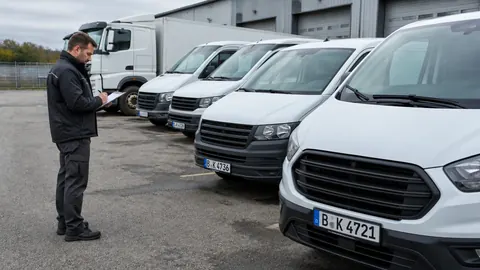
Carrier liability insurance in Germany: covering your liability for other people's goods
If you carry, forward or store goods for others in Germany, you are liable for them from pick-up to delivery, even without fault. Carrier liability insurance (Verkehrshaftungsversicherung) pays what you owe your customer under contracts of carriage, forwarding and storage, and defends you against inflated claims. It does not insure the cargo itself. That is the cargo owner's job.
Is carrier liability insurance compulsory in Germany?
For commercial road hauliers, yes. Section 7a of the Road Haulage Act (GüKG) requires liability insurance for loss, damage and delay under the Commercial Code (HGB) on carriage that is loaded and unloaded within Germany. The minimum sum insured is EUR 600,000 per event, and proof of cover must be carried on the journey. Section 7a does not name freight forwarders and warehouse keepers, but their customers almost always ask for a certificate.
Liability by weight, not by value
German carriage law makes the carrier responsible for loss and damage between taking over and delivering the goods, but caps compensation by weight. Under section 431 HGB and Article 23 CMR the cap is 8.33 special drawing rights per kilogram of gross weight, roughly EUR 10. That is plenty for a pallet of bolts and far too little for a pallet of phones. For late delivery, the Commercial Code limits liability to three times the freight charge.
For a shipper this means that only its own cargo insurance protects the full value. For the carrier it means the policy has to match the liability regimes it actually works under. A firm that drives domestically under the Commercial Code, across borders under CMR and also acts as a forwarder under ADSp needs all three named in the contract.
When the cap no longer applies
The weight limit is not absolute. If the carrier or its staff act intentionally, or recklessly and knowing that damage will probably result, section 435 HGB removes the limit altogether. Article 29 CMR has the same effect for international carriage. German courts have applied this, for example, where easily sold goods were left unsecured overnight.
This is where policies differ most. Some cover this kind of qualified fault only up to a sublimit, or reserve the right to recover from the policyholder. A higher liability agreed in the consignment note, such as a declared value under Article 24 CMR, is insured only if the policy expressly includes it. Check both points before you sign, not after a theft.
Forwarders and warehouses: the ADSp 2017 limits
German freight forwarders usually contract on the ADSp 2017, the industry's standard terms. They limit liability for damage to goods to 8.33 special drawing rights per kilogram, capped at EUR 1.25 million per claim and EUR 2.5 million per event, with a floor of 2 special drawing rights per kilogram. For ordered storage the limit is EUR 35,000 per claim, and EUR 70,000 a year for stock differences.
Those limits are only as good as the insurance behind them. A forwarder's policy should carry at least the ADSp amounts and list the activities the firm really performs: fixed-price forwarding, groupage, handling, storage, customs clearance. Added logistics services such as order picking or assembly often fall outside the transport contract and need a separate agreement.
Policy conditions: where cover is lost in practice
Carrier liability wordings demand care and spell it out. Typical conditions cover where a loaded vehicle may be parked, which anti-theft devices are required, how drivers and subcontractors are chosen, and how each handover of the goods is checked and recorded. A breach can reduce the payout or lead to recovery against you.
Jobs placed through freight exchanges need particular attention. If a fraudster poses as a carrier and disappears with the load, you are liable to your customer, and some policies exclude exactly this or tie cover to verification steps. Ask what the insurer expects before you award work to an unknown firm, and keep a written record.
What is covered
Liability for loss of and damage to goods under contracts of carriage governed by the German Commercial Code
Liability under the CMR Convention for international road carriage
Liability as a freight forwarder under ADSp 2017, if agreed
Liability as a warehouse keeper for transit and ordered storage, if agreed
Losses from late delivery within the statutory limit
Consequential and pure financial losses up to the agreed sublimits
Assessment of liability and defence against unfounded or excessive claims
Costs of averting and reducing a loss, in some policies also recovery and disposal
Liability for subcontracted carriers, where the policy includes them
What is not covered
The value of the goods above your statutory or agreed liability
Damage caused intentionally
Contractual penalties and liability promises beyond the law that were not declared
Damage to your own vehicle and your own goods
Bodily injury and road traffic damage, which belong to motor liability insurance
Goods the policy excludes or covers only by special agreement, often valuables
Activities not named in the policy, such as pure logistics services
Who needs it
Road hauliers operating commercially in Germany with vehicles over 3.5 t
Freight forwarders, including those who only organise and subcontract the driving
Warehouse and handling firms holding goods that belong to others
Courier, express and parcel contractors whose principals ask for a certificate
Removal firms and heavy haulage operators with their own liability rules
Who does not need it
Firms that only move their own goods: without a contract of carriage there is no carrier's liability
Shippers who want to protect the value of their cargo: that is what cargo insurance is for
Wheel of misfortune
Spin the wheel of bad luck
Six things that really happen. The wheel picks yours and shows who pays.
Cost:
Budget policy Strong policy
See all six cases
Truck overturns, 18 tonnes written off, up to roughly €180,000 by weight. Budget policy: pays, Strong policy: pays. The core case. The policy pays what you owe by weight, at most the value of the goods. Anything above that is for the customer's cargo insurance, if there is one.
Curtain slashed, TVs gone overnight, often five or six figures. Budget policy: pays in part, Strong policy: pays. Electronics count as theft-attractive. Cheap policies exclude them or pay only after guarded parking. Strong ones include them with conditions you can meet.
Bogus carrier collects the load, the full cargo value, often six figures. Budget policy: does not pay, Strong policy: pays in part. Freight exchange fraud is often excluded. Better wordings cover it if the firm's identity and insurance were verified.
Late delivery stops a production line, at most three times the freight. Budget policy: pays, Strong policy: pays. For delay the Commercial Code caps liability at three times the freight charge. Within that cap the loss is insured.
Customer demands a €5,000 penalty, €5,000 per breach under the contract. Budget policy: does not pay, Strong policy: does not pay. Contractual penalties are not statutory liability. No policy pays them without special agreement, so read such clauses before signing.
Subcontractor loses two pallets, roughly €2,000 to €10,000. Budget policy: pays in part, Strong policy: pays. You are liable to your customer yourself. Whether the policy pays depends on whether subcontractors are included in general or only by name.
What it costs
The premium follows what you carry and for whom. Small hauliers are usually rated per vehicle, forwarders on turnover from transport contracts. A reliable figure needs your fleet, the goods, the territory and your claims record.
What drives the premium
Number and type of vehicles, or turnover from transport contracts
Type of goods, above all theft-attractive and temperature-controlled cargo
Territory: Germany only, Europe or beyond
Sums insured and deductible, often higher for theft
Use of subcontractors and freight exchanges
Claims history of recent years
There are no reliable public comparisons for this line, so we do not publish sample premiums. Your premium is fixed only in the quote we obtain for you.
The policy levels on the market
01
Compulsory cover for hauliers
Liability under the Commercial Code for domestic German carriage with the statutory minimum sum. Satisfies section 7a GüKG, but not cross-border trips or forwarding work.
02
National and international carriage
Commercial Code and CMR in one policy, with cabotage, higher sums and rules for subcontractors. The usual choice for hauliers who also drive abroad.
03
Forwarding, storage and logistics
Adds liability under ADSp, storage, handling and, on request, logistics services. For forwarders and firms with their own warehouse.
How to recognise a good policy
Criterion
Minimum standard
Strong policy
Why it matters
Sum insured per event
EUR 600,000, the statutory minimum
at least the ADSp 2017 limits of EUR 1.25 million per claim and EUR 2.5 million per event
One trailer of high-value goods exceeds the minimum quickly once the weight cap falls away.
Liability regimes
Commercial Code for domestic carriage
Commercial Code, CMR and ADSp, plus other transport modes if needed
Only liability under the rules named in the policy is insured.
Qualified fault
covered with a sublimit
covered up to the full sum insured, without recovery for staff errors
Reckless conduct means unlimited liability, and that is when losses are largest.
Territory and cabotage
Germany
geographical Europe including cabotage under local law
A single job abroad would otherwise be uninsured.
Subcontractors
only firms named in the policy
all subcontractors used, with clear rules for freight exchanges
You answer for their mistakes as for your own.
Theft-attractive goods
excluded or tightly sublimited
included, with parking conditions you can actually meet
Electronics, tobacco, alcohol and branded goods are what cargo thieves look for.
Named vehicles
cover only for declared registration numbers
cover for all owned and hired vehicles without individual declaration
A replacement truck hired at short notice must not create a gap.
Parking and guarding
strict conditions with total loss of cover
conditions that fit real route planning, with reductions in proportion to the breach
A condition nobody can meet in daily work is a hidden exclusion.
Insurers on the German market
Carrier liability is written by marine and transport insurers. The list names insurers authorised in Germany that offer this line. It describes the German market and says nothing about which insurers we work with.
Insurer
Background
KRAVAG
specialist insurer of the German road haulage trade, part of the R+V group
Allianz
carrier and forwarder liability through agents and brokers
Mannheimer
transport division with its own wordings for hauliers, forwarders and removal firms
Dialog
broker insurer of the Generali group offering haulier liability
VHV
mutual group from Hanover, sold mainly through brokers
Alte Leipziger
property insurer of the ALH group with wordings for carrier and forwarder liability
From the BaFin register
134
134 insurers supervised by BaFin, the German regulator, are licensed for this class of insurance.
Liability under contracts of carriage governed by the Commercial Code and CMR, usually rated per vehicle. The basis for any haulage firm.
Forwarder liability (Speditionshaftung)
Liability under forwarding contracts on ADSp terms, including fixed-price and groupage forwarding, usually rated on turnover.
Warehouse keeper liability
Liability for stored third-party goods including stock differences, on its own or as part of a forwarder policy.
Combined carrier liability policy
Carriage, forwarding and storage in one contract with one sum insured. Avoids gaps at the interfaces.
Logistics extension
For services outside the transport contract, such as order picking, labelling or assembly.
Myth or truth
True or false?
Five things people say about this insurance. Guess first, then see the answer.
Carrier liability insurance always pays the customer the full value of the goods.
This is false.
False. It pays what the carrier owes, which is normally 8.33 special drawing rights per kilogram. Only cargo insurance closes the gap to the full value.
Domestic German haulage with trucks over 3.5 t requires this insurance by law.
This is true.
True. Section 7a GüKG requires liability insurance of at least EUR 600,000 per event, and proof must be carried on board.
A reckless carrier is liable without any cap.
This is true.
True. Under section 435 HGB the limits fall away for intent and for reckless conduct in the knowledge that damage will probably result. Article 29 CMR works in a similar way.
A forwarder who never drives needs no carrier liability cover.
This is false.
False. A forwarder is liable for its choice of carrier and often like a carrier itself, for example when working at a fixed price. Customers therefore ask forwarders for a certificate too.
The compulsory policy may include a deductible.
This is true.
True. The law allows a deductible and an annual aggregate of at least twice the minimum sum.
Common mistakes
Buying only the compulsory domestic cover and then accepting cross-border jobs
Signing framework contracts with higher liability or penalties without asking the insurer
Using subcontractors from freight exchanges without checking identity and insurance
Carrying theft-attractive goods the policy excludes
Not passing parking conditions on to dispatchers and drivers
Telling the customer the cargo is fully insured under your liability policy
Frequently asked questions
Questions and answers
Frequently asked
What is the difference between carrier liability and cargo insurance?
Carrier liability protects the haulier or forwarder against claims,
and only to the extent of their legal or contractual liability.
Cargo insurance protects the owner of the goods and pays their value whether or not anyone is
liable.
The two complement each other.
How much is paid after a total loss?
What you owe.
As a rule that is 8.33 special drawing rights per kilogram, roughly EUR 10,
and never more than the value of the goods.
For a 5-tonne load the cap is around EUR 50,000, even if the cargo is worth several times that.
Does the obligation apply to vans up to 3.5 tonnes?
The duty in section 7a GüKG is tied to commercial road haulage,
which starts with vehicles of more than 3.5 t gross weight including trailer.
Below that you are still liable under the Commercial Code,
and most principals ask for proof of cover.
I am based outside Germany. Does section 7a affect me?
The provision covers carriage that is loaded and unloaded within Germany.
Whether and how it applies to your operation, for example on cabotage,
should be clarified before the first trip.
We can check this with the insurer for you.
What proof do I need to carry?
Section 7a GüKG requires proof of valid liability insurance to be carried during the journey.
Your insurer issues it.
The provision was amended in February 2026,
so check the current rules on the form the proof may take.
May the policy have a deductible?
Yes.
The law expressly allows a deductible and an annual aggregate,
provided the aggregate is at least twice the minimum sum.
Many policies apply a higher deductible to theft.
Am I liable if my subcontractor causes the loss?
Yes.
A carrier, or a forwarder working at a fixed price, answers for sub-carriers as for its own staff.
Recovering from the subcontractor is then the insurer's task,
provided the policy includes subcontractors.
Is freight exchange fraud covered?
It depends on the wording.
Some policies exclude loss to bogus carriers, others cover it if defined checks were carried out.
Ask about this point specifically before you buy.
What about chilled goods and dangerous goods?
Neither is included automatically.
For temperature-controlled cargo insurers usually require complete temperature records,
and dangerous goods need express agreement.
Mention such goods in your enquiry.
Does my truck's motor liability insurance cover the load?
No.
Motor liability pays for damage the vehicle causes to others on the road.
The goods being carried are excluded there.
For them you need carrier liability insurance.
NAMMERT insurance broker
Request quotes for Carrier liability
We obtain quotes and come back with a comparison, free of charge.
You can write in English.
Thank you, we have your request.
We will be in touch within one working day. If it is urgent: +49 3375 29 12 77.