How high is the deductible for natural hazard insurance in Germany?
In short
How high the deductible (Selbstbeteiligung) is depends on the policy. A common model for natural hazard insurance in Germany is 10 percent of the loss, at least EUR 500 and at most EUR 5,000. In flood risk classes 1 to 3 some policies have no compulsory deductible. In class 4 insurers often require a fixed EUR 10,000 or a minimum loss amount.
Published policy details from German insurers and worked deductible examples.
Example
Typical range
Stand-alone natural hazard policy for one- and two-family houses, as of July 2025
flat EUR 175 a year, deductible 10 percent, EUR 500 to 5,000
Buildings insurance in flood class 4, compulsory deductible
fixed EUR 10,000 per flood or backflow claim
EUR 3,000 loss with 10 percent, EUR 500 to 5,000
your share EUR 500, payout EUR 2,500
EUR 80,000 loss with 10 percent, EUR 500 to 5,000
your share EUR 5,000, payout EUR 75,000
As of October 2026, from published policy documents of two insurers (July 2025 and tariff KT2023).
Other policies differ.
How much a deductible lowers the premium is a guide value from our quoting practice;
we obtain the exact quote for you.
Worked example
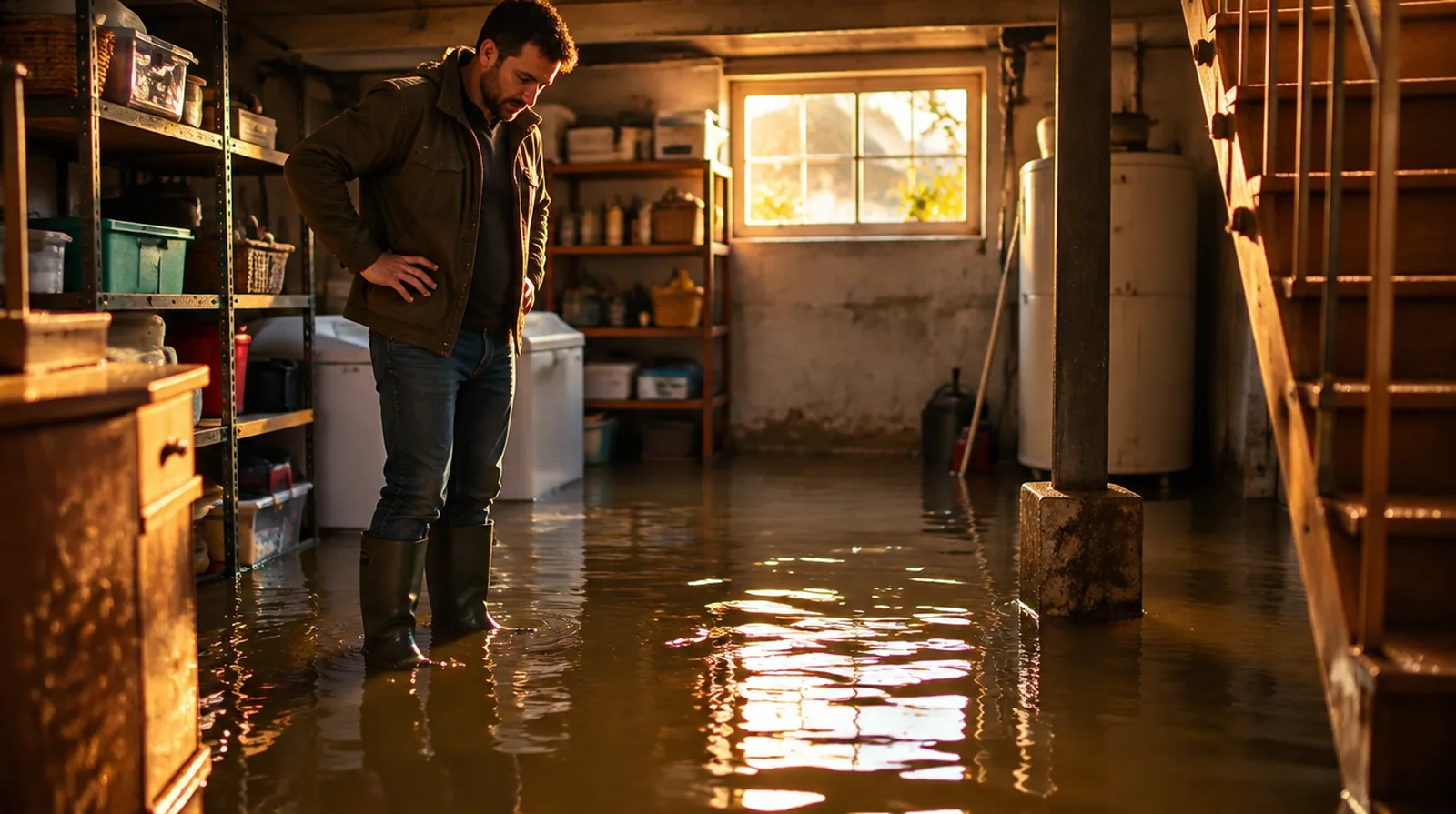
Heavy rain floods the basement, detached house in class 2, EUR 24,000 loss
Policy with a 10 percent deductible, minimum EUR 500, maximum EUR 5,000, for flooding and backflow.
Damage to screed, heating and walls
EUR 24,000
10 percent deductible
EUR 2,400
Within EUR 500 to 5,000 limits
yes
Payout
EUR 21,600
The family carries EUR 2,400. With a fixed EUR 1,000 deductible it would have been EUR 1,400 less, usually for a somewhat higher premium. Worked example.
Three models you will meet
A percentage deductible grows with the loss but has a floor and a cap. With 10 percent and limits of EUR 500 and 5,000, you pay EUR 500 on a EUR 3,000 basement claim and EUR 3,000 on a EUR 30,000 claim.
A fixed deductible is the same amount per claim. A minimum loss amount (Mindestschadenhöhe) works differently: below the threshold the natural hazard insurance pays nothing, above it pays in full. One insurer sets it at 25 percent of the 1914 sum insured in class 4.
Model
How it works
Your share of a EUR 20,000 loss
10 percent, EUR 500 to 5,000
percentage with floor and cap
EUR 2,000
Fixed EUR 1,000
same amount per claim
EUR 1,000
Fixed EUR 10,000, class 4
same amount per claim
EUR 10,000
Minimum loss amount
nothing below the threshold, everything above
EUR 0 or 20,000 depending on the threshold
No deductible
full payment
EUR 0
How the flood risk class sets your share
German insurers place each address in a flood risk class from 1 to 4 (ZÜRS). In classes 1 to 3 the deductible for natural hazards is often your choice, and some policies have none.
In class 4, where flooding is expected at least once in ten years, a deductible becomes a condition for getting cover at all. One policy we reviewed requires a fixed EUR 10,000 there, with no premium discount, or alternatively a minimum loss amount.
Which perils the deductible covers
Often the natural hazard deductible applies only to flooding and backflow, where most claims arise. Landslide, subsidence, snow load, avalanche and volcanic eruption then have no deductible.
Other policies set a separate figure for earthquake, for example a fixed EUR 5,000. Read not only the number but also which perils it applies to.
On top of your main policy deductible?
Many homeowners already have a general deductible in their buildings insurance (Wohngebäudeversicherung). Whether the natural hazard deductible applies in addition or replaces it is set in the contract. Ask before signing, or a heavy rain claim may cost you twice.
Contents insurance (Hausratversicherung) is similar: besides the general choice, for example none, EUR 150 or EUR 300, the natural hazard add-on can carry its own deductible depending on the flood risk of your address.
No deductible: when it pays off
Natural hazard insurance without a deductible makes sense if you live in class 1, the surcharge is small and a EUR 500 to 5,000 loss would hurt. You pay a little more and carry nothing in a claim.
In classes 3 and 4 you will rarely get cover without a deductible. There a higher deductible is often the way to be accepted at all, so keep savings to match.
What the planned compulsory cover changes
The German government has announced nationwide natural hazard cover. In March 2026 a parliamentary group was still asking the government to present a bill. There is no rule yet on the deductible such cover would carry.
So plan with today's policies. A contract with a suitable deductible protects you whatever the outcome of the debate.
Step by step
Ask for the flood risk class of your address.
Check the quote: percentage, floor and cap, or fixed amount.
Check which natural perils the deductible applies to.
Clarify whether it applies on top of the main policy deductible.
Compare premiums with and without, and keep savings to match.
Checklist
Maximum deductible known
Minimum loss amount avoided or chosen knowingly
Scope for flooding, backflow and earthquake clear
Relation to the main policy deductible clear
Savings at least equal to the cap
Common mistakes
Reading only the percentage and missing the cap
Confusing a minimum loss amount with a deductible
Assuming the deductible applies equally to all natural perils
Not noticing a double deductible from main policy and add-on
Questions and answers
Frequently asked
Can I get natural hazard cover without a deductible?
Yes, mainly in flood classes 1 to 3 some policies offer it.
In class 4 a deductible is usually a condition.
What is a minimum loss amount?
A threshold below which the insurer pays nothing.
Above it the loss is paid in full.
It is not the same as a deductible.
Does a deductible apply to contents too?
The natural hazard add-on to contents insurance can carry its own deductible,
depending on the flood risk at your address.
Will the planned compulsory cover bring a fixed deductible?
There is no rule on that yet.
Compulsory cover has been announced, but no government bill had been presented by March 2026.
Is this like flood excess in the UK?
Similar in effect,
but in Germany natural hazard cover is an add-on you choose, not part of standard home insurance.