All about this insurance: Natural hazard cover
Is flood insurance included in German home insurance?
Insurance broker / Insurance questions / Natural hazard cover
In short
Not yet. As of September 2026 there is no obligation and no published bill. The coalition agreement says new buildings policies should only be offered with natural hazard cover (Elementarschadenversicherung) and existing ones extended on a cut-off date. The Ministry of Justice announced key points in May 2026.
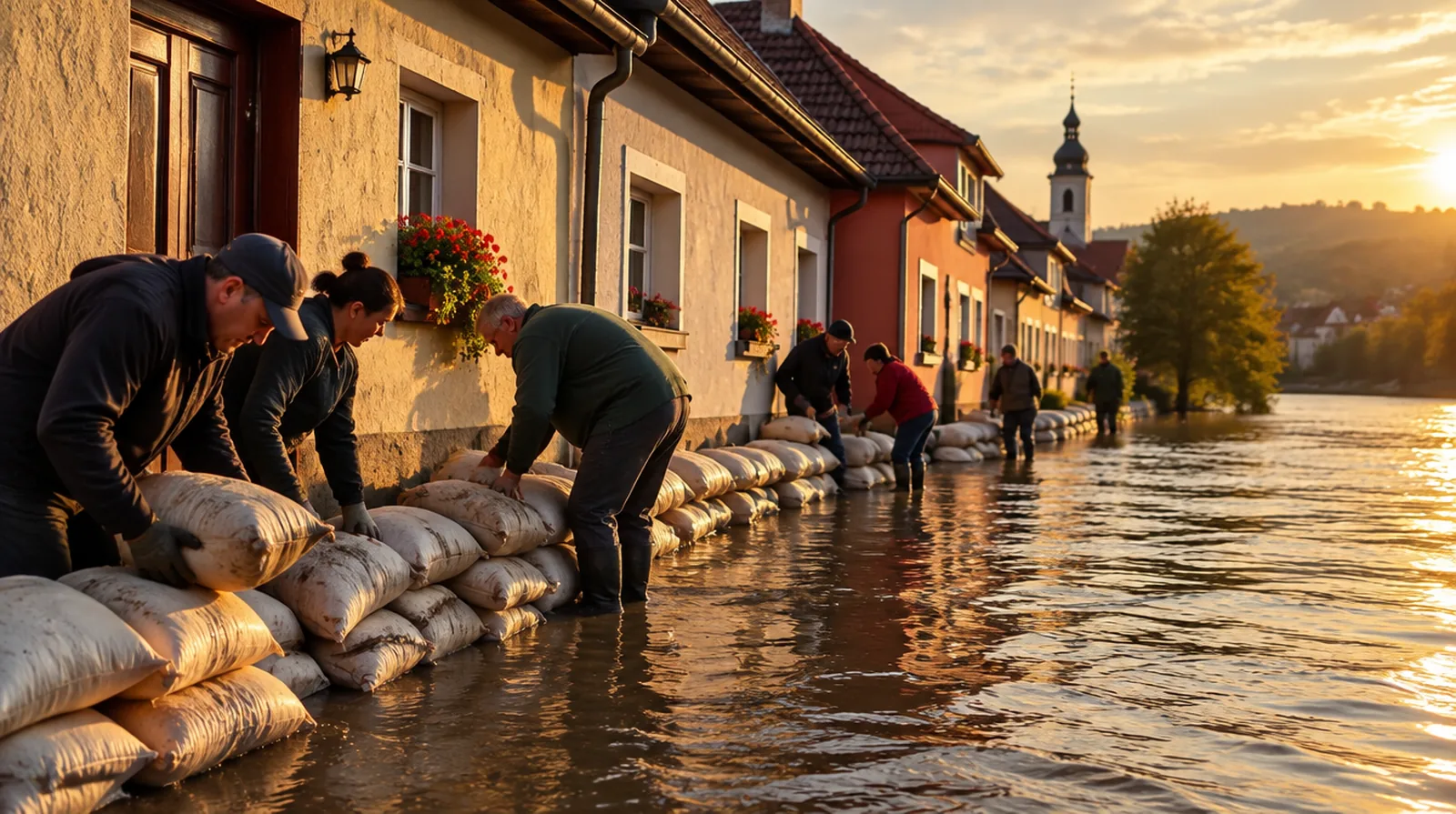
Guide figures for the natural hazard add-on to buildings insurance by flood hazard class, as of 2026.
| Example | Typical range |
|---|---|
| Hazard class 1, more than nine in ten addresses | about EUR 90 to 290 a year |
| Hazard class 2 | about EUR 240 to 650 a year |
| Hazard class 3 | about EUR 1,300 to 1,500 a year |
| Hazard class 4, highest exposure | about EUR 1,100 to 2,100 a year |
| Buildings insurance including the add-on, total | about EUR 600 to 2,900 a year |
Guide values as of September 2026, taken from publicly quoted examples for a detached house. Your premium depends on the property, the location and the scope of cover; we obtain the exact quote for you. The loss amount in the worked example is a guide value from our quoting practice.
Worked example
A homeowner in hazard class 1 buys the add-on once summer is already under way.
| Application reaches the insurer | 10 July |
| Waiting period under the policy conditions | 14 days |
| Cover starts | 24 July |
| Heavy rain floods the basement | 18 July, about EUR 25,000 of damage |
| Premium for the add-on | about EUR 150 a year |
The insurer pays nothing, because the loss falls inside the waiting period. Signed eight days earlier, a premium of about EUR 150 a year would have covered roughly EUR 25,000.
Nobody in Germany has to insure against natural hazards. The cover is an add-on to buildings insurance (Wohngebäudeversicherung) or contents insurance (Hausratversicherung), and the decision is yours alone.
According to the insurance industry, around 59 percent of residential buildings have the add-on. That leaves about 41 percent with no cover for heavy rain, flooding or sewer backflow (Rückstau).
On 14 June 2024 the Bundesrat, the chamber of the federal states, passed a resolution asking the federal government to put forward a proposal for a nationwide obligation without delay. A resolution of that kind is a request, not a law.
Several routes are being discussed. They differ in who gets the final say: you, your insurer or the legislator.
The coalition agreement of 9 April 2025 names two steps. New buildings policies are to be offered only together with natural hazard cover, which is an obligation to contract (Kontrahierungszwang) for new business. Existing policies are to be extended on a cut-off date, with an opt-out under review.
On 7 May 2026 the Federal Ministry of Justice announced key points for a nationwide solution at an industry event. Three requirements were named: the model must provide security, stay affordable and be widely accepted.
| Model | What it would mean for you |
|---|---|
| Duty to offer | The insurer must offer you the cover, you may decline |
| Obligation to contract | The insurer may not refuse cover, not even in an exposed location |
| Opt-out | The cover is included by default, you may object expressly |
| Full obligation | Every building must be insured, no objection possible |
There is no timetable. Even if a law arrives, existing policies are only meant to be extended on a cut-off date. Until then you carry the risk yourself.
Then there is the waiting period. Under many policy conditions the natural hazard cover only starts 14 days after the application reaches the insurer. If you sign up once a storm warning is already running, that storm is not covered. Some insurers stop accepting applications altogether while a warning is active.
No loss can ever be insured retrospectively. That rule is what keeps the premium affordable for everyone else.
Emergency aid after a disaster is voluntary. There is no legal entitlement, and the amount depends on the public budget and on the individual case.
Bavaria has granted no state emergency aid since 1 July 2019 where a building could have been insured. If cover was available and you did not buy it, you get nothing there.
Federal reconstruction aid after major disasters also tends to recognise only the part of the loss that could not have been insured.
The timetable, the right to object and the treatment of very exposed locations are all unsettled. No ministerial draft has been published.
The industry is arguing for an opt-out plus a premium cap in high-risk locations, staggered by building size, with the gap to the technically required premium covered by a levy. The state would only step in for very large loss events. Whether the legislator follows is not decided.
To be straight with you: anyone naming a date for the obligation today is guessing. Your own policy is the part you can control.
Questions and answers
No. As of September 2026 no law is in force and no draft bill has been published.
On 14 June 2024 it passed a resolution asking the federal government to propose a nationwide obligation without delay. That is a request, not a law.
The natural hazard cover would be part of your buildings policy by default. You could object expressly, and would then stand without that protection.
That is open. Premium caps with a levy are being discussed for high-risk locations, but nothing is decided.
Under the coalition agreement, existing policies would be extended on a cut-off date. Whether and how you could object is not yet settled.
Do not rely on it. There is no legal entitlement, and Bavaria has withheld emergency aid since 1 July 2019 where the building was insurable.
Usually 14 days after the application reaches the insurer. While a storm warning is running, some insurers stop accepting applications.
Often yes, with a higher deductible or after protective building work. These are exactly the locations the political debate is about.
NAMMERT insurance broker
We compare several insurers and come back with a proposal. Free for you; the insurer pays our fee. You can write in English.
Thank you, we have your request.
We will be in touch within one working day. If it is urgent: +49 3375 29 12 77.
All about this insurance: Natural hazard cover
Is flood insurance included in German home insurance?
Is natural hazard insurance worth it in Germany?
For most homeowners, yes. Heavy rain can hit any location, even far from a river, and in safe areas natural hazard cov …
How much does natural hazard insurance cost in Germany?
As an add-on to buildings insurance, natural hazard cover (Elementarschadenversicherung) for a detached house in a saf …
What counts as natural hazard damage in Germany and what is covered?
Elementarschaden covers seven natural perils: flooding and sewer backflow, earthquake, ground subsidence, landslide, s …
NAMMERT Assekuradeur GmbH, insurance broker licensed under section 34d(1) of the German Trade Regulation Act, broker register no. D-C08Q-TOSD4-37. For boat and yacht insurance we act as underwriting agency, not as broker. Statutory disclosure (German) · Updated