All about this insurance: Buildings insurance
Is buildings insurance mandatory in Germany?
Insurance broker / Insurance questions / Buildings insurance
In short
German policies define a storm (Sturm) as wind of at least Beaufort force 8, meaning at least 62 km/h. If no wind speed can be established for your address, a storm is assumed when you can show that the wind damaged sound buildings nearby, or that only a storm could have caused the damage to your well-maintained house.
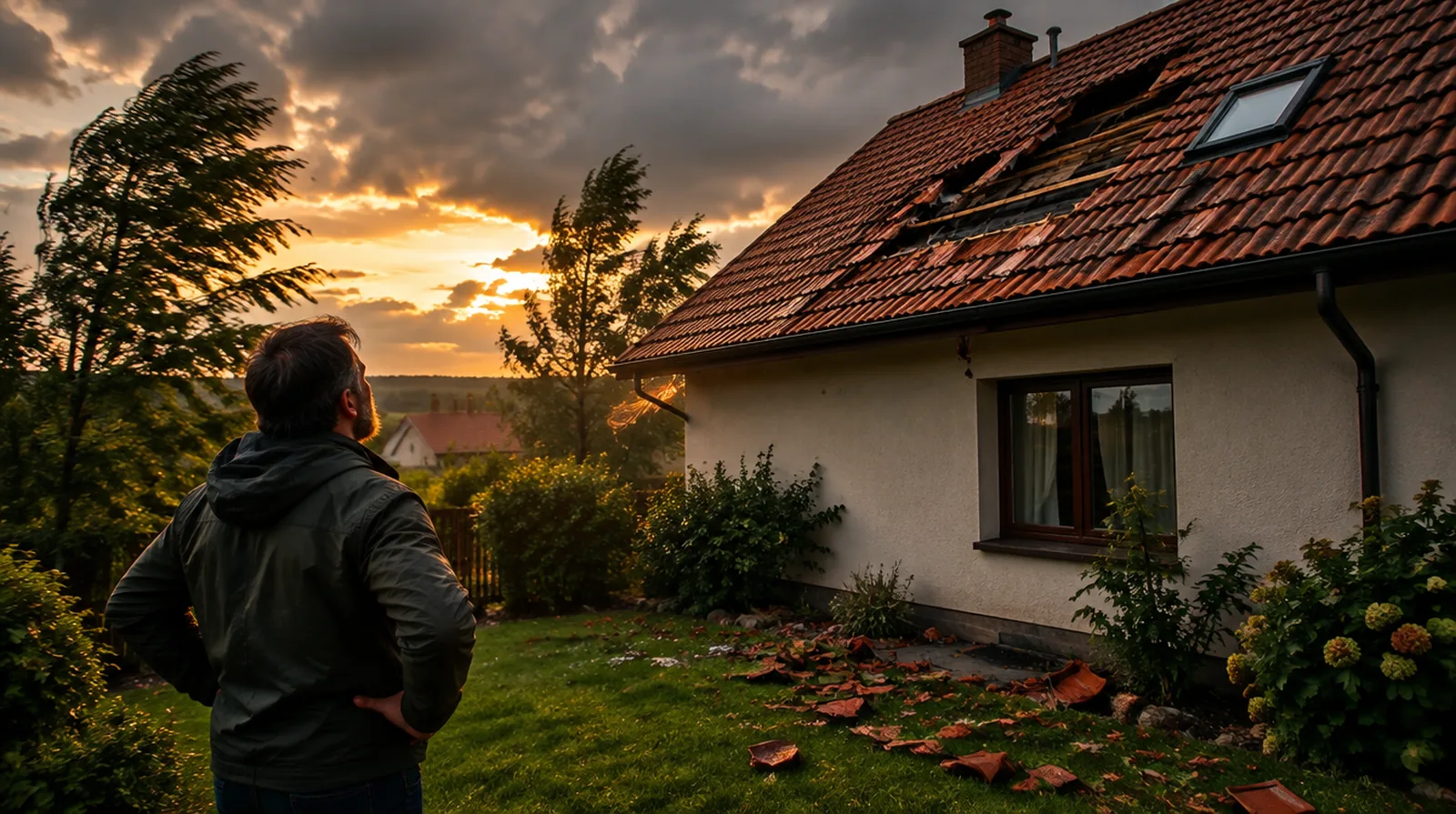
Two sets of figures matter here: what a storm-damaged roof costs to repair, and what the cover costs. Both are guide values from published German examples, as of 2026.
| Example | Typical range |
|---|---|
| Re-covering a roof, labour and material per square metre | about EUR 50 to 200 |
| Repair to the roof structure per square metre | about EUR 50 to 200 |
| Scaffolding per square metre | about EUR 6 to 12 |
| Storm damage to a roof of about 50 square metres, full job | about EUR 10,550 to 17,100 |
| Buildings insurance for an ordinary detached house | about EUR 300 to 800 a year, often EUR 400 to 500 |
| Add-on for natural hazards | often EUR 100 to 300 a year, more in exposed locations |
Guide values as of September 2026 from publicly quoted examples. The split of amounts in the worked example is a guide value from our quoting practice. Your premium depends on the year of construction, size, location and cover; we obtain the exact quote for you.
Worked example
A thunderstorm gust rips about 12 square metres of tiles off the roof and rain gets into the attic. The nearest weather station records 78 kilometres per hour, which is Beaufort force 9 and well above the 62 kilometres per hour threshold.
| Measured gust | 78 km/h, Beaufort force 9 |
| Emergency tarpaulin the same evening | about EUR 300 to 800 |
| Re-tiling about 12 square metres | about EUR 600 to 2,400 |
| Drying out and redecorating the attic | about EUR 500 to 1,500 |
| Deductible under the policy | EUR 500 |
Total damage of roughly EUR 1,400 to 4,700, of which you carry the EUR 500 deductible. The rest is storm damage to the building and is paid, including the water damage in the attic, because the storm opened the roof first.
The Beaufort scale runs from 0 to 12. The German weather service calls force 8 a gale (stürmischer Wind) and puts it at 62 to 74 kilometres per hour. That exact step appears in the model wording for German buildings insurance (Wohngebäudeversicherung): a storm is a weather-related air movement of at least Beaufort force 8, which means at least 62 kilometres per hour.
What counts is the gust, not an hourly average. A thunderstorm with a short gust of 80 kilometres per hour clears the bar; a steady 55 kilometres per hour does not. For your car, partial cover (Teilkasko) often starts at force 7, but that is a different policy with different terms.
| Beaufort force | Speed | What it means for cover |
|---|---|---|
| 7, near gale | 50 to 61 km/h | below the threshold, buildings insurance usually pays nothing |
| 8, gale | 62 to 74 km/h | threshold reached, storm damage to the building is covered |
| 9, strong gale | 75 to 88 km/h | covered, this is where meteorologists first speak of a storm |
| 10, storm | 89 to 102 km/h | covered, typical for roofs stripped of tiles |
| 12, hurricane force | 118 km/h and above | covered, often a mass-claim event with long waits for tradespeople |
Weather stations are not on every corner, so the wording contains a fallback rule. If the wind speed cannot be established for the place of loss, a storm is assumed when you prove one of two things.
First: the air movement damaged buildings in sound condition, or equally sturdy objects, in the area around your property. Second: because your building was in sound condition, only a storm can have caused the damage.
In practice that means evidence. Photograph snapped trees, torn fences and damaged neighbouring roofs. Keep the weather report or the official storm warning for that day, and note when you first saw the damage. For a measured value you can order a weather report from the German weather service; it is not free, but insurers often accept the cost when they ask for it.
Cover applies when the storm acts directly on the insured building, and when the storm throws building parts, trees or other objects onto it. Knock-on damage counts too: if rain comes through the torn roof into your rooms, the water damage is part of the storm claim.
Storm surge is not covered. Nor is rain, hail or snow entering through windows or doors that were not properly closed. The exception: if the storm itself tore the opening and that is damage to the building, the rain that follows is covered.
Flood, backwater from drains, earthquake, landslide, snow pressure and avalanches are not storm damage. They belong to the natural hazards add-on (Elementarschadenversicherung), which you have to agree separately. After a bad night it is not the word storm in the forecast that decides, but what the wind or the water actually did.
What is insured is the building named in your policy schedule (Versicherungsschein), with its fixed parts and its accessories. Garages, carports, garden sheds and fences are not automatically included. They are covered only if they are listed in the schedule, so check that before the next storm rather than after it.
An awning bolted to the house usually counts as building accessory (Gebäudezubehör) and is then covered. Many policies cap the payout or expect you to retract the awning when a storm is forecast. Leave it out through a warned storm and the insurer will cut the payout for gross negligence (grobe Fahrlässigkeit).
Solar panels are expressly excluded in the model wording and must be added or insured separately. Plug-in balcony solar units do count as building accessory. Movable things such as garden furniture or a trampoline belong to contents insurance (Hausratversicherung), not to buildings insurance.
Section 82 of the German Insurance Contract Act (Versicherungsvertragsgesetz) obliges you to avert and limit the loss as far as you reasonably can. Fail to do so deliberately and you get nothing; act with gross negligence and the insurer may reduce the payment. Throwing a tarpaulin over an open roof is therefore a duty, not a favour.
Photograph first, tidy up afterwards. Take wide shots and close-ups of every single item of damage, keep the broken tiles and store damaged parts until the insurer releases them. You may order emergency repairs straight away and the cost forms part of the claim. Agree the full repair with the insurer first, otherwise you will argue about the price later.
Report the loss without delay and get a written quote. After a hurricane-force event roofers are booked out for weeks, so an early report secures your place in the queue.
The most common dispute is not the wind speed but the condition of the building. Loose tiles, a rotten roof structure or a chimney that has been cracked for years point to wear rather than to the storm. Neglect the upkeep and you lose all or part of the cover, even when there really was a storm. Keep the invoices from roofers and chimney sweeps, they are your proof.
Buildings and parts of buildings that are not ready for occupation are not insured, and neither are shop windows. Purely cosmetic damage with no loss of function, such as dents in cladding, is often refused or paid only in part.
And storm cover is not all-round weather protection. If you live on a slope, next to a stream or in a dip, you need the natural hazards add-on as well. If you live in a sheltered spot with a new roof and only a small shed of little value, you do not need to pay extra to insure outbuildings.
Questions and answers
At least 62 kilometres per hour, which is Beaufort force 8. A few contracts ask for more, so it is worth reading the wording.
A storm is taken as proven if the wind damaged sound buildings nearby, or if the damage to your well-maintained house can only have been caused by a storm.
No. Rain through windows that were not properly closed is excluded. If the storm destroyed the window, the resulting damage is covered.
No. Storm surge (Sturmflut) is expressly excluded, including under the natural hazards add-on.
With a healthy tree and a genuine storm, your own buildings insurance pays. If the tree was visibly diseased, the neighbour's liability insurance may step in.
Not under buildings insurance. Movable items belong to contents insurance, and even there storm cover has limits.
Report it without culpable delay. Waiting costs money and also makes it harder to prove that the storm was the cause.
If you can carry smaller losses, yes. It lowers the premium and keeps small claims off the contract, which otherwise invites the insurer to cancel.
Usually not. Some insurers offer English service, but the German wording is what applies in a claim, so ask us when a clause is unclear.
NAMMERT insurance broker
We compare several insurers and come back with a proposal. Free for you; the insurer pays our fee. You can write in English.
Thank you, we have your request.
We will be in touch within one working day. If it is urgent: +49 3375 29 12 77.
All about this insurance: Buildings insurance
Is buildings insurance mandatory in Germany?
What does buildings insurance cover in Germany?
Buildings insurance (Wohngebäudeversicherung) pays to repair or rebuild your house after fire, escaping tap water, sto …
Does buildings insurance pay out for gross negligence in Germany?
Usually yes, but only in part. Section 81 subsection 2 of the German Insurance Contract Act (VVG) lets the insurer cut …
How much does buildings insurance cost in Germany?
For a typical detached house you usually pay EUR 300 to 800 a year in 2026, often around EUR 400 to 500. Simple polici …
NAMMERT Assekuradeur GmbH, insurance broker licensed under section 34d(1) of the German Trade Regulation Act, broker register no. D-C08Q-TOSD4-37. For boat and yacht insurance we act as underwriting agency, not as broker. Statutory disclosure (German) · Updated