Magazine / Magazine
Locked or not: the security conditions that decide a theft claim ashore
Laid up for the winter, a boat can sit unwatched for months. Whether a theft is paid then often turns on a locking bolt, a hitch lock and a fence, written down word for word.
14 September 20267 min readNAMMERT Assekuradeur GmbH
Every autumn, motor boats, fishing boats and small sailing boats come out of the water and spend the winter on a trailer in a yard, a field or a parking space behind a shed. Nobody looks at them for months, and thieves know it: outboards are unbolted, and a whole trailer boat can be hitched to a stranger's car and driven away. Many hull wordings list theft as an insured peril. The part that decides the claim, though, usually sits further down, among the exclusions, where the wording says how the boat had to be secured.
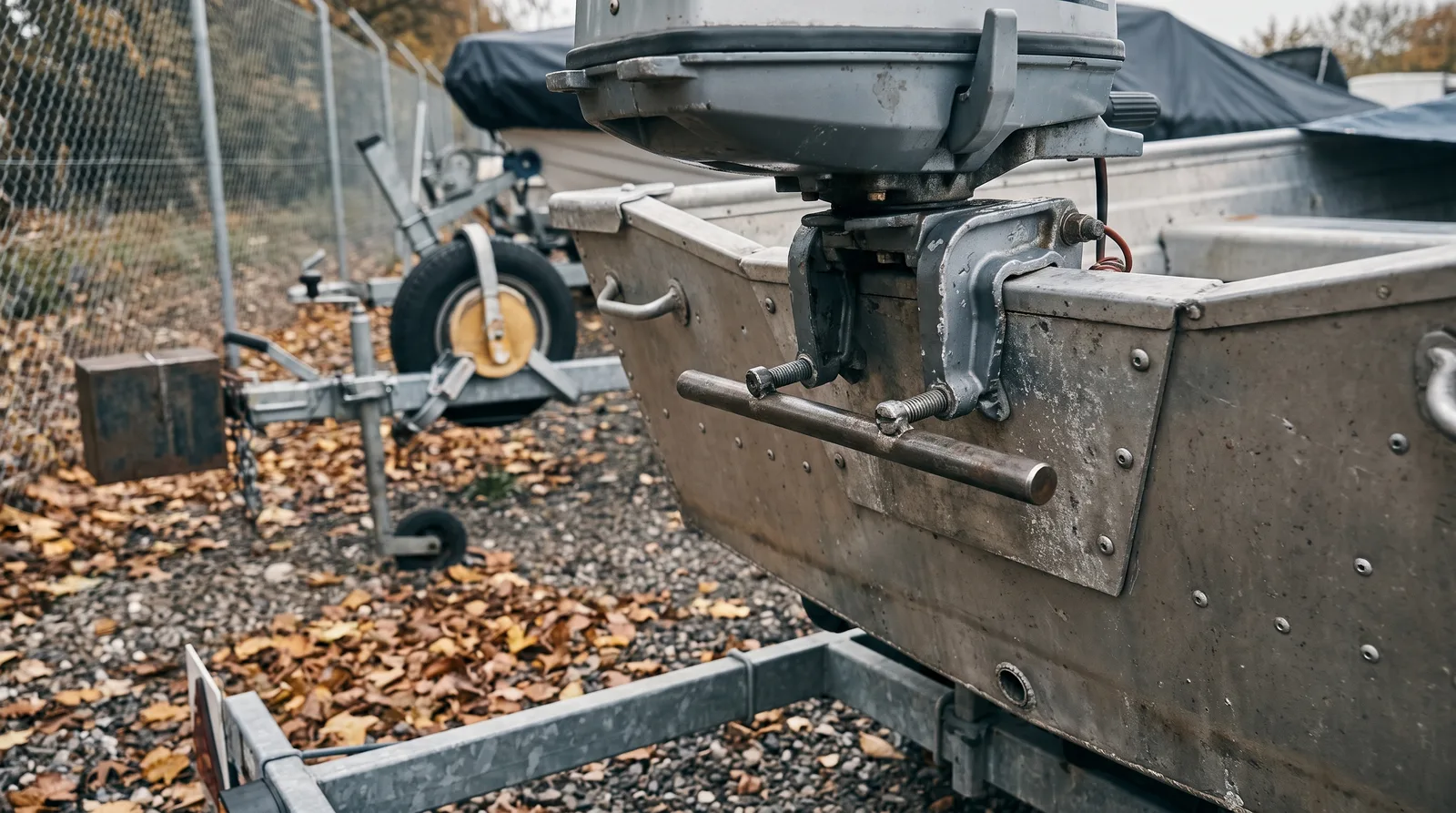
Start with the outboard. Many wordings carry a clause that excludes damage to an outboard motor unless it was secured with a locking bolt or a comparable anti theft device, or kept in a locked building. Read it closely, because some versions refer to any damage to the motor, not only to theft. In practice, a motor held on the transom by its two clamp screws counts as unsecured however tight they are. Check too whether a motor taken off the boat and stored in a locked garage is still covered there, and whether another policy, such as home contents, has to respond first.
The trailer usually has two conditions of its own. While it is coupled to the towing vehicle, some wordings require an extra chain or steel cable with a security lock against unauthorised uncoupling. Parked on its own, it needs a hitch lock against unauthorised coupling or a wheel clamp. A third clause often covers the trailer boat itself: theft of a boat on its trailer is excluded unless the hitch was locked with a box type lock and the boat was chained or locked to the trailer. An owner who locks only the coupling has not secured the boat in the sense of that clause.
Then the place. A common exclusion removes theft and malicious damage by strangers where the boat is stored ashore on ground that is not enclosed and locked, or in a building that is not locked. Look for how the wording defines enclosed: some treat a waterside plot as enclosed if only the water side is open. An open field behind the club house does not meet that test, nor does a barn with the door left open. Loose items are the other trap. Electronics, cushions and fuel tanks that are not packed, covered and lashed down, or that lie in an unlocked boat, are frequently excluded from theft altogether.
The deductible can move with the storage as well. Some wordings waive the deductible on theft entirely; others apply it on theft unless the owner can prove the boat was kept in a locked room or building or on enclosed land, which turns the storage place into money rather than into a yes or no. Look also at how gross negligence is treated. A wording may limit reductions for gross negligence up to a share of the sum insured and then except theft from that limit, so a boat left unlocked may be judged more strictly than a grounding.
After a theft, the claim rests on evidence. Many wordings make it a duty to report theft, burglary and vandalism to the nearest police station without delay, and in a harbour to the harbour office as well. The security has to be shown, too: the cut shackle, the box lock with its key, the invoice for the locking bolt, photographs of the storage place with its fence and gate. A lock that nobody can produce afterwards does little for a survey report, which is why those photographs belong to laying up as much as draining the engine.
Worth checking
Common questions
Are tight clamp screws enough to secure an outboard?
Usually not. Wordings with an outboard clause ask for a locking bolt or a comparable anti theft device, or for the motor to be kept in a locked building. Clamp screws alone rarely meet that.
My boat is laid up on club ground without a fence. Does that matter for a theft claim?
It can matter a great deal. Many wordings exclude theft ashore where the ground is not enclosed and locked. Read the storage clause and ask the club about a locked compound before the boat goes in.
Who do I tell first after a theft?
The police, without delay, and in a harbour the harbour office too. Then the insurer, with the police report number and photographs showing how the boat, trailer and motor were secured.
Related