Business liability
Covers bee stings affecting third parties, pollination disputes with farmers, product liability for honey, and incidents at market stalls or farm shops.
Insurance broker / Business types / Farming and nature
A sting that sends a neighbour to hospital, a hive that topples off the trailer on the way to the rapeseed bloom, a jar of honey that gets complained about: beekeeping carries risks that many only notice once they happen. This page shows what professional and part-time beekeepers in Germany should insure and what it costs.
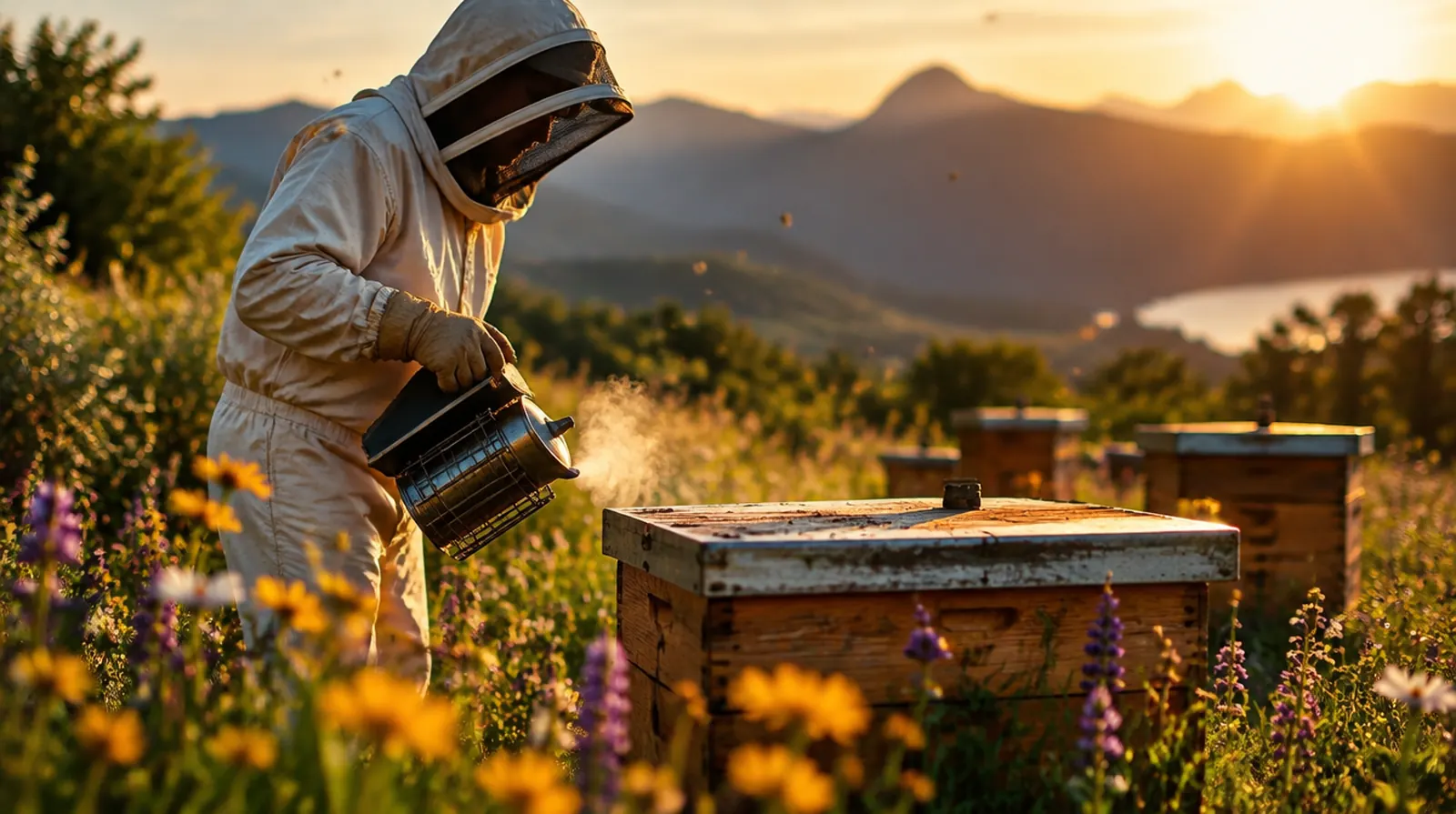
The question almost everyone asks first
No. Bee diseases such as American foulbrood are not covered by general liability or a standard contents policy, the risk is practically uninsurable on the open market. If the authorities order a quarantine and destruction of colonies, Germany's state-run animal disease fund (Tierseuchenkasse) steps in instead, funded by compulsory contributions from registered beekeepers. Theft, storm and vandalism at the apiary can be covered separately through a contents policy.
A passer-by or neighbour has an allergic reaction to a sting and needs emergency treatment, the cost falls on the beekeeper.
A farmer blames the beekeeper for a poor harvest, claiming colonies arrived too late or in too small a number.
A customer complains about contaminated or mislabelled honey, a product liability claim can quickly exceed a year's turnover.
Hives fall off the trailer while moving to the rapeseed or lime bloom, damaging the vehicle and the load.
Beehives often stand in remote spots and get stolen or deliberately knocked over.
A notifiable bee disease or a pesticide accident nearby can wipe out whole colonies, and general liability does not step in for that.
Compared with other trades, 1 low to 5 high.
Essential
Covers bee stings affecting third parties, pollination disputes with farmers, product liability for honey, and incidents at market stalls or farm shops.
Strongly advised
Covers extractors, equipment, hives at the apiary and stored honey against fire, storm, theft and vandalism.
For the vans and trailers used to move colonies for mobile beekeeping; liability cover is compulsory on public roads.
Depends on the business
For professional beekeepers with larger revenue losses when a whole season falls away after damage to the apiary or extraction room.
For fixed bee houses and permanent stands, as an add-on to contents cover against flooding and heavy rain.
For beekeeping businesses running their own online shop for honey and supplies, against data loss and order fraud.
Beekeepers mainly pay for general liability, tiered by colony count, turnover and whether mobile beekeeping is involved. Many members of German beekeeping associations already have basic cover through their membership, which is usually not enough for professional beekeepers with their own sales.
| Insurance | Example | Typical range |
|---|---|---|
| Business liability | Part-time business with up to 25 colonies and farm-gate sales | around €100 to €200 a year |
| Business liability | Professional beekeeping business with about 100 colonies, turnover up to €50,000, €3 million cover | around €130 to €600 a year |
| Business contents | Extractor, equipment and store worth €20,000 | around €150 to €400 a year |
| Car insurance | Transport vehicle for mobile beekeeping, liability and partial cover | around €400 to €900 a year |
| Business interruption | Twelve months of lost income for professional beekeepers | around €300 to €900 a year |
For comparison: General liability for a small beekeeping business costs about as much a year as 15 to 20 jars of honey sold at the farm gate.
Indicative figures excluding insurance tax, as of September 2026, based on publicly stated sample offers. Beekeeping association membership in Germany often includes a group cover that is cheaper but narrower than a dedicated business liability policy. Foulbrood and other notifiable diseases are not covered by these premiums, that is the job of the state animal disease fund. We obtain the exact quote for you.
01
For: Hobby and part-time beekeepers with farm-gate sales
Together around €250 to €600 a year
Request this package02
For: Professional beekeepers with their own sales and pollination contracts
Together around €1,000 to €2,500 a year
Request this package03
For: Businesses that move colonies frequently for pollination work
Together around €700 to €1,700 a year
Request this packageSix things that really happen to beekeepers, put together into one day. Tap through and see who pays.
Loading up for the rapeseed bloom, a hive slips off the trailer, damaging the van.
A walker gets stung repeatedly near the mobile apiary and has an allergic reaction, needing emergency treatment.
A farmer blames the beekeeper for a weak apple harvest, claiming the colonies were set up too late.
A customer falls ill after a jar of honey and reports a product defect.
Unknown intruders knock over three hives at an exposed teaching apiary overnight, destroying hives and tools.
A short circuit in the extraction room floods the store and equipment.
Which package would you have had?
Illustrative amounts before any excess. Whether and how much is paid depends on the policy terms.
Claims from farmers over supposedly missed or poor pollination are the gap beekeeping businesses underestimate most. As a broker we compare which insurers cover this properly.
Anyone selling honey carries the same liability as any food business. We make sure that cover is actually written into the policy.
We look after your apiary, your transport vehicles and your personal cover from a single point of contact.
Many beekeeping businesses run as a side occupation, and so do we. Free of charge for you, the insurer pays our fee.
Questions and answers
For a small part-time business with farm-gate sales, €100 to €200 a year is a realistic range, professional beekeeping businesses with more colonies and turnover can reach up to €600.
No. Foulbrood and other notifiable bee diseases are not covered by general liability or contents insurance, the state animal disease fund handles this, funded by compulsory beekeeper contributions.
Membership in a German state beekeeping association usually includes basic group cover. For professional beekeepers with their own sales, pollination contracts or higher turnover, that is often not enough and a dedicated liability policy makes sense.
Transporting colonies is a motor risk covered by your vehicle insurance, damage to hives and equipment while moving them should be clarified separately in your contents policy.
The SVLFG, Germany's agricultural social insurance body. Beekeepers above a certain colony count fall under its compulsory insurance.
Only if it is explicitly named in your general liability policy. For risks like data loss or fraud during checkout, you also need a separate cyber insurance policy.
NAMMERT insurance broker
The recommended covers are already ticked. Change what does not fit; we obtain quotes and come back with a comparison. You can write in English.
Thank you, we have your request.
We will be in touch within one working day. If it is urgent: +49 3375 29 12 77.

Is hail or multi peril crop insurance worth it for my farm?

Are my plants covered if the heating fails in winter?
The animal disease fund pays anyway, so why do I need insurance?
Boat or yacht? Here we are not the broker but the underwriting agency, with our own policies and our own claims handling.
Boat insuranceNAMMERT Assekuradeur GmbH, insurance broker licensed under section 34d(1) of the German Trade Regulation Act, broker register no. D-C08Q-TOSD4-37. For boat and yacht insurance we act as underwriting agency, not as broker. Statutory disclosure (German) · Updated