All about this insurance: Car insurance
Can I use my no-claims bonus from abroad in Germany?
Insurance broker / Insurance questions / Car insurance
In short
In Germany damage to your own car after hitting a deer, stag, wild boar or fox is paid by partial cover (Teilkasko), minus your deductible and without affecting your no-claims class. The average wildlife collision cost about EUR 4,100 in 2024. With liability only, you pay yourself. You need a wildlife accident certificate from the police or the local hunter.
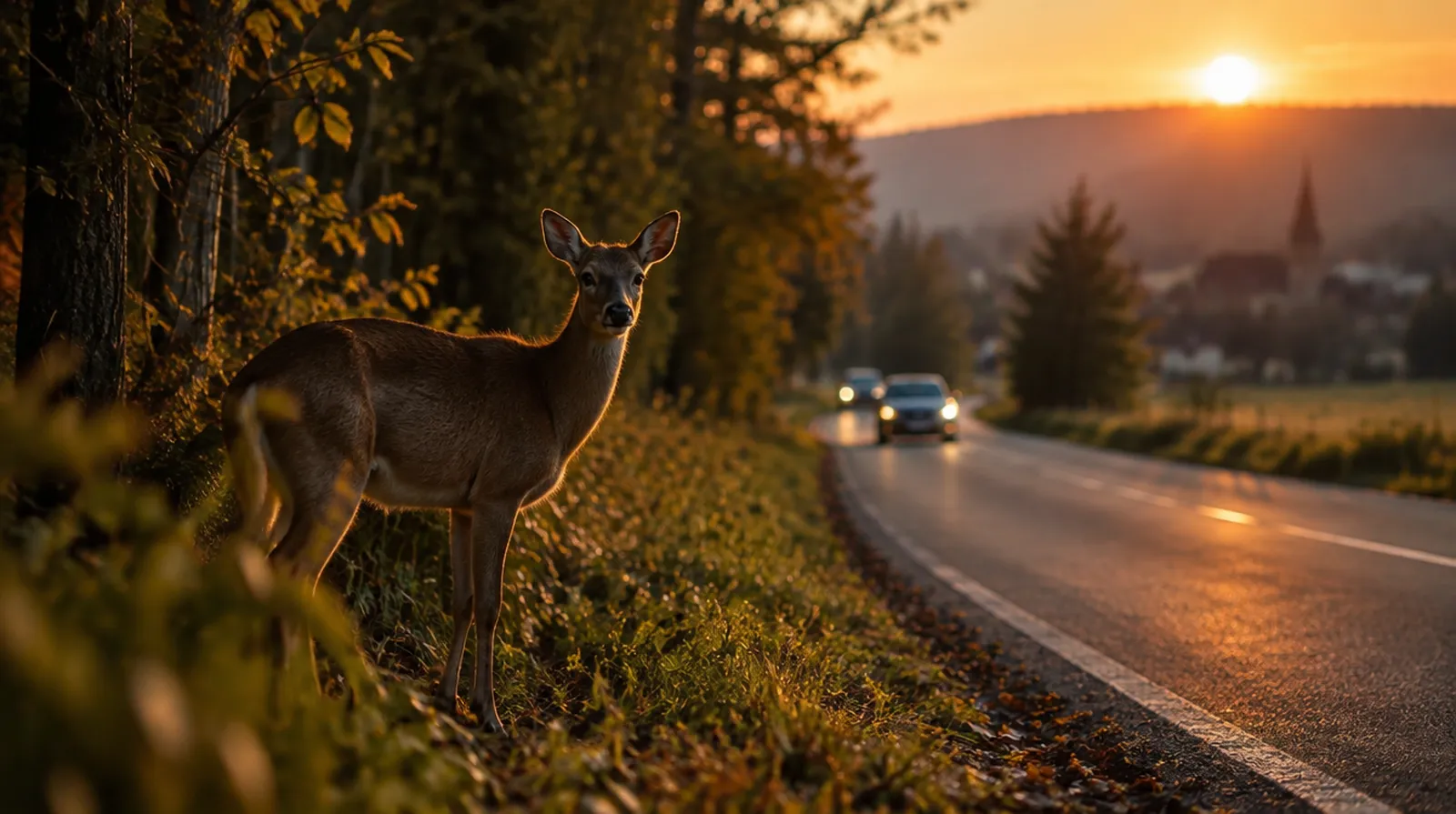
Published figures for wildlife collisions involving insured cars in Germany.
| Example | Typical range |
|---|---|
| Average wildlife collision, 2024 | about EUR 4,100 |
| Average wildlife collision, 2023 | about EUR 3,850 |
| Estimated average, 2025 | about EUR 4,350 |
| Share of claims above EUR 5,000 | about 1 in 5 |
| Reported wildlife collisions with insured cars, 2024 | over 276,000 |
Figures from published industry statistics as of September 2026. The amounts in the worked example are guide values from our quoting practice. Whether your policy covers animals of all kinds is something we can check for you.
Worked example
Damage to bumper, headlight and radiator. This is how the bill is split.
| Repair at the garage | about EUR 4,000 |
| Your deductible in partial cover | EUR 150 |
| Paid by the insurer | about EUR 3,850 |
| Effect on your no-claims class | none |
You pay EUR 150. Without partial or comprehensive cover you would have paid the full EUR 4,000 or so yourself.
Partial cover pays for repairs after a collision with furred game (Haarwild), meaning wild mammals that fall under German hunting law. Many policies go further and cover animals of all kinds (Tiere aller Art), which adds cows, horses, dogs and birds.
Without that extension, partial cover does not pay for farm animals or pets. Only comprehensive cover steps in, and then you lose no-claims years. The animal's owner can also be liable, for example a farmer whose cow escaped.
| Animal | Basic partial cover | Partial cover with all animals | Comprehensive cover |
|---|---|---|---|
| Deer, stag, wild boar | yes | yes | yes |
| Fox, hare, badger | yes | yes | yes |
| Cow, horse, sheep | no | yes | yes, you lose no-claims years |
| Dog, cat | no | yes | yes, you lose no-claims years |
| Birds | no | yes | yes, you lose no-claims years |
If you swerve to avoid a deer and end up in a ditch without touching it, partial cover only pays if you can show the manoeuvre was meant to prevent greater damage. German law calls these rescue costs.
With large animals this often works, with small ones hardly ever. Courts have repeatedly found that swerving for a hare or fox was out of proportion. Then only comprehensive cover pays. The safer rule: brake hard, hold your lane, use the horn.
Hazard lights on, high-visibility vest on, warning triangle out. Call the police on 110 even if the animal ran away. They inform the hunter and issue the certificate your insurer will ask for.
Do not touch the animal and never take it with you, that can count as poaching. Photograph the car, the animal and the spot. Hair or blood on the car is good evidence, leave it until the damage has been inspected.
If you were driving far too fast or had been drinking, the insurer can reduce its payment for gross negligence unless your policy waives that defence. Reporting very late can also cause problems.
Injured people or damage to other cars, for example if your car is pushed into oncoming traffic, are paid by your liability insurance. That claim can cost you no-claims years there.
If you drive almost only in the city, basic furred game cover is usually enough. The extension to all animals often costs little and is worth it mainly for commuters on country roads through forests and pastures.
For an old car with a very low value, the insurer will never pay more than its replacement value anyway. Paying yourself can then be cheaper than the premium over the years.
Questions and answers
No, as long as partial cover pays. If only comprehensive cover pays, for example for a dog without the all-animals extension, you are downgraded.
Not for your own car. It only pays if others are harmed, such as another car.
Call the police anyway. Hair, blood and photos of the car help prove the collision.
From the police usually nothing. If the hunter issues it, a small fee is possible.
Only if swerving was meant to prevent greater damage. Often yes for large animals, usually not for a hare or fox.
At dawn and dusk, especially in April and May and from October to December.
NAMMERT insurance broker
We compare several insurers and come back with a proposal. Free for you; the insurer pays our fee. You can write in English.
Thank you, we have your request.
We will be in touch within one working day. If it is urgent: +49 3375 29 12 77.
All about this insurance: Car insurance
Can I use my no-claims bonus from abroad in Germany?
What is the difference between Teilkasko and Vollkasko?
Teilkasko (partial cover) pays for damage you did not cause yourself: theft, storm, hail, fire, broken glass and colli …
What should I do after a car accident in Germany?
Hazard lights on, put on the high visibility vest, set up the warning triangle, help anyone injured and call 112 if so …
When is comprehensive car insurance worth it in Germany?
Comprehensive cover (Vollkasko) is usually worth it for new, financed, leased and expensive cars, roughly in their fir …
NAMMERT Assekuradeur GmbH, insurance broker licensed under section 34d(1) of the German Trade Regulation Act, broker register no. D-C08Q-TOSD4-37. For boat and yacht insurance we act as underwriting agency, not as broker. Statutory disclosure (German) · Updated
Was this useful?