All about this insurance: Private pension
Should I take out a German private pension if I might leave Germany?
Insurance broker / Insurance questions / Private pension
In short
The surrender value (Rückkaufswert) is the reserve your contract has built up, minus an agreed cancellation charge. In the first years it is below your premiums, because acquisition and sales costs are taken first. German law requires these costs to be spread over at least five years for this calculation, which protects you from losing almost everything early on.
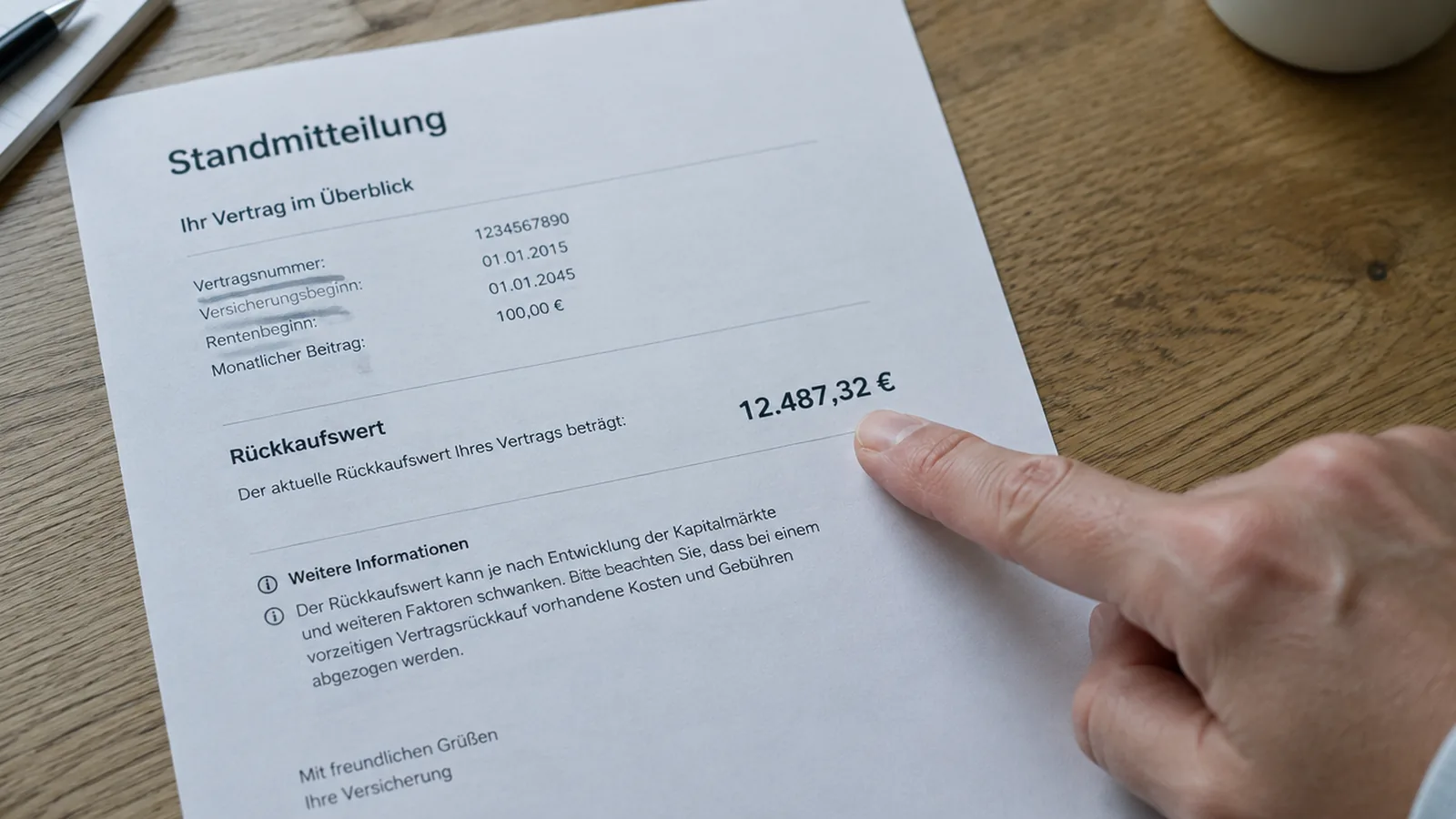
Figures from German law, regulation and published market data, September 2026.
| Example | Typical range |
|---|---|
| Acquisition and sales costs, legal cap | at most 25 per mille, meaning 2.5 percent of total premiums |
| Minimum surrender value, spreading of these costs | evenly over the first 5 contract years |
| Guaranteed interest for new contracts since 2025 | 1.0 percent |
| Current interest, market average 2026 | 2.6 percent, range 1.95 to 3.6 percent |
| Cancellation charge in newer contracts | usually 0 to 3 percent of the reserve |
| Example contract after 2 years, 2,400 euros paid in | about 1,930 euros surrender value |
The 2.5 percent cap, the five year spread and the interest figures come from law, regulation and published market data. The cancellation charge of 0 to 3 percent and the administration costs in the example are guide values from our quoting practice. Your contract may differ; your insurer gives you the binding figure in writing.
Worked example
How the gap between premiums and payout arises. Calculated with 2.6 percent interest and costs at the legal cap.
| Total premiums (360 × 100 euros) | 36,000 euros |
| Acquisition costs, 2.5 percent of that | 900 euros |
| Spread over five years | 180 euros a year |
| Administration, guide value 5 percent per premium | 60 euros a year |
| Paid in after five years | 6,000 euros |
| Reserve after five years | about 5,120 euros |
| Cancellation charge 2 percent | about 100 euros |
About 5,010 euros are paid out, so almost 1,000 euros short of 6,000. In the same contract the surrender value is about 11,650 euros after 10 years (12,000 paid in) and about 27,800 euros after 20 years (24,000 paid in). Only after about eleven years does it turn positive.
Only part of each premium goes into savings. The rest covers acquisition and sales costs, ongoing administration and, in some contracts, a small amount of death cover.
The savings part earns interest and forms the reserve (Deckungskapital). That is the pot your pension would later be paid from, and it is the basis if you cancel.
Surplus already allocated to you is added. An agreed cancellation charge is deducted. What remains is paid out.
| Component | Effect on the surrender value |
|---|---|
| Reserve | the basis, grows with each premium and with interest |
| Allocated surplus | increases the value, it is yours for good |
| Terminal bonus | on cancellation usually only in part or not at all |
| Acquisition and sales costs | reduce the first years strongly, later hardly |
| Cancellation charge | reduces the payout, often 0 to 3 percent |
| Unpaid premiums and loans | are deducted before money is paid |
Signing a contract creates one off costs for advice and processing. Many insurers take them from the first premiums instead of spreading them over the whole term. This is called Zillmerung.
The amount is capped at 25 per mille of total premiums, meaning 2.5 percent of everything agreed. With 100 euros a month over 30 years that is at most 900 euros.
For the surrender value the insurer must calculate at least as if these costs were spread evenly over five years. The costs are still real, though: cancel after two years in the example below and you get back about 1,930 of 2,400 euros.
A charge on cancellation is allowed under three conditions: agreed in the contract, stated as a figure and reasonable. A clause that only mentions a reasonable charge is not enough.
A charge for acquisition costs not yet repaid is expressly not allowed, because those costs are already in the reserve calculation.
In newer contracts the charge is often between zero and three percent. If your documents show no figure, it is worth asking.
New contracts since 2025 guarantee 1.0 percent again. On top comes surplus participation; the market average for current interest in 2026 is 2.6 percent, ranging from 1.95 to 3.6 percent.
What has been allocated is yours and is part of the surrender value. The terminal bonus is different: it is paid at the end of the term and is usually lost in part or in full if you cancel early. Always ask for two numbers: the surrender value today and the maturity value at the agreed date.
A move abroad changes nothing about how the surrender value is calculated. It does change what cancelling costs you in tax, because your new country may tax the gain as well.
Before you cancel on your way out, compare with making the contract paid up. The contract can usually stay, and the surrender value keeps growing.
Questions and answers
Because acquisition and administration costs have already been used. They are spread over the first five years, then interest slowly closes the gap.
Yes, if it is agreed, stated as a figure and reasonable. A charge for acquisition costs not yet repaid is not allowed.
The guaranteed part and allocated surplus are. Future surplus is not. With unit linked contracts the value follows the funds.
Usually within a few weeks after the cancellation arrives. Ask for a calculation first so you see the number before deciding.
Only on the gain above your premiums. In the early years there is often no gain and no tax.
NAMMERT insurance broker
We compare several insurers and come back with a proposal. Free for you; the insurer pays our fee. You can write in English.
Thank you, we have your request.
We will be in touch within one working day. If it is urgent: +49 3375 29 12 77.
All about this insurance: Private pension
Should I take out a German private pension if I might leave Germany?
Should I cancel my German pension insurance or make it paid up?
Making the contract paid up (beitragsfrei stellen) is usually the calmer choice. The contract stays, your savings keep …
What happens if I cancel my Riester contract?
Cancelling with a payout counts as harmful use (schädliche Verwendung). You repay all allowances and the tax benefits …
Is private pension insurance worth it in Germany?
As your only retirement savings, often not. Costs of about 0.4 to over 1.3 percent a year and a guaranteed interest ra …
NAMMERT Assekuradeur GmbH, insurance broker licensed under section 34d(1) of the German Trade Regulation Act, broker register no. D-C08Q-TOSD4-37. For boat and yacht insurance we act as underwriting agency, not as broker. Statutory disclosure (German) · Updated
Was this useful?