Magazine / Magazine
Collision with a working vessel: what matters while fault is still unclear
After contact with a working vessel it is often one word against another. The official investigation expressly does not decide fault. What counts is your own evidence and doing things in the right order.
27 September 20268 min readNAMMERT Assekuradeur GmbH
On 28 August 2023 a 9.60 metre sailing yacht was heading under sail at five to six knots towards the Nordperd tanker anchorage off Rügen, on Germany's Baltic coast. A one nautical mile exclusion zone surrounded two LNG tankers at anchor there, and a tug was patrolling it as a guard vessel. The tug headed towards the yacht to warn her off, both vessels manoeuvred, and they touched. The yacht suffered minor hull damage and nobody was hurt. Germany's Federal Bureau of Maritime Casualty Investigation (BSU) published its report 472/23 on 29 April 2026 and has now condensed it into Lessons Learned 26.
The most revealing part for owners is the radio exchange straight afterwards. The yacht said the tug should never have rammed her. The tug replied that it had not rammed anyone, the yacht had sailed into it. Two vessels, two versions, and nothing to show the yacht's track, because there was neither AIS data nor radar recording for her. The official report will not settle it either. Under section 9(2) of the German Maritime Safety Investigation Act, the investigation does not serve to establish fault, liability or claims, and the report is not meant to be used in court. That is the normal approach of accident investigation bodies across Europe: they look for causes, not culprits.
So the question of fault does not have to be answered at sea, and it is better not to try. Look at how a typical liability section is worded in German yacht policies: the insurer examines whether the owner is liable, defends unjustified claims and indemnifies justified ones. The same wording usually adds that an admission made without the insurer's consent binds the insurer only to the extent the claim would have existed anyway. Anything beyond that stays with the owner. What the wording does demand is speed. Many contracts require notice of any incident within a week, even before a claim has been made. Check the time limit in the duties section of your own contract.
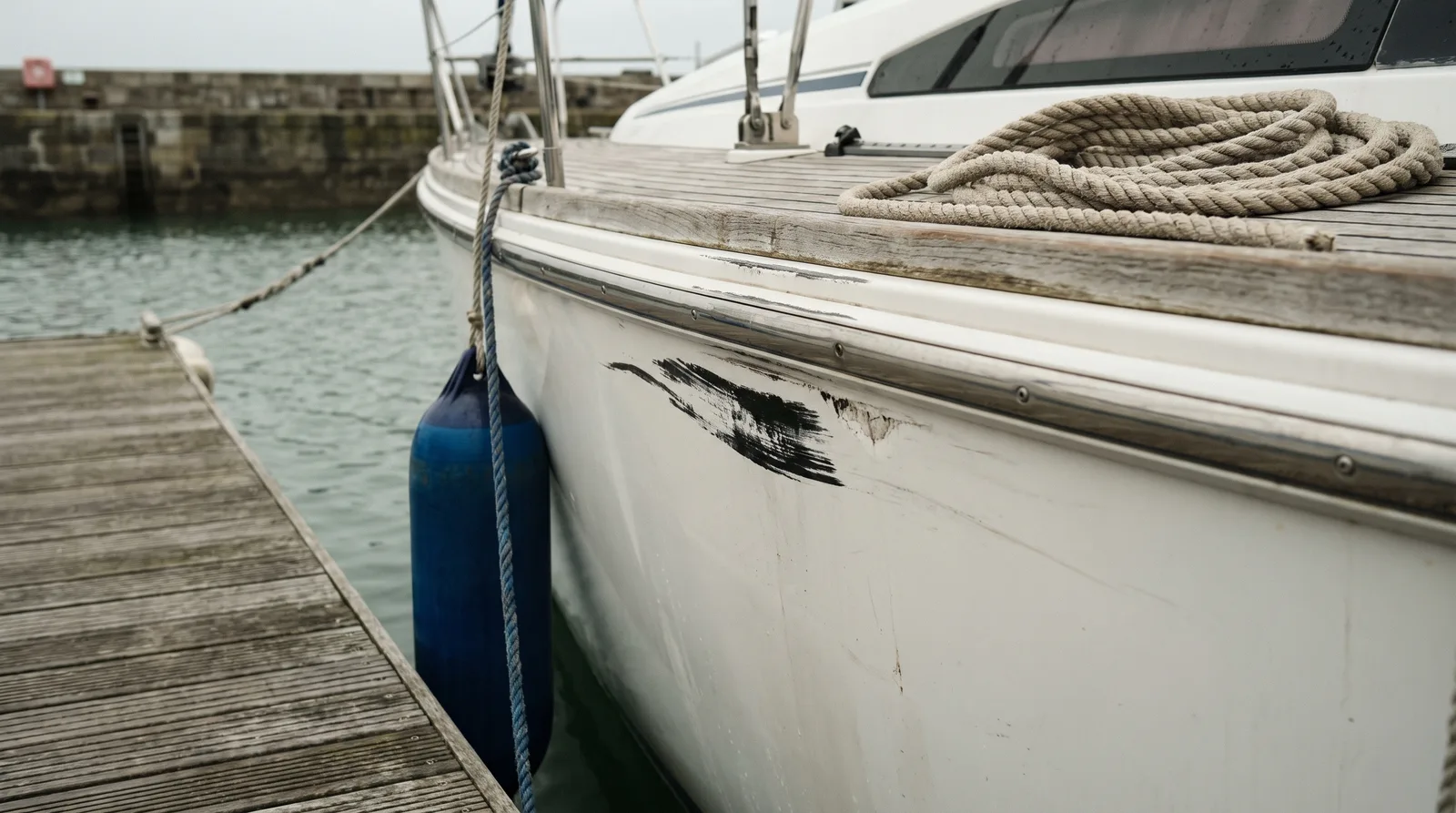
Damage to your own hull is a separate question, and it sits in the hull section of the policy. What to look for is a named event such as collision with fixed or floating objects. Where it is listed, hull cover normally settles your own loss less the deductible without waiting for the fault question, and the insurer then recovers the money from the other party if they caused it. That is why hull wordings usually oblige the owner to hand over every document and piece of information needed for the recovery, and to allow the insurer to survey the damage before repairs start. Having the scrape polished out in the marina the next morning destroys the evidence everyone still needs.
Then there is the dispute itself. Recovering your own uninsured loss from the other side, the deductible for instance, is a matter for legal expenses insurance, where such a policy exists. In the German wordings the relevant clause is usually called damages recovery, and it names an accident with your own boat as a typical case. There is a second point few people think of after a collision: according to the report, entering a closed safety zone is an administrative offence in Germany. Legal expenses cover for administrative offences may pay for a defence against that allegation. No insurance pays the fine itself.
The last question is whether entering the zone puts your cover at risk. Most hull wordings allow the insurer to reduce payment in proportion to gross negligence, and some waive that reduction up to a share of the sum insured. Whether missing a navigational warning counts as gross negligence depends on the facts of each case. Off Rügen the closure had been published in the German Notices to Mariners and entered on the charts, and the Warnemünde vessel traffic service broadcast it every hour, announced on channel 16 and read on channels 9 and 13. The yacht's radio was on channel 16 without dual watch. The broadcast never reached her.
The people most exposed are those on sailing yachts, motor boats and trailer boats without AIS or radar in coastal waters shared with commercial shipping: near anchorages, terminals, offshore construction and cable routes. Exclusion zones there appear at short notice and disappear again. The BSU addresses both sides: guard vessels must not keep closing in when there is no radio answer, and leisure skippers should check restrictions before casting off. From a claims point of view one more lesson belongs here. The skipper who stays calm after contact, admits nothing and writes everything down has not yet won the argument about fault, but has not lost it either.
Worth checking
Common questions
The other skipper says I was to blame. Should I give them my insurance details?
Yes, the name of your insurer and the policy number can be shared. A statement that you were at fault should not be given. Examining liability is the insurer's task under most liability wordings.
Will my hull damage be settled while fault is still open?
Check whether your hull wording names collision as an insured event. Where it does, settlement normally does not depend on fault; the deductible applies, and the insurer can recover its payment from whoever caused the damage.
Can I use the official investigation report against the other party?
Do not rely on it. In Germany the law says the investigation does not establish fault or liability and the report is not meant for court proceedings. Your own log entries, photos and witnesses carry more weight.
Related