Magazine / Magazine
Lifting out: the three minutes when the whole boat is visible
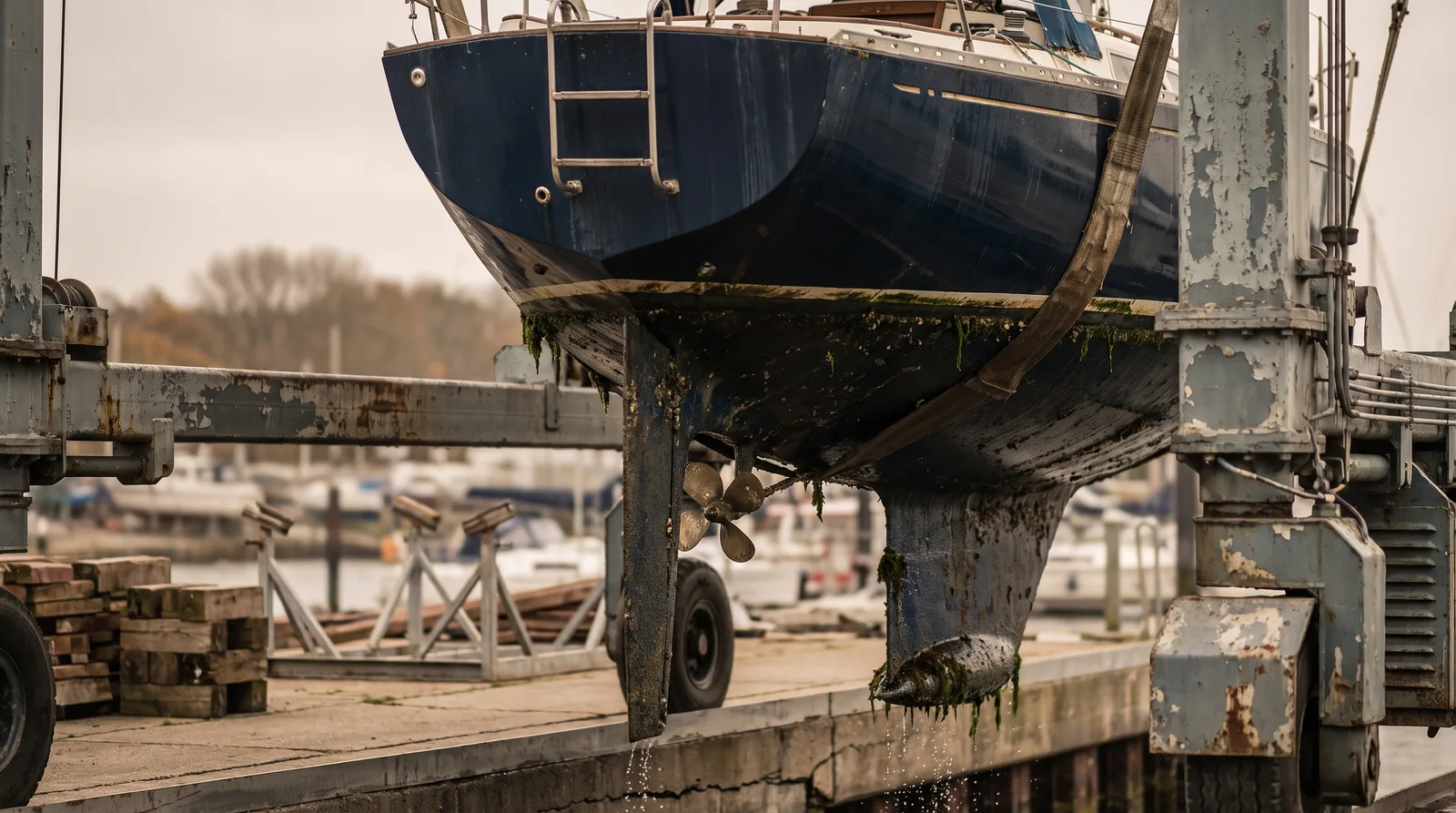
The hour in the slings is the only time the whole hull is visible. What typically goes wrong, which clauses decide it, and why three minutes of photographs settle arguments in spring.
16 September 20268 min readNAMMERT Assekuradeur GmbH
In northern Europe the lifting season runs from late September to early November, and in most yards the routine is the same: book a slot, drop the mast, set the cradle, drive home. The travel lift or the yard crane takes the boat out of the water, the slings come off, and within an hour the owner is gone. That hour is worth more attention than it usually gets, because it is the only time in the year when the whole boat is visible at once. Hull, keel, rudder, shaft, propeller, saildrive gaiter and the seacocks from the outside are all exposed while the water is still running off.
Two very different things happen on lifting day, and owners routinely report them as if they were one. The first is damage caused by the lift itself: a sling creeping, the boat settling crooked on the cradle, a stand tipping, a log transducer housing shearing off. The second is damage from the season just finished that only becomes visible now: a gouge where the keel meets the hull from a grounding in July, a chipped rudder blade, a hairline crack in the gelcoat below the waterline. Both end in a yard invoice, but the way an insurer looks at them is not the same.
For the first kind, the question to put to any hull wording is whether cover continues while the boat is out of the water. Many policies extend to time ashore, hauling out and launching, and to periods of repair, inspection or overhaul, but almost all of them attach a condition to the place: the site has to be one that is objectively suitable for craft of that type. That phrase is where arguments start. A yard crane on a commercial hardstanding is one thing, a borrowed piece of construction plant on a grass bank behind a club house is another, and an owner pulling a trailer boat out with a friend's front loader should ask the question before the lift rather than after it.
For the second kind, the key word in most wordings is notification. Cover for the survey or inspection costs that follow a grounding is commonly limited, and it is commonly tied to the grounding having been reported when it happened. An owner who touches a sandbank in July, carries on because nothing seems wrong, and first sees the mark on the keel in October has three months of silence behind them. Nothing is automatically lost, but the question of cause becomes a photographic reconstruction instead of a two sentence phone call, and on a sailing yacht with keel bolts that is exactly where a survey becomes expensive.
There is a cost item that owners regularly expect to recover and usually cannot: the lift itself. Read the settlement section of your wording rather than the cover section. Crane and haul out charges are typically reimbursed only when they were incurred because of an insured loss. The annual autumn lift is maintenance, and maintenance is not a loss. If the boat has to come out because of a reported incident, the crane charge normally sits with the claim, along with transport to the repair yard, which is often treated the same way as the repair cost itself and counted against the sum insured.
The paperwork on lifting day deserves a minute of attention that it almost never gets. Yards and clubs frequently present a form before the slings go on, limiting or excluding their own liability for the lift. It gets signed standing up, with a fender under one arm. That signature matters later, because hull wordings generally oblige the owner to hand the insurer everything needed to pursue a claim against a third party. An owner who has already signed away that claim has made the insurer's recovery route harder, and a wording that requires cooperation can treat that as a breach of duty. The form is rarely more than one page.
Liability is also frequently misread on this day. If the boat swings in the slings and hits the boat on the next cradle, that is not one claim with an extra line for the neighbour. Hull wordings routinely exclude third party liability claims altogether, which means the damage to the other boat belongs to a liability policy and the damage to your own hull to the hull policy, each with its own notification. On a catamaran or a wide motor yacht lifted with special slings in a tight yard entrance, this is an everyday scenario rather than a textbook one.
One exclusion catches people out every autumn. Wear in ordinary use, and design, manufacturing or material defects, are typically not covered at the part directly affected, while damage that follows on directly from that failure often is. In practice: if a lifting eye that has been corroding for years tears out as the strop is attached, the eye is the owner's problem and the damage the falling boat causes may well not be. That is the argument for looking at the attachment points before the slings go on, and it applies twice over to a classic with original fittings or an older motor boat that has never had them replaced.
The habit worth building is unglamorous and works every year: walk once around the boat while it is still hanging and photograph it. Both sides of the hull, the keel from ahead and astern, rudder, propeller, shaft, seacocks, anodes. Three minutes, no cost, and in a dispute the only record of the condition the boat was in when it came out of the water. An owner who has those pictures does not have to argue in spring about whether the damage happened before or after the winter. An owner who does not have them argues, and in most wordings the burden of proof sits with the owner.
Worth checking
Common questions
Does hull cover continue while the boat is in the slings?
In most wordings yes, because time ashore including hauling out and launching is named explicitly, but nearly all of them require the site to be objectively suitable for craft of that type. Check that phrase.
Can I claim the autumn crane charge?
Usually not. Settlement clauses commonly reimburse crane and haul out costs only where they were incurred because of an insured loss, and the seasonal lift is maintenance rather than a loss.
My boat swung in the slings and hit the boat beside it. How is that handled?
As two separate matters. Hull wordings routinely exclude third party liability claims, so the damage to the other boat goes to a liability policy and your own hull damage to the hull policy.
I have only now noticed a gouge on the keel from a grounding in July. Is it too late?
Notify it as soon as you know. Inspection cover after a grounding is generally limited and tied to notification, and a late report turns a simple question of cause into a reconstruction from photographs.
The yard wants a liability waiver signed before the lift.
Read it first. Hull wordings generally oblige you to hand the insurer what it needs to pursue a third party, and a waiver signed in advance can undercut exactly that route before anything has happened.
Related