Magazine / Magazine
Unstepping the mast: where the rig stands once it leaves the boat
The mast comes down in October and spends six months on trestles. From that moment one word in the wording decides the outcome: attached. What that means for shrouds, spreaders and sails.
24 September 20269 min readNAMMERT Assekuradeur GmbH
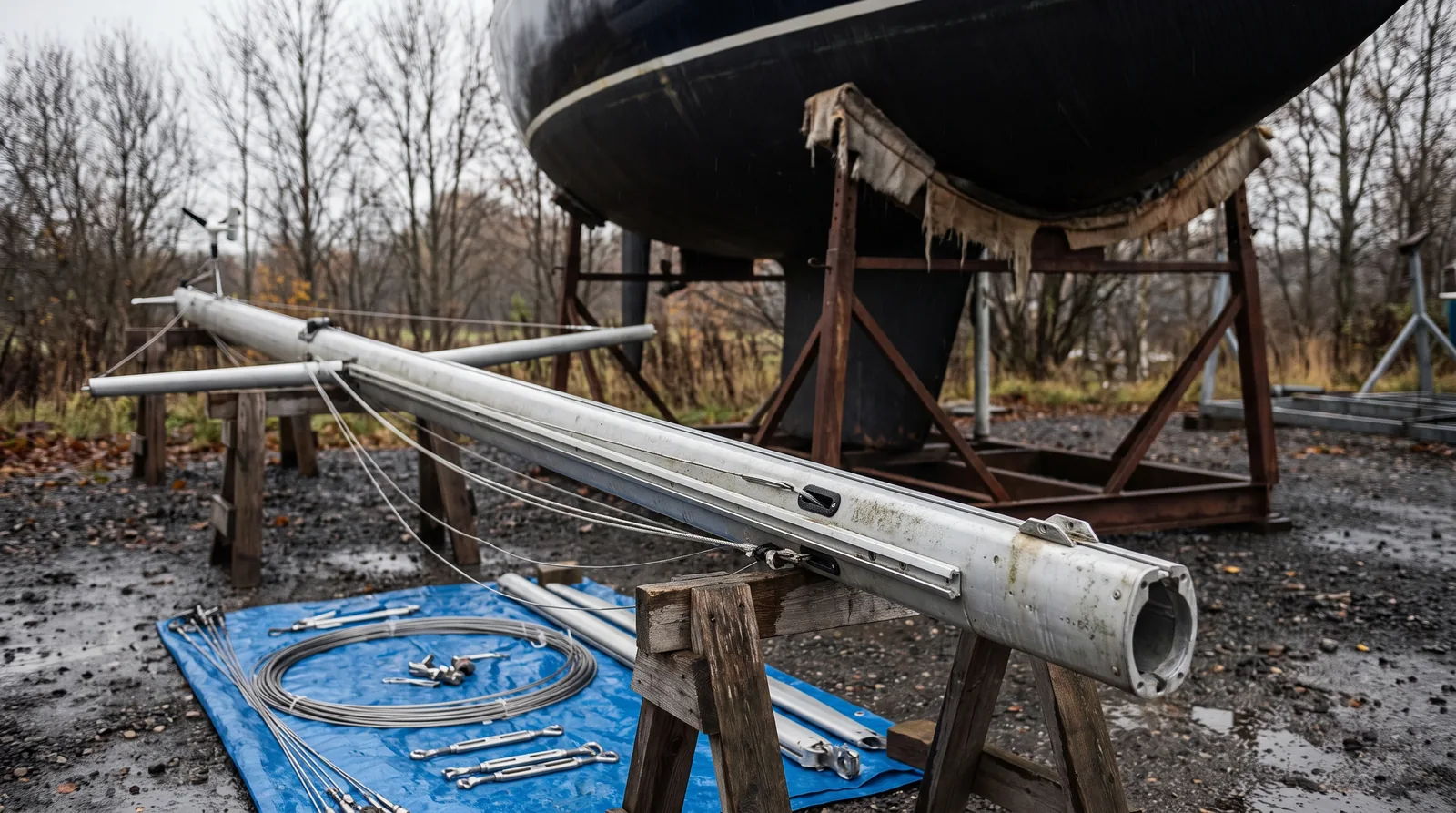
In northern Europe masts come down between the last week of September and the first week of November. On a sailing yacht it is the step before the lift: the standing rigging comes off, the spar goes onto trestles, into a rack against the shed wall or onto the grass behind the fence, and there it stays until April. That is not a footnote for insurance purposes, because several clauses in a hull wording turn on whether a part is attached to the vessel or lying next to it.
Start with the definition of insured property. Better hull wordings for pleasure craft name masts, booms, standing and running rigging and sails explicitly, alongside the vessel itself, the permanently installed parts, the navigational equipment, the accessories and the inventory. Where that sentence exists, the rig is part of the insured object rather than an optional extra, and there is no separate line for it on the schedule. Where the sentence is missing, that is the first question to put to a broker, and it is a question worth asking in writing.
The second question is place. A wording that covers time ashore usually says so in a single sentence that also covers hauling out, launching and periods of repair, inspection or overhaul, and then attaches a condition: the site has to be objectively suitable for craft of that type. Read that condition before the winter and not in March. A commercial hardstanding is one thing, a borrowed rack on a grass bank behind a clubhouse is another, and the difference gets argued after the damage rather than before it.
The third question is the one owners rarely ask: what happens to gear kept away from the boat. Some wordings extend cover to equipment, inventory and outboard motors stored separately from the vessel, and then attach two limits that matter here. The storage has to be in locked rooms or buildings, and other insurance, typically the yard policy or a household contract, takes precedence. A spar on open trestles is neither in a locked room nor in a building, so it is worth asking in advance where a given wording puts it.
Theft is where the abstract becomes concrete. Nearly every hull wording excludes the theft of loose parts that were not properly packed, covered and lashed, or were not inside a locked vessel. Shrouds, turnbuckles and spreaders lying open on a tarpaulin beside the cradle are exactly that case. Many wordings also distinguish between theft of the whole vessel and theft of parts attached to it, and an unstepped mast is no longer attached, which is precisely the distinction such a claim turns on.
Breakage and wear sit in adjacent clauses and are treated very differently. The breaking or bending of masts, spars and booms, of standing and running rigging, and the tearing of sails is commonly listed among accident events. The counterweight is the exclusion for material and manufacturing defects and for wear in ordinary use, which usually bites on the directly affected part while the immediate consequential damage to other insured property stays covered. Translated to a rig: the corroded terminal that lets go is the owner's, and the spar that comes down with it is the consequence. Corrosion and maintenance backlogs normally have exclusions of their own a few letters further down.
Weather over the winter is not an event. Most wordings exclude damage caused by weather influences such as rain, snow, ice, heat, frost and sunlight, and then read the exclusion back only for storm, which is typically defined as wind of at least Beaufort force 8. For a spar on trestles that means the brittle plastic of the furling gear and ice in the luff groove are maintenance, while a rack blown over in a named gale is a different conversation and a different clause.
Money is decided by two lines in the schedule rather than by the loss itself. Some wordings settle repairable damage at reinstatement cost with no deduction for age, others apply a published scale of deductions that rises with the age of the part, and others settle on market value throughout. On a twenty year old rig the gap between those routes is roughly half the invoice, and a full re rig on a ten metre sailing yacht is not a small invoice. Find out which route applies while the spar is still in the air.
Finally the duties, which are where cover is lost without any bad luck at all. Almost every wording requires immediate written notification of a loss, a police report for theft, an opportunity for the insurer to inspect before repairs begin, and consent before damaged property is sold or scrapped. An owner who has the bent section taken away by a scrap dealer in February has removed the evidence on which the payment would have rested, and no amount of photographs taken afterwards replaces it.
Worth checking
Common questions
Does a hull wording normally include the mast and rigging?
Better wordings name masts, booms, standing and running rigging and sails explicitly as insured property, so no separate line on the schedule is needed. Where the sentence is absent, ask the broker before the season ends.
Are shrouds and turnbuckles in winter storage protected against theft?
Usually only if they were properly packed, covered and lashed, or kept inside a locked vessel. Left open on a tarpaulin they are loose parts, and loose parts are the classic exclusion in this area.
Will a claim pay for a whole new rig when one old wire fails?
Rarely for the wire itself, because wear in ordinary use is excluded on the directly affected part. The immediate consequential damage to other insured property, for example the spar, is commonly still covered.
Is the spar covered while the yard is unstepping it?
Wordings that cover time ashore usually name repair, inspection and overhaul as well, subject to the site being objectively suitable. If the yard caused the damage, the claim against the yard has to be preserved too.
Does a winter gale over the mast rack count as storm damage?
Storm is normally defined as wind of at least Beaufort force 8, so the wind strength on the day matters. Weather influences without storm, such as frost, ice, snow and sunlight, are the excluded group.
Related