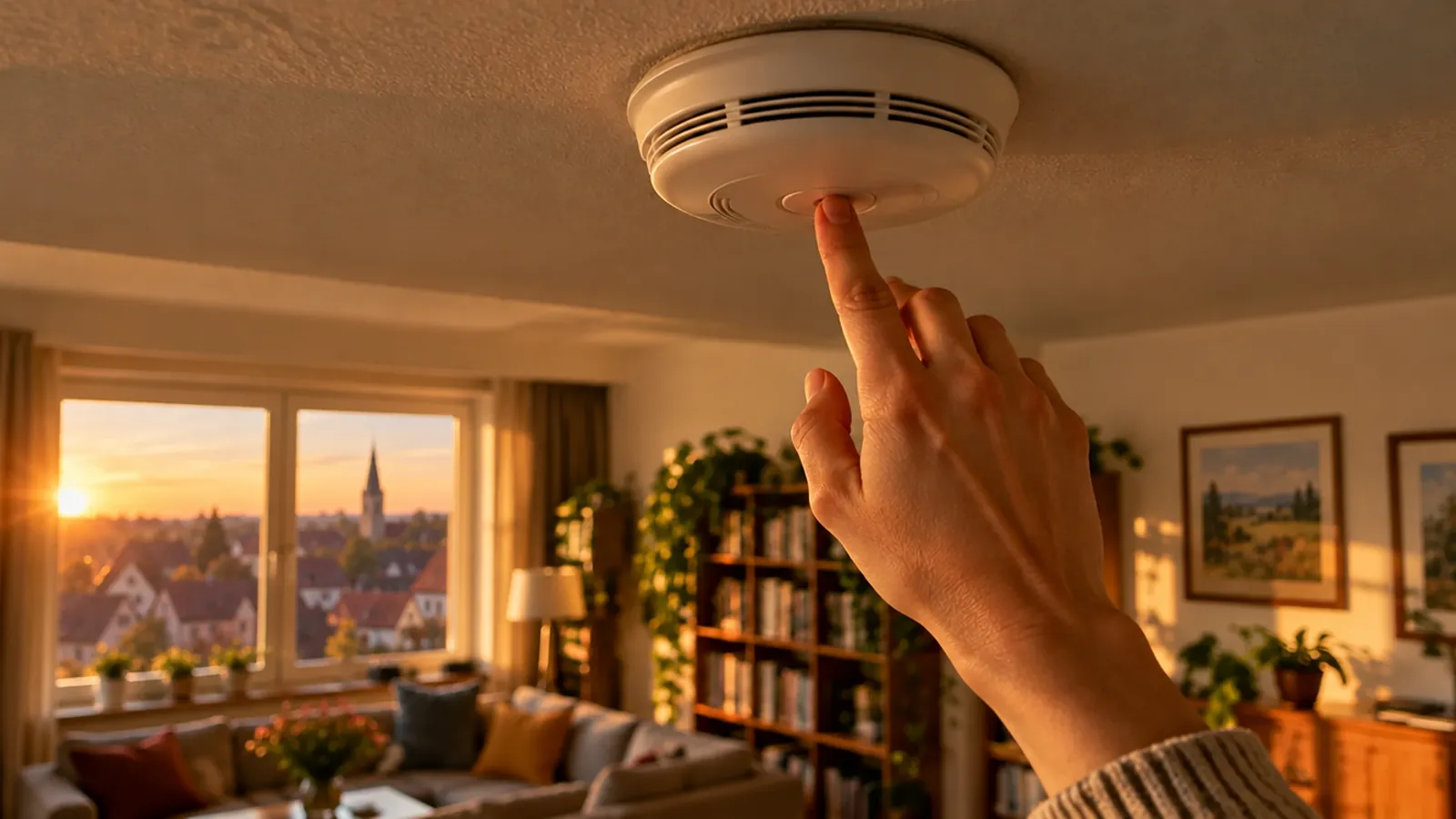
Usually yes. In Germany, insurance does pay for fire damage even if there was no smoke alarm (Rauchmelder) in your flat. Alarms wake people up, they do not stop a fire. Your insurer may only reduce the payment if your policy expressly requires alarms and a working one would provably have kept the damage smaller. One alarm costs about EUR 13 to 30.
Publicly quoted prices for smoke alarms and limits for damage after a false alarm.
Example
Typical range
Smoke alarm with 10-year battery and Q mark
about EUR 13 to 30 each
Pack of three on offer
around EUR 25
Damage from emergency entry after a false alarm, mid-level policy
up to EUR 5,000 per case
Damage from emergency entry after a false alarm, top-level policy
up to EUR 30,000 per case
Fee a town charged after a home smoke alarm false alarm
around EUR 2,523, overturned in court
As of October 2026, from retail prices, policy descriptions and a court report.
The number of alarms in the example is a guide value from our quoting practice.
We will check whether your policy contains a smoke alarm clause.
Worked example
Three rooms, 80 square metres, kitchen fire
The tenant is at work when a kettle catches fire. There was no alarm in the hallway because the landlord had not replaced it.
Damage to furniture and appliances
about EUR 15,000
Smoke alarms required by the policy
no
Would an alarm have changed anything?
no, nobody was home
Payment from contents insurance
full replacement value minus deductible
Fitting four alarms afterwards
about EUR 52 to 120
The insurer pays in full. The missing alarm does not matter, because nobody could have stepped in. Calculation with guide values.
Why a missing alarm rarely matters to the insurer
A smoke alarm beeps when smoke enters its chamber. It does not put out a fire and it does not prevent one. Its job is to wake sleeping people so they get out in time. That is why most German insurers do not treat a missing alarm as a reason to pay less for damaged property.
The building codes of the German states require alarms to protect people. That does not automatically create a duty towards your insurer. What counts is the wording of your own policy conditions (Versicherungsbedingungen).
When the insurer can cut the payment
Some policies make it a duty to follow all legal safety rules, or to fit smoke alarms specifically. Lawyers call this an Obliegenheit. If you breach such a duty through gross negligence, section 28 of the Insurance Contract Act (VVG) lets the insurer reduce the payment in line with how serious your fault was.
The insurer must also show that the missing alarm affected the damage. That rarely works. It might, for example, if you were asleep at home, an alarm would have woken you early and you could have smothered the fire with a blanket. If nobody was home, an alarm would not have changed anything.
Situation
Effect on the property claim
Policy says nothing about smoke alarms
full payment, the missing alarm does not count
Policy requires alarms, nobody was home
usually full payment, an alarm would not have helped
Policy requires alarms, you were asleep in the flat
a cut is possible if an early alarm would have reduced the damage
You rent and the landlord must fit the alarms
someone else's duty usually cannot be held against you
Tenant or owner: who is responsible
In most German states the owner has to fit the alarms. Tenants are often responsible for checking that they work, for example by pressing the test button and telling the landlord when one fails. The rules differ from state to state.
For your contents insurance (Hausratversicherung) this means: if, as a tenant, an alarm is missing that your landlord should have fitted, that is usually not your breach of duty.
False alarms and a forced door
When an alarm beeps in an empty flat, neighbours often call the fire brigade, which may force the door. Some contents policies pay for damage from such an emergency entry after a false alarm, depending on the level up to EUR 5,000 or up to EUR 30,000. Basic policies often do not.
Whether the town may charge you for the call-out is a matter of state law. In Saxony, the Higher Administrative Court in Bautzen ruled on 20 May 2026 that such fees for home smoke alarms were not allowed (case 5 C 5/25).
When you do not need to worry
If your conditions say nothing about smoke alarms, there is no insurance risk. The alarms are still worth having: for sleeping people the smoke is the bigger danger, because it does not wake them.
Check your conditions if you have an older policy or let out a multi-family building. General clauses about safety rules are more common there.
Step by step
Search your conditions for the words Rauchmelder, Rauchwarnmelder and Sicherheitsvorschriften.
Find out who must fit and check the alarms under your state law and tenancy agreement.
Report missing alarms or fit them yourself, with a Q mark and a 10-year battery.
Press the test button once a year and write down the date.
After a fire, state honestly whether alarms were fitted and working.
Checklist
Alarms in bedroom, children's room and hallway
Devices to DIN EN 14604, ideally with a Q mark
Conditions checked for a smoke alarm clause
Yearly test recorded with the date
Emergency entry after a false alarm included if you travel a lot
Common mistakes
Taking the alarm down because it goes off while cooking and never putting it back
Telling the insurer alarms were fitted when they were not
Assuming there is no cover without an alarm and not reporting the claim at all
Buying cheap devices without a test mark that keep going off
Questions and answers
Frequently asked
Can the insurer refuse to pay at all because there was no smoke alarm?
A full refusal is only possible for intent.
With gross negligence a reduction is the most that can happen,
and only if the policy requires alarms and the missing one made the damage worse.
Does the same apply to building insurance?
Yes, the same principle applies to Wohngebäudeversicherung.
Landlords should look out for general clauses on safety rules in their policy.
What if the alarm was there but the battery was flat?
Insurers treat that like a missing alarm.
Without a clause in the policy it has no effect on the property claim.
Who will pay if a smoke alarm causes a false alarm?
The cost of the fire brigade call-out is governed by state law,
and towns often bear it the first time.
Damage to the door from an emergency entry is covered by some contents policies.
As a tenant, do I have to buy smoke alarms myself?
In most states the owner fits them.
You should check that they work and report failures straight away.
Does a missing alarm matter if someone is injured?
The owner may be liable for injuries if they ignored the legal duty.
That is a question for liability insurance, not contents insurance.