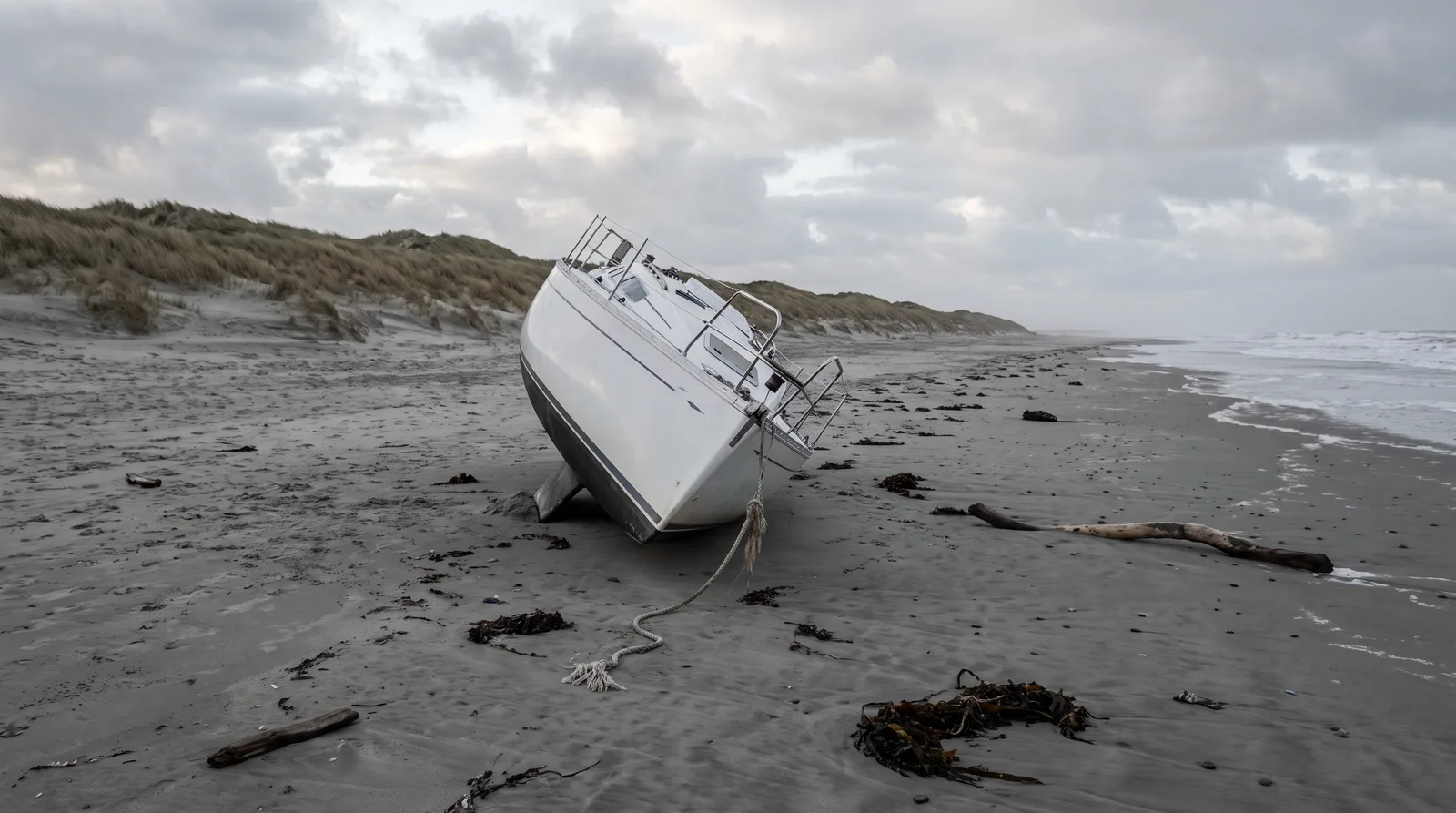
Boat on the beach after a storm: what hull cover pays and what not
The mooring line has parted, the anchor dragged, and in the morning the yacht lies heeled over in the sand. Three questions follow, and one of them was settled before the wind arrived.
11 October 20268 min readNAMMERT Assekuradeur GmbH
Every autumn storm leaves this picture somewhere: a sailing yacht or a motor cruiser lying on its side in the sand, a broken mooring line hanging from the bow, the surf already pulling back. Sometimes the boat dragged its anchor, sometimes a mooring buoy gave way or a line chafed through in the harbour. On the morning after, the owner has three questions. Is the damage to the boat covered, who gets the boat off the beach and pays for it, and what about anything it hit on the way.
The first question is decided by the type of hull wording. Wordings that insure accidents usually name stranding, grounding, capsizing and collision outright, and list storm as a separate peril. Under such a wording it hardly matters whether the line chafed through in a force 7 or parted in a force 10. Named perils wordings are different: they cover storm, fire, explosion and theft of the whole boat, but not an accident as such. There, a stranding is only covered if a storm caused it, and some wordings define storm precisely, for instance as at least force 8 on the Beaufort scale. Wind readings from the nearest weather station then become the most important evidence.
The second point is settled before the wind arrives. Many hull wordings exclude loss when a boat lies unattended off an open coast, at anchor in a bay or on a buoy off the beach, for longer than a set time without anyone able to move it when danger threatens. Wordings seen in Germany use 24 or 48 hours, and some drop the clause altogether. An owner who leaves the yacht at anchor off an island and takes the ferry home needs someone who will come when the warning comes, and a written record of that arrangement.
Getting the boat off the beach is often the most expensive part. An excavator, a tug at the next high tide, a low loader to the yard: most wordings treat these as costs of averting or reducing the loss, often called sue and labour, and pay them even when the first attempt fails, sometimes on top of the sum insured. The condition is that the damage itself is covered and the measure was reasonable. Many wordings add a separate limit for salvage, wreck removal and disposal, often triggered only when an authority orders it. A written order from a harbour authority or coastguard is therefore a document to keep and pass on.
Once the boat is in the sand, time works against the owner. Rain running through a cracked coachroof and sand washed into the cabin by the next tide are weather damage, and most hull wordings exclude weather unless it follows from an insured storm. Leave the boat open for days and the insurer will ask what came from the storm and what from the waiting. A tarpaulin, closed hatches and a timed photograph are cheaper than that argument.
The third question concerns everyone else. If the drifting boat damaged a pontoon, a groyne or another yacht, that is not a hull claim; hull wordings regularly exclude claims by third parties. It belongs to the liability cover. A liability insurer typically examines first whether the owner is liable at all, defends unfounded claims and pays justified ones. After a storm this matters: an owner who had moored properly and was caught by a severe gale is not automatically liable, and then the defence is the real benefit.
In the first hours, the usual duties apply: report the loss without delay, do what is reasonable to limit it and follow the insurer's instructions, allow a survey before repairs start, and do not sell the damaged boat before the claim is accepted. That holds for a cruising yacht on the North Sea coast, a motor cruiser in a Baltic lagoon or a catamaran off Mallorca alike. Photographs at low water, the wind data for the night and every invoice from the excavator to the tarpaulin, and the file is complete.
Worth checking
Common questions
Is a boat that a storm has driven onto the beach covered?
Under hull wordings that insure accidents, stranding is normally covered. Named perils wordings only pay if a storm caused it, and some define storm as at least force 8 on the Beaufort scale.
Who pays for the excavator or tug that refloats the boat?
Most hull wordings pay reasonable costs of reducing a covered loss, often even when the attempt fails. Salvage and wreck removal ordered by an authority usually fall under a separate limit.
Does it matter that the boat was left unattended at anchor?
It can. Many wordings exclude loss when a boat lies unattended off an open coast for longer than a set time and nobody could move it when danger threatened.
My drifting boat damaged another yacht. Which policy pays?
The liability cover, not the hull cover. A liability insurer typically checks whether you are liable at all, defends unfounded claims and pays justified ones.
Related