Home / Waterway signs
Inland waterway signs explained, with a quick quiz
A red border means you must or must not do something, blue means permission or information, yellow is a recommendation. Below are all 94 signboards from the German inland waterway regulations, each with its meaning in English, explained group by group. The signs that matter most on a pleasure boat are marked, and the quick quiz asks you ten of them per round. Most of these inland signs look the same across Europe.
Quiz: ten signs, four answers each
Each round shows ten random signs that matter for leisure boats. Pick the right meaning and see your score at the end. Nothing is saved.

What does this sign mean?
Prohibitory signs (A)
White board, red border, red diagonal bar across a black symbol. The general prohibition A.1 is striped red, white and red.
-
A.1
No passage, navigation closed (general prohibition sign)
Key for leisure boats -

A.1a
Closed area, but open to small craft without an engine
Key for leisure boats -

A.2
No overtaking
Key for leisure boats -
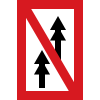
A.3
No overtaking between convoys, or between a convoy and coupled craft; does not apply to pushed convoys up to 110 m long and 12 m wide
-

A.4
No meeting or overtaking
Key for leisure boats -
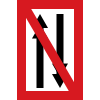
A.4.1
No meeting or overtaking between convoys
-
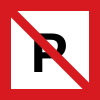
A.5
No berthing on the side of the waterway where the sign stands
Key for leisure boats -
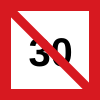
A.5.1
No berthing within the width of water shown on the sign in metres, measured from the sign
Key for leisure boats -
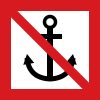
A.6
No anchoring and no dragging of anchors, cables or chains on the side of the waterway where the sign stands
Key for leisure boats -

A.7
No making fast to the bank on the side of the waterway where the sign stands
Key for leisure boats -

A.8
No turning
Key for leisure boats -
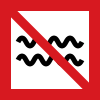
A.9
Avoid creating wash or suction
Key for leisure boats -

A.10
No navigation outside the marked limits
Key for leisure boats -

A.11
No entry, but get ready to proceed
-

A.12
No motorised craft
Key for leisure boats -

A.13
No recreational craft
Key for leisure boats -
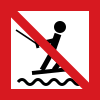
A.14
No water skiing
Key for leisure boats -
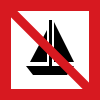
A.15
No sailing craft
Key for leisure boats -
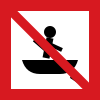
A.16
No craft that are neither motorised nor under sail
Key for leisure boats -
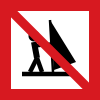
A.17
No windsurfing
Key for leisure boats -
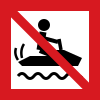
A.18
No personal watercraft (water scooters, jet skis and the like)
Key for leisure boats -
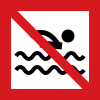
A.20
No bathing or swimming
Key for leisure boats
Mandatory signs (B)
White board with a red border but no diagonal bar. The symbol or number tells you what to do: direction, speed limit, sound signal, radio.
-

B.1
Proceed in the direction shown by the arrow
Key for leisure boats -
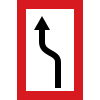
B.2a
Move across to the side of the fairway on your port side
-
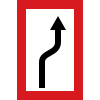
B.2b
Move across to the side of the fairway on your starboard side
-

B.3a
Keep to the side of the fairway on your port side
-

B.3b
Keep to the side of the fairway on your starboard side
-
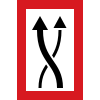
B.4a
Cross the fairway to port
-
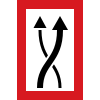
B.4b
Cross the fairway to starboard
-

B.5
Stop under certain conditions
Key for leisure boats -
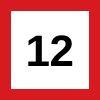
B.6
Do not exceed the speed shown (in km/h relative to the bank)
Key for leisure boats -

B.7
Sound a signal
Key for leisure boats -

B.8
Exercise special caution
Key for leisure boats -

B.9a
Enter or cross the main waterway only if no vessel on it has to change course or speed as a result
Key for leisure boats -

B.9b
Same meaning as B.9a
Key for leisure boats -

B.10
Keep-away signal given from the shore: take the prescribed measures (alternating short and long blasts for at least 15 minutes)
-

B.11a
Use radiotelephony
Key for leisure boats -

B.11b
Use radiotelephony on the channel shown
Key for leisure boats -

B.12
Use the shore power connections
Restrictive signs (C)
Also white with a red border. They warn of limited depth, headroom or width, or of a fairway narrowed at one bank.
-

C.1
Limited depth of water in the fairway
Key for leisure boats -

C.2
Limited headroom above the water level
Key for leisure boats -

C.3
Limited width of the passage or fairway
Key for leisure boats -

C.4
Navigation restrictions apply, shown on an additional panel below the sign
Key for leisure boats -

C.5
Fairway narrowed at the right (left) bank; the number gives the distance in metres to keep from the sign
Key for leisure boats
Recommendatory signs (D)
Yellow diamonds mark the recommended bridge opening, green and white boards the recommended area, an arrow the recommended direction.
-

D.1a
Recommended passage for traffic in both directions
Key for leisure boats -

D.1b
Recommended passage only in the direction from which the signs are visible (prohibited the other way)
Key for leisure boats -

D.2
Recommended to keep within the area marked by the boards
Key for leisure boats -

D.3
Recommended to proceed in the direction of the arrow
Key for leisure boats
Informative signs (E)
Blue boards with a white symbol allow something or point it out: berthing, anchoring, ferries, weirs. A white diagonal bar on blue ends a rule.
-

E.1
Passage permitted (general sign)
Key for leisure boats -

E.2
Overhead high-voltage cable crossing
Key for leisure boats -
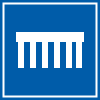
E.3
Weir ahead
Key for leisure boats -

E.4a
Ferry not moving independently (cable ferry)
Key for leisure boats -

E.4b
Ferry moving independently
Key for leisure boats -

E.5
Berthing permitted on the side of the waterway where the sign stands
Key for leisure boats -
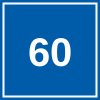
E.5.1
Berthing permitted within the width of water shown on the sign in metres, measured from the sign
Key for leisure boats -

E.5.2
Berthing permitted between the two distances in metres shown on the sign, measured from the sign
Key for leisure boats -

E.5.3
Maximum number of vessels allowed to berth side by side on this side of the waterway
Key for leisure boats -
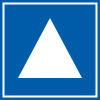
E.5.4
Berth for push-tow craft not required to carry the marking under § 3.14
-

E.5.5
Berth for push-tow craft required to carry the marking under § 3.14 no. 1
-

E.5.6
Berth for push-tow craft required to carry the marking under § 3.14 no. 2
-

E.5.7
Berth for push-tow craft required to carry the marking under § 3.14 no. 3
-

E.5.8
Berth for craft other than push-tow craft not required to carry the marking under § 3.14
-

E.5.9
Berth for craft other than push-tow craft required to carry the marking under § 3.14 no. 1
-

E.5.10
Berth for craft other than push-tow craft required to carry the marking under § 3.14 no. 2
-

E.5.11
Berth for craft other than push-tow craft required to carry the marking under § 3.14 no. 3
-

E.5.12
Berth for any craft not required to carry the marking under § 3.14
-

E.5.13
Berth for any craft required to carry the marking under § 3.14 no. 1
-

E.5.14
Berth for any craft required to carry the marking under § 3.14 no. 2
-

E.5.15
Berth for any craft required to carry the marking under § 3.14 no. 3
-

E.6
Anchoring permitted on the side of the waterway where the sign stands
Key for leisure boats -

E.7
Making fast to the bank permitted on the side of the waterway where the sign stands
Key for leisure boats -
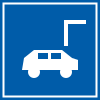
E.7.1
Making fast to the bank permitted for immediate loading or unloading of a motor vehicle
-

E.8
Turning area
Key for leisure boats -

E.9a
The main waterway you are on meets a side waterway joining from both sides
-

E.9b
The main waterway you are on meets a side waterway joining from starboard
-

E.9c
The main waterway you are on meets a side waterway joining from port
-

E.10a
The side waterway you are on meets a main waterway running off to both sides
-

E.10b
The side waterway you are on flows into a main waterway
-
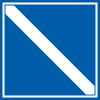
E.11
End of a prohibition or of an obligation applying in one direction only, or end of a restriction
Key for leisure boats -

E.12a
Warning of a vessel coming out
-
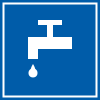
E.13
Drinking water tap
Key for leisure boats -

E.14
Telephone
Key for leisure boats -

E.15
Motorised craft permitted
Key for leisure boats -

E.16
Recreational craft permitted
Key for leisure boats -
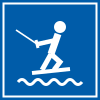
E.17
Water-skiing area
Key for leisure boats -

E.18
Sailing craft permitted
Key for leisure boats -
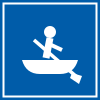
E.19
Craft that are neither motorised nor under sail permitted
Key for leisure boats -
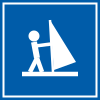
E.20
Windsurfing permitted
Key for leisure boats -

E.21
Nautical information by radio
Key for leisure boats -
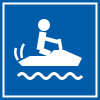
E.22
Personal watercraft (water scooters, jet skis and the like) permitted
Key for leisure boats -

E.23
High-water marks
Key for leisure boats -

E.24
Kitesurfing permitted
Key for leisure boats -

E.25
Shore power connection available
-
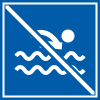
E.26
Notice of a ban on bathing and/or swimming
Key for leisure boats
The English meanings are our own translation and not legal advice. Many signs also exist as lights or flags, which are not drawn here. The official German text is binding.
Sources, accessed 11 October 2026:
How the signs are built
The letter before the number gives the group: A for prohibitions, B for obligations, C for restrictions, D for recommendations and E for information. Once you can tell the group by shape and colour, you know from a distance whether to stop doing something, do something, or simply take note.
Red stands for rules. Prohibitory, mandatory and restrictive signs all have a red border, and the red diagonal bar turns a sign into a ban. Blue means permission or information, yellow and green mean advice. Many signs come in pairs with the same symbol: A.6 bans anchoring, E.6 allows it.
A number on a board is part of the rule. On B.6 it is the speed limit in km/h relative to the bank, on A.5.1 and E.5.1 the width of water in metres. An additional panel below a sign can narrow the rule down; on C.4 the panel states the restriction itself.
Where these signs apply
These signs follow CEVNI, the European code for inland waterways drawn up by the UN Economic Commission for Europe. That is why you will meet the same boards on many rivers and canals across Europe, from the Netherlands to the Danube.
Each country puts CEVNI into its own rules, and small differences in numbering or wording remain. We use the German version, Annex 7 of the Binnenschifffahrtsstraßen-Ordnung, as our source. It applies on federal inland waterways such as the Elbe, Weser, Main, Havel and the canals; the Rhine, Moselle and Danube have their own regulations with largely the same signs.
Lakes that are not federal waterways fall under the law of the German states, and Lake Constance has its own rules. If you charter a boat on a new stretch of water, ask which regulations apply there before you set off.
Questions about waterway signs
What does a red, white and red board on the water mean?
That is A.1, the general prohibition sign: no passage, the waterway is closed. You often see it at bridge openings and locks. Instead of the board, red lights or red flags may be shown.
How do I know whether I may anchor or moor here?
Blue boards allow it: E.5 for berthing, E.6 for anchoring, E.7 for making fast to the bank. Their red counterparts with a diagonal bar, A.5, A.6 and A.7, forbid it. Each rule applies to the side of the waterway where the sign stands.
Is the speed limit on sign B.6 measured over the water?
No, B.6 gives the speed in km/h relative to the bank, so speed over ground. Going downstream you reach the limit sooner than going upstream.
Do I need a licence to use these waterways in Germany?
On German inland waterways you need a licence for most boats with more than 15 hp (11.03 kW); on the Rhine the limit is 5 hp. The signs apply to everyone, with or without a licence, including canoes and rowing boats.
