All about this insurance: Bicycle and e-bike
Is my bike covered by my German contents insurance?
Insurance broker / Insurance questions / Bicycle and e-bike
In short
In your own locked cellar compartment, German contents insurance (Hausratversicherung) usually pays even if the bike itself was not locked, provided there are signs of a forced entry. In a shared cellar the policy wording almost always requires a proper lock, usually attached to something fixed. If the door stood open it counts as simple theft and basic cover does not pay.
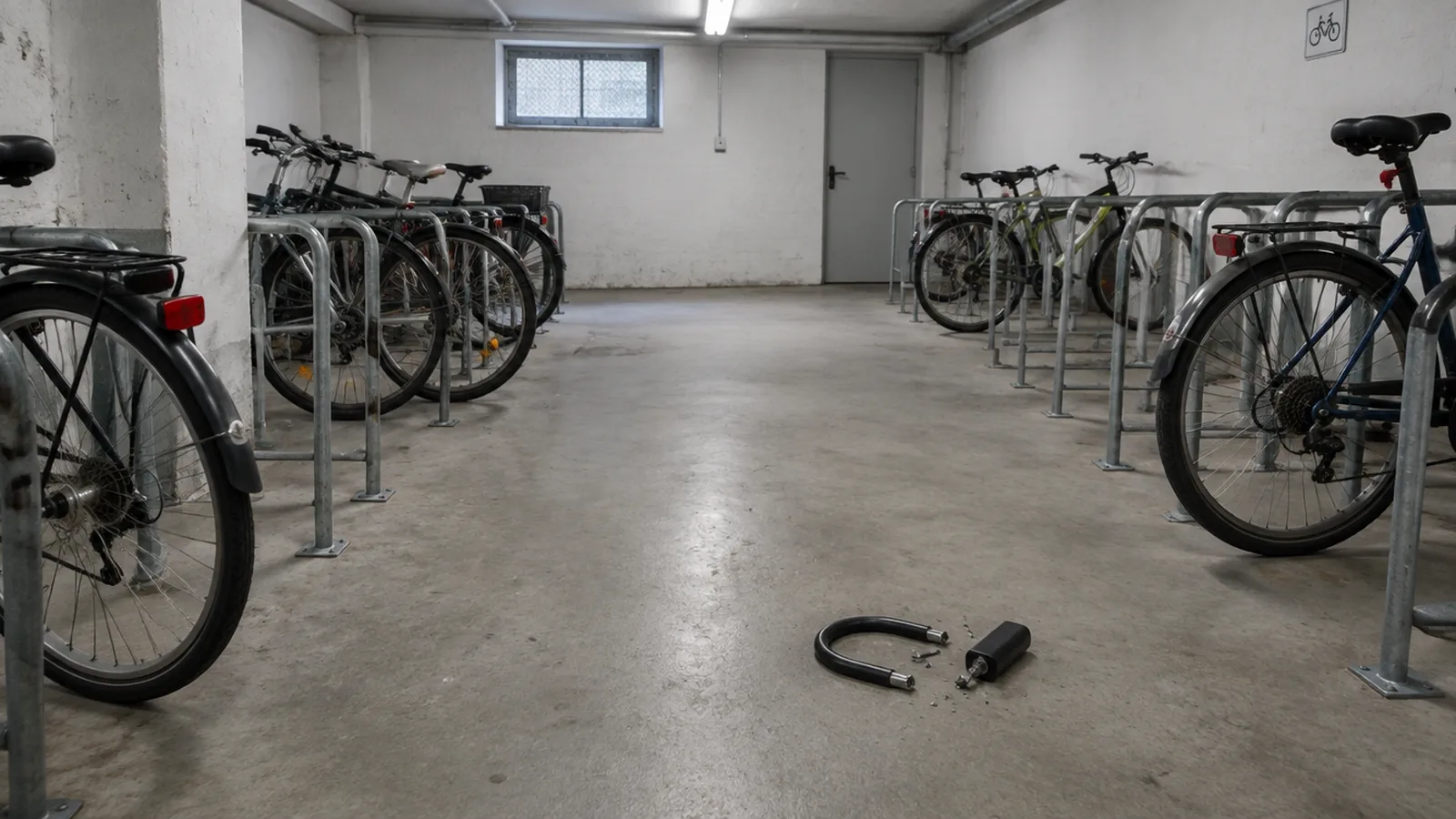
Prices for locks, frame coding and the bike add-on from publicly quoted figures, as of 2026.
| Example | Typical range |
|---|---|
| U-lock with good resistance to attack | from about EUR 50, top models up to about EUR 300 |
| Chain lock rated well in testing | about EUR 58 to 60 |
| Folding lock from a known range | rarely under EUR 50, recommended models from about EUR 70 |
| Coding of the frame number (Codierung) | about EUR 15 to 20, locally EUR 5 to 10 for cycling club members |
| Bike add-on in contents insurance for a bike worth EUR 1,000 | often around EUR 50 a year |
| Payout limit without the bike add-on | often 1 to 2 percent of the sum insured |
Guide values as of September 2026 from publicly quoted test results and tariff examples. What your own policy does in a shared cellar is written only in your terms, and the German wording is what counts in a claim. The premium for the bike add-on is a guide value from our quoting practice; we obtain the exact quote for you.
Worked example
The cellar door was locked and was forced open; the bike stood next to it without a lock. The sum insured is EUR 50,000 and no bike add-on was agreed.
| Replacement value of the e-bike | EUR 3,200 |
| Sum insured, contents | EUR 50,000 |
| Payout limit of 1 percent | EUR 500 |
| Deductible | EUR 150 |
| Payout | EUR 350 |
Out of EUR 3,200 you keep EUR 350. With a bike add-on of EUR 3,200 it would be EUR 3,050. Worked example with guide values.
German contents insurance draws a hard line. Burglary (Einbruchdiebstahl) means someone used force to get into a locked room: they broke the cellar door, bent a grille or destroyed a lock. In that case your bike is covered at that address even if it was standing free.
Simple theft (einfacher Diebstahl) means the bike was accessible and nobody had to break anything. The classic case is the shared cellar whose door never really closes, or which every neighbour opens with the normal building key. Basic cover almost never pays for that, only a specific bike theft add-on does.
| Where the bike stands | Cover under contents insurance | What is required |
|---|---|---|
| Flat, hallway of the flat, balcony | covered as burglary | flat door locked, marks on lock or frame |
| Your own locked cellar compartment | covered as burglary | compartment locked, photograph the break-in marks |
| Shared cellar or bike room | usually only with the bike add-on | bike locked, room named as an insured location |
| Underground car park of the building | treated like a shared room, depends on wording | bike locked, garage named in the policy |
| Courtyard, front garden, the property | as a rule only with the bike add-on | bike locked to something fixed, check the night clause |
| Public space, out and about | only with the add-on or a separate bike policy | bike locked, check the night clause |
A room used by several households is not treated like your flat. The widely used model wording states plainly that you must secure the bike there with a customary lock (verkehrsübliches Schloss). Customary means a lock that matches the value of the bike, not a thin cable lock for an e-bike.
The second half is the part people miss: a shackle through the rear wheel is often not enough. The wording asks for a connection to something fixed, such as a wall anchor, a bike stand or a grille. Otherwise two people simply carry the locked bike out. Also check whether the shared cellar is named as an insured location (Versicherungsort) in your policy at all.
You have to prove the break-in; the insurer does not have to disprove it. So photograph the forced door, the destroyed door lock and the remains of your bike lock before the building management repairs anything, and keep the lock remains, they are your main piece of evidence.
The payout limit then decides the amount. Without a bike add-on, many policies cap the payment at 1 to 2 percent of the sum insured. With the add-on, a fixed sum is agreed and it should match the purchase price. Keep to your duties as well: report the theft to the police, notify the insurer without delay and hand in a list of what was stolen.
Plainly said: with no signs of a break-in and no lock on the bike, you get nothing without the add-on or a separate policy. The same applies if a neighbour opened the cellar with their own key, because then there is no force on the door. Hardly any policy pays when only parts are gone, such as the saddle, a wheel or the battery.
Gross negligence (grobe Fahrlaessigkeit) can also cut the payout, for example if the cellar key was left in the lock. Good tariffs waive that cut up to the sum insured, cheap ones often do not. If your bike is worth more than about EUR 2,000 and lives in a shared cellar, a separate bike policy is usually the more honest answer than hoping for the contents policy.
Questions and answers
After a break-in into a locked compartment most policies pay even without a lock on the bike. A few wordings still require one, so read your own policy.
Broken locks, bent grilles, lever marks on the door or frame. You carry the burden of proof, so photograph everything and keep the lock remains.
No. It covers bikes left outdoors, usually between 10 pm and 6 am. It does not apply in the flat or in a locked cellar.
Often 1 to 2 percent of the sum insured. On EUR 50,000 that is EUR 500 to 1,000, far too little for an expensive bike.
Yes, for instance if the cellar key was left in the lock. Good tariffs waive that cut up to the sum insured, simple tariffs often do not.
For an everyday bike under about EUR 1,000 usually not. From about EUR 2,000, or if the bike lives in a shared cellar, a separate policy often makes more sense.
NAMMERT insurance broker
We compare several insurers and come back with a proposal. Free for you; the insurer pays our fee. You can write in English.
Thank you, we have your request.
We will be in touch within one working day. If it is urgent: +49 3375 29 12 77.
All about this insurance: Bicycle and e-bike
Is my bike covered by my German contents insurance?
What should I do if my bike is stolen in Germany?
File a police report (Anzeige) the same day, within 48 hours at the latest, and notify your insurer without delay. Hav …
Contents insurance or a separate bike policy: which is better?
Up to a bike value of about EUR 1,000 the bike add-on in your contents insurance (Hausratversicherung) is usually enou …
How much does bike insurance cost in Germany?
For a bike worth EUR 1,000, the bike add-on of your contents insurance often costs only around EUR 50 a year. A separa …
NAMMERT Assekuradeur GmbH, insurance broker licensed under section 34d(1) of the German Trade Regulation Act, broker register no. D-C08Q-TOSD4-37. For boat and yacht insurance we act as underwriting agency, not as broker. Statutory disclosure (German) · Updated
Was this useful?