What insurance do long-term campers need in Germany?
In short
Long-term campers (Dauercamper) in Germany mainly need long-term camping insurance (Dauercamping-Versicherung) for the deregistered caravan, the awning and the contents against storm, fire and burglary. It starts at about EUR 130 to 155 a year. What other insurance you need depends on the pitch: liability for the pitch is often an add-on.
Published entry premiums for long-term camping insurance in Germany.
Example
Typical range
Long-term camping insurance, entry tariff
from about EUR 131 a year
Basic cover, permanent pitch in Germany
from about EUR 154 a year
Basic cover, permanent pitch abroad
from about EUR 192 a year
Pitch liability as an add-on
limits up to EUR 10 million, extra premium depends on the tariff
As of October 2026, entry prices of the providers.
Higher sums, natural hazards, solar panels or liability raise the premium;
the extra charge is a guide value from our quoting practice.
Norman Nammert can obtain a quote as an insurance broker; the insurer pays the commission.
Worked example
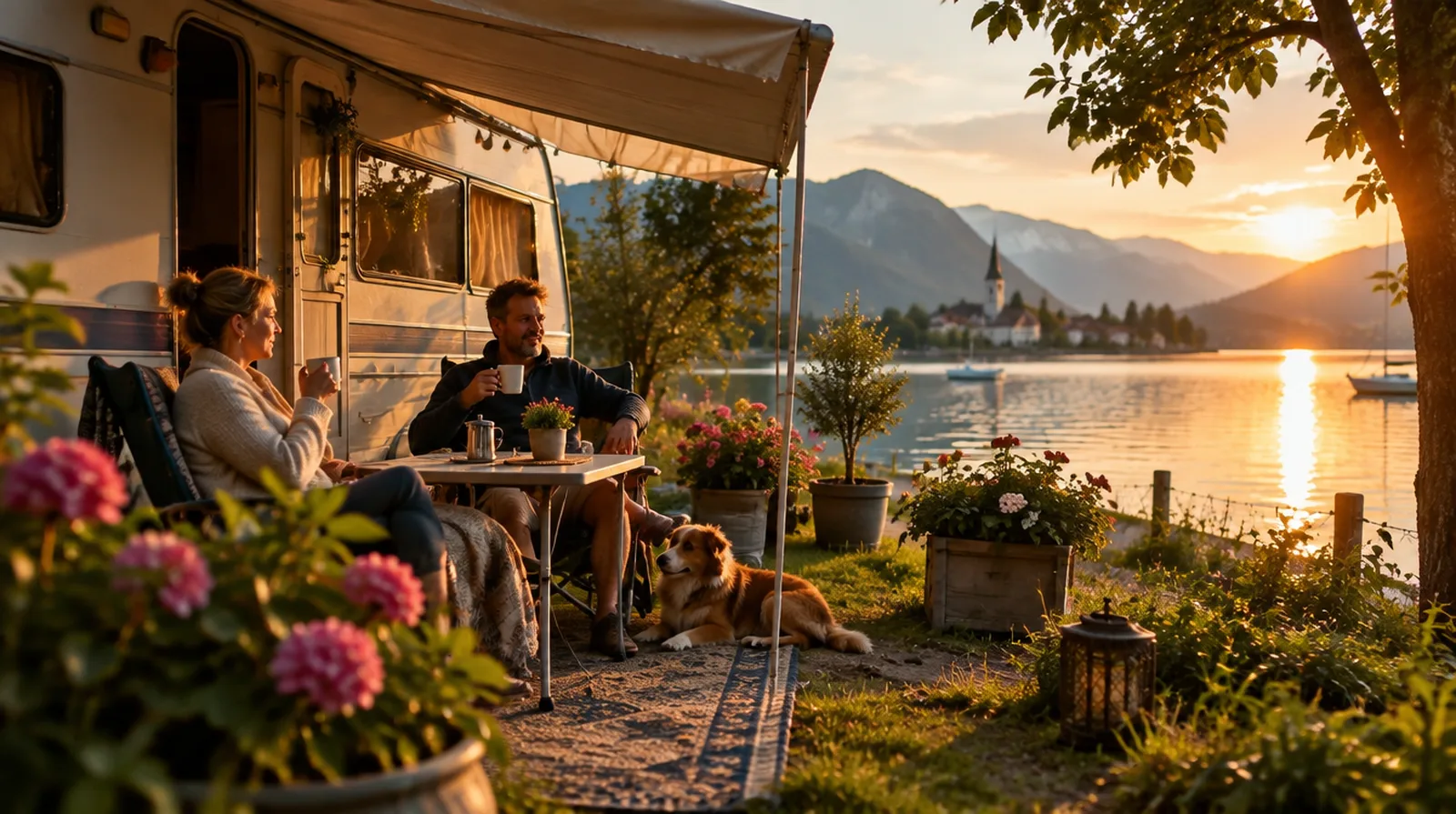
Deregistered caravan from 2012 with winter awning by a lake
This is what typical cover for a long-term camper with caravan, awning and contents looks like.
Caravan, current value
EUR 12,000
Awning and decking
EUR 4,000
Contents
EUR 5,000
Basic cover for fire, storm, burglary
from about EUR 131 to 154 a year
Flood cover for the lakeside pitch and pitch liability
extra, depending on the tariff
About EUR 150 to 250 a year is a realistic range for this pitch, depending on sums and add-ons.
Why a deregistered caravan has a gap
Many long-term campers deregister their caravan once it stays on the same pitch for years. That ends the motor insurance including partial cover. Under the German registration rules (FZV) the caravan may then no longer be used on public roads.
If a tree falls on the roof or the caravan burns during that time, no motor policy pays. Long-term camping insurance closes exactly this gap.
What long-term camping insurance covers
Cover usually includes the caravan or mobile home, the awning or canopy, fixed additions such as decking and flooring, and the contents from the fridge to the bike stored in the awning.
The perils resemble a mix of contents and buildings insurance: fire, lightning, storm, hail, burglary, vandalism and, depending on the tariff, escaping water and glass breakage. Natural hazards such as flooding at a lake or river often cost extra.
What can be insured on a long-term pitch
What to watch
Caravan or mobile home
new value for young units, otherwise current value
Awning, canopy, decking
must be named and built to withstand storms
Contents in caravan and awning
own sum insured, burglary from the awning often capped
Pitch liability
damage to neighbours and the site, often an add-on
Solar panels, greenhouse, garden tools
usually only via add-on packages
Awning and burglary: where disputes start
Tariffs set conditions for the awning of a long-term camper. Often it needs a fixed frame and must withstand storm and snow load. A light touring awning then falls outside the cover.
For burglary from the awning, some tariffs require it to be secured against simple opening and cap the payout, for example at EUR 3,000 per claim. Keep valuables such as a laptop or e-bike in the locked caravan or at home over winter.
Liability: does your personal liability policy help?
If an awning pole blows onto your neighbour's car in a storm, you are liable as the owner. The pitch liability in a long-term camping policy covers damage caused by the caravan, its additions or the pitch.
Whether your personal liability insurance (Privathaftpflicht) already covers this is in its terms. Some tariffs include a second holiday home or a permanent pitch, others do not. Checking saves you paying twice.
When you do not need a separate policy
If your caravan stays registered and only stands on the site for a few weeks in summer, its partial motor cover already pays for storm, fire and theft of the caravan. For the contents, the cover outside the home in your contents insurance may be enough.
An old caravan with little value and few belongings does not always justify full long-term camping cover either. Liability for the pitch may then be all you need.
Step by step
Decide whether the caravan stays registered or is deregistered.
Add up values: caravan, awning, additions, contents.
Check the awning conditions: fixed frame, winter proof.
Look in your personal liability policy for cover of a permanent pitch.
Add natural hazard cover if you are by water or under trees.
Checklist
Caravan insured at the right sum, new or current value clarified
Awning and additions named in the policy
Contents with their own sum insured
Limit for burglary from the awning known
Liability for the pitch in place
Storm excess known
Common mistakes
Deregistering the caravan and assuming partial cover continues
Leaving the awning out because it seems part of the caravan
Setting the contents sum too low after years of collecting things
Leaving valuables in the awning over winter
Questions and answers
Frequently asked
Does a deregistered caravan have to be insured?
Motor liability is no longer required, but the caravan may not go on the road.
Cover against storm, fire and burglary and a liability policy are voluntary but sensible.
Does my contents insurance cover things in the caravan?
Cover outside the home (Außenversicherung) usually applies only temporarily and often not to a
permanent pitch.
Contents are safer in the long-term camping policy.
Can a mobile home be insured the same way?
Yes, many long-term camping tariffs accept mobile homes and static caravans.
For larger units on foundations, buildings insurance can also be an option.
Does the cover work on a site abroad?
Some tariffs cover permanent pitches in many European countries at a higher price.
Ask about the country before you sign.
What happens if a tree falls on the caravan?
In a storm, long-term camping insurance pays for the damage to the caravan and often for removing