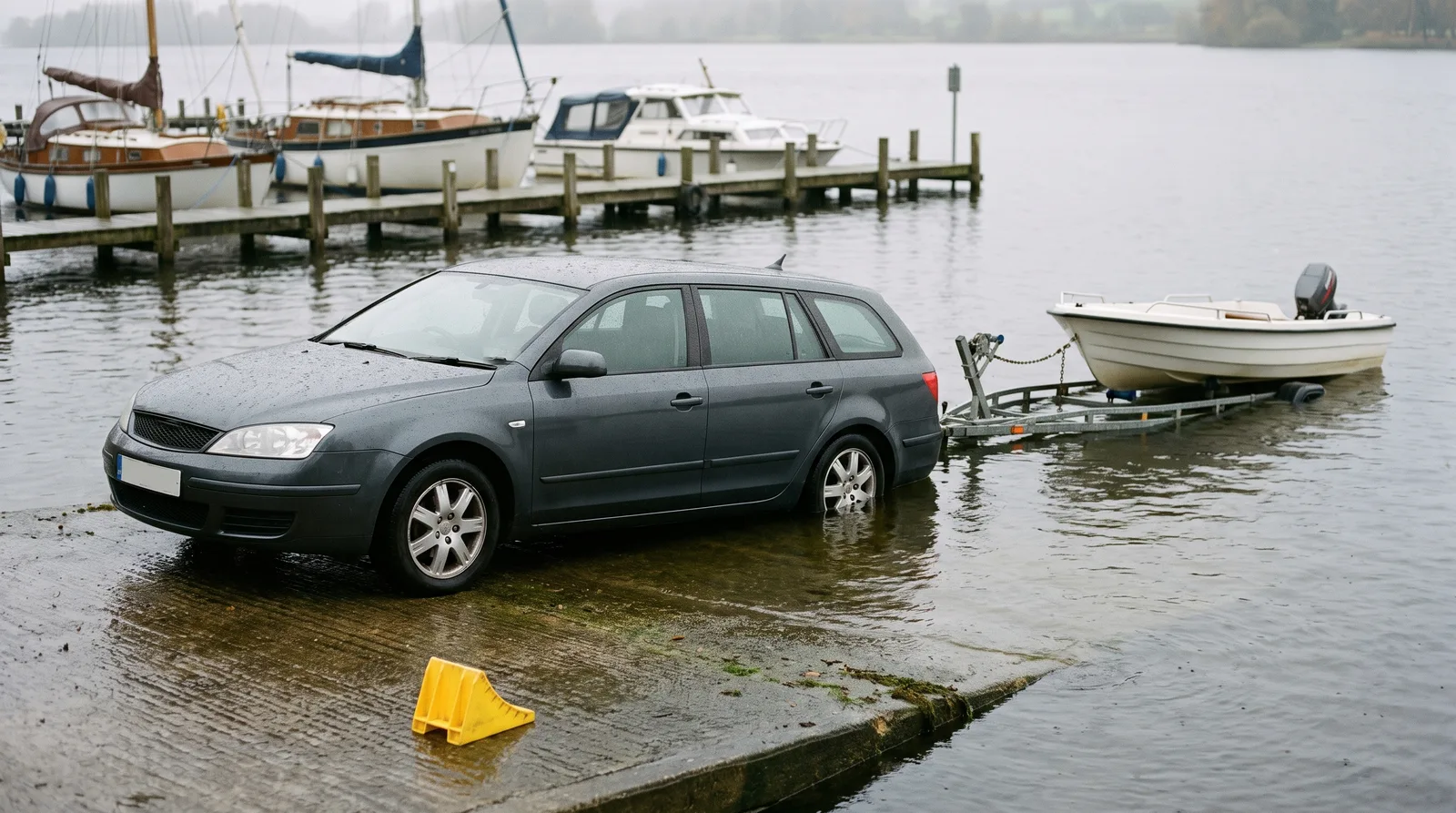
Car in the water at the slipway: which insurance pays for what
The ramp is slippery, the handbrake gives, and the car follows the trailer into the water. Afterwards the question of who pays is not one question but four.
11 October 20267 min readNAMMERT Assekuradeur GmbH
Anyone who has spent an autumn morning at a public slipway has seen it, or come close: the concrete is wet and green with weed, the trailer is already deep in the water, and the car starts to slide after it until the rear wheels are under or the whole back end is. Pictures like this go round the news every year, usually with a smile. For the owner it is no joke, because four things are now involved at once: the car, the trailer, the boat and whatever else gets damaged on the way, from the pontoon to the oil in the harbour.
The boat policy has the least to do with the car itself. Damage to the towing vehicle belongs to the motor insurance, and in most cases only to comprehensive cover. A third party or third party, fire and theft policy will not pay to repair your own car after you let it roll into the water. Recovering the car with a crane or a tow truck is also normally a matter for the motor insurer, as far as its terms allow. If the car only has third party cover, the owner pays for recovery and repair.
The surprise comes with liability. If the sliding car and trailer damage the pontoon, a boat moored alongside or the slipway itself, many owners think first of their boat liability cover. Boat wordings commonly exclude exactly this. German wordings, for example, state that liability for damage caused by the use of a motor vehicle or a vehicle trailer is not insured, and launching with a car is using the car. The claim therefore goes to the motor liability insurance of the towing vehicle, which in most countries also deals with fuel or oil leaking from the car into the water.
With the trailer, two separate questions arise. Damage the trailer causes to others is, in most European countries, handled first by the motor insurance of the car pulling it. Some boat liability wordings add cover for a boat trailer that needs no insurance of its own, but only where the motor policy does not pay. Damage to the trailer itself is a hull matter, and many hull wordings only include the trailer if it was declared with its own sum insured. Read the schedule: if the trailer is not listed, it is not in the policy.
For the boat, the hull policy is the place to look, and two lines decide. The first is where cover applies: a good wording says plainly that launching and hauling out are included, not only time afloat and in storage. The second is which events are insured. Wordings that list accident perils, such as collision with fixed or floating objects and sinking, respond to a dinghy, trailer sailer or small motorboat hitting the pontoon at the ramp. Named perils wordings that only list storm, fire, explosion and theft of the whole boat do not. Many wordings also exclude damage caused by improper loading and securing during transport.
An outboard that went under needs attention within hours: flush it with fresh water, change the oil and do not try to start it until a mechanic has looked at it. Most wordings expect this. The owner has a duty to reduce the loss, and the reasonable cost of doing so is usually recoverable even when the effort fails. Check separately whether the outboard is covered at all, because many hull policies only include it when it is listed in the schedule. Salvage of the boat may come under its own clause, often tied to an order from an authority.
So, once the shock has passed: get people clear, tell the harbour office if oil is leaking, and take photographs before anything is moved. Then make two claims rather than one, to the motor insurer for the car, the pontoon and other boats, and to the boat insurer for the boat, trailer and engine. Next time, set the handbrake, leave the car in gear or in park, put wheel chocks on the water side and keep a second person at the car. The rest of what matters on launch day is in the article on trailering and launching.
Worth checking
Common questions
Does boat liability insurance pay if my car damages a pontoon while launching?
Usually not. Boat wordings commonly exclude damage caused by using a motor vehicle or vehicle trailer. The claim belongs with the motor liability insurance of the towing car.
Is the boat covered if it is damaged at the slipway?
Only if the hull wording covers accidents such as collision or sinking and includes launching and hauling out. Named perils wordings that only list storm, fire and theft will not respond.
Is my boat trailer part of the hull policy?
In many wordings only if it was declared and appears in the schedule with its own sum insured. Check the schedule before launch day, not after.
Who pays for my own car if it ends up in the water?
Your motor insurer, if you have comprehensive cover. Third party policies do not pay for your own car, and the boat policy is not the place for this claim.
Related