All about this insurance: Natural hazard cover
Is flood insurance included in German home insurance?
Insurance broker / Insurance questions / Natural hazard cover
In short
Landslides and subsidence are covered by insurance in Germany only if you have added natural hazard cover (Elementarschutz) to your buildings or contents policy, and only if nature caused them. Damage from mining, building work, dried out clay soil or poor ground is excluded. For a house in a low risk area the add-on costs around EUR 92 a year on average.
Extra cost of the whole natural hazard add-on on an existing policy, from published market analyses. There is usually no separate price for landslides alone.
| Example | Typical range |
|---|---|
| Buildings insurance, base premium without natural hazard cover | around EUR 241 a year on average |
| Buildings insurance, add-on in hazard class 1 | around EUR 92 a year on average |
| Buildings insurance, add-on in hazard class 2 | around EUR 200 a year on average |
| Contents insurance, add-on in hazard classes 1 and 2 | around EUR 18 to 27 a year extra |
Guide values as of October 2026 from published market analyses.
Hazard classes mainly reflect flood risk; a hillside location can also affect the price.
The damage amounts in the example are guide values from our quoting practice.
We obtain the exact quote for you.
Worked example
After weeks of rain the slope above the plot gives way. Earth presses against the back wall and one corner of the foundation sinks.
| Expert report on cause and stability | around EUR 1,500 to 4,000 |
| Securing and underpinning the foundation | around EUR 20,000 to 60,000 |
| Back wall, cracks and interior | around EUR 10,000 to 30,000 |
| Stabilising the slope and removing earth | around EUR 10,000 to 50,000, usually not insured |
| Natural hazard add-on in a low risk area | around EUR 92 a year |
With natural hazard cover the insurer pays the report and the damage to the building, around EUR 30,000 to 90,000 in total, minus any excess. Stabilising the slope often stays with you. Without the add-on you pay everything yourself.
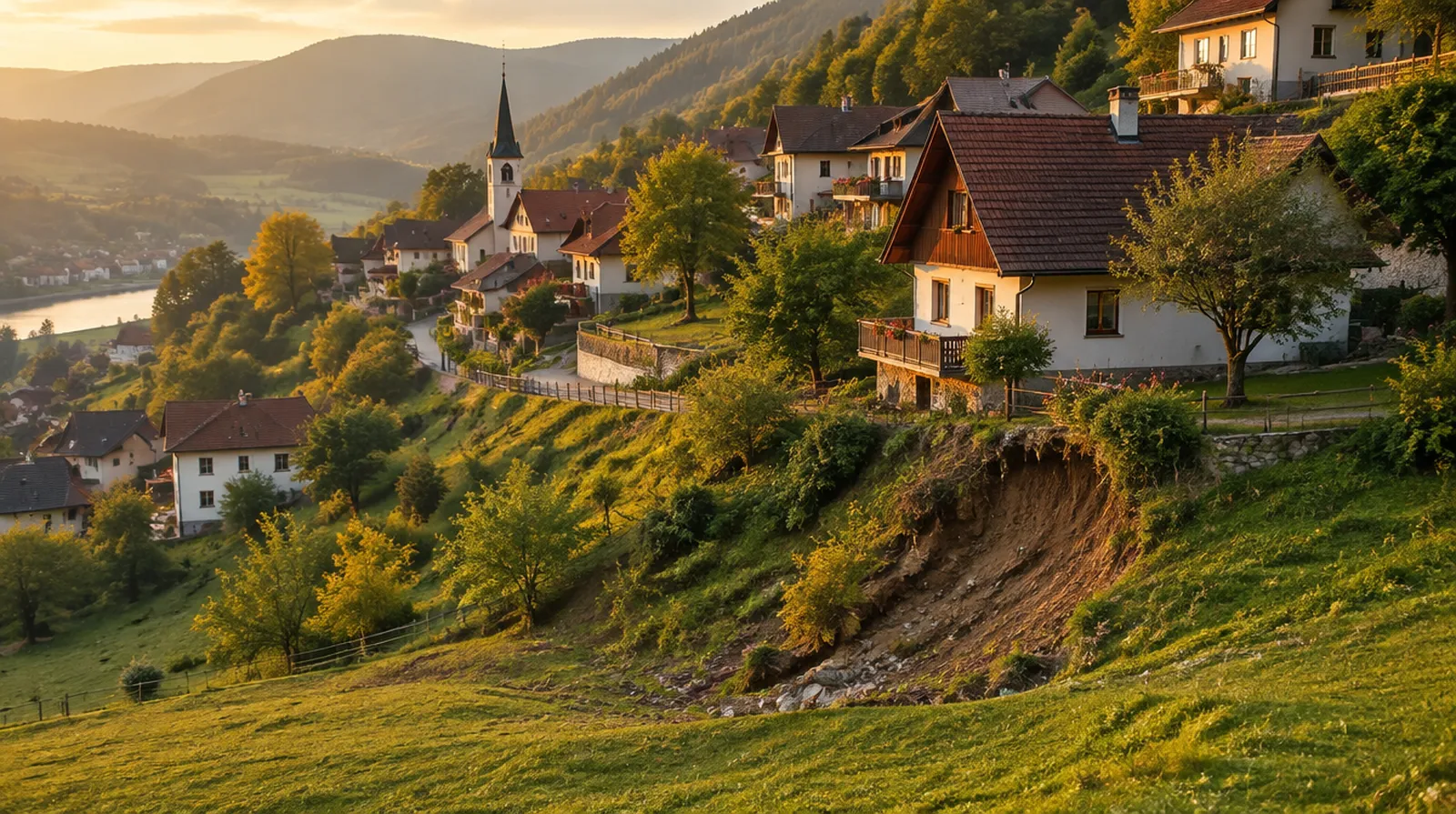
In German policy wording, Erdrutsch means earth or rock sliding or falling for natural reasons. A typical case is a slope that gives way after weeks of rain and pushes into the house below or takes part of the foundation with it.
Erdsenkung means the ground sinking over natural cavities. These form when water dissolves gypsum, salt or limestone underground. Some policies call a sudden collapse above such a cavity Erdfall.
The key word is natural. As soon as people have dug, mined or loaded the ground, natural hazard cover does not pay.
| Cause | Who pays |
|---|---|
| Slope slides after heavy rain and damages the house | natural hazard cover on the buildings policy |
| Natural cavity in gypsum rock collapses | natural hazard cover on the buildings policy |
| Ground sinks above an old mine shaft | mining company or its fallback fund, not the insurer |
| Neighbour's excavation makes your plot sink | the builder or contractor through their liability cover |
| Clay soil shrinks in a dry summer, cracks appear | usually nobody |
| House settles on badly compacted ground | nobody, it is a construction defect |
| Furniture in the collapsed part of the house | natural hazard cover on the contents policy |
In former mining regions such as the Ruhr, Saarland or parts of Saxony, the ground is full of man made cavities. If it sinks above them, this is mining damage (Bergschaden), not a natural hazard.
Under the Federal Mining Act the company that ran the mine is liable. If your house lies within the area affected by a mine, the law presumes that subsidence and cracks come from the mining, which makes your claim easier.
If the company no longer exists, a fallback fund of the mining industry can step in, and several federal states run arbitration boards. Very old mines without a legal successor are harder and usually need a case by case review.
Clay and loam soils shrink when they dry out in hot summers. One corner of the house drops and cracks open in walls and floor slab. There is no cavity, so the definition of subsidence does not fit.
Most German policies therefore do not pay for this. A few tariffs go further, but that is the exception and has to be written into the contract.
If you buy or build on clay, prevention matters more: lead rainwater away from the house and do not plant large trees right next to the walls, because their roots draw extra water from the soil.
The building is covered: foundation, walls, roof and pipes, plus clearing up, demolition and rebuilding as far as the policy names these costs.
The land itself is not insured. Stabilising the slope, refilling earth or relaying the garden is usually not paid, or only within tight limits for outdoor areas. After a landslide this can be a larger bill than the damage to the house.
Damage visible before the policy started, such as existing cracks, is excluded. Many policies also have a waiting period after you take out the cover.
On flat land with no soluble rock below, the risk of landslides and subsidence is low. For that reason alone you would not need the add-on.
But it comes as a package with heavy rain, flooding, sewer backflow, snow load and earthquakes. Heavy rain in particular hits houses far from any river, so the decision is rarely about landslides alone.
If you rent a flat on an upper floor, you hardly need natural hazard cover on your contents because of landslides. It matters more on the ground floor and for belongings kept in the cellar.
Questions and answers
Not in the basic cover. Landslides are only insured with the natural hazard add-on, and even then only if nature caused them.
In most policies no. When clay soil shrinks there is no natural cavity, which the wording requires for subsidence.
The mining company under the Federal Mining Act, with the cause presumed inside the area affected by a mine. If the operator is gone, a fallback fund may step in.
Then the builder or contractor is liable, usually through their liability insurance. Your natural hazard cover does not pay because the cause is not natural.
Usually not. The building is insured, not the land. Outdoor areas are only included within tight limits if the policy names them.
Usually not. Landslides and subsidence are part of the natural hazard add-on, together with flooding, backflow, earthquakes, snow load and avalanches.
NAMMERT insurance broker
We compare insurers and come back to you, in English. Free; the insurer pays our fee.
Thank you, we have your request.
We will be in touch within one working day. If it is urgent: +49 3375 29 12 77.
All about this insurance: Natural hazard cover
Is flood insurance included in German home insurance?
What counts as natural hazard damage in Germany and what is covered?
Elementarschaden covers seven natural perils: flooding and sewer backflow, earthquake, ground …
How much does natural hazard insurance cost in Germany?
As an add-on to buildings insurance, natural hazard cover (Elementarschadenversicherung) for …
Is natural hazard insurance worth it in Germany?
For most homeowners, yes. Heavy rain can hit any location, even far from a river, and in safe …
What to do if flood and natural hazard cover is refused in Germany?
A refusal rarely means your house cannot be insured anywhere. According to the German insuran …
NAMMERT Assekuradeur GmbH, broker licensed under section 34d(1) of the German Trade Regulation Act.
Broker register no. D-C08Q-TOSD4-37.
For boat and yacht insurance we act as underwriting agency, not as broker.
Statutory disclosure (German) · Updated
Was this useful?