Does comprehensive car insurance pay if your EV battery breaks?
In Germany, comprehensive car insurance does pay if your EV battery breaks because of an acci …
Insurance broker / Insurance questions
In short
No, in Germany building insurance (Wohngebäudeversicherung) does not usually pay for cracks caused by heat and drought. The model conditions explicitly exclude drought and drying out under natural hazards, and the natural hazards add-on, about EUR 92 a year on average, does not help either. Fire, lightning, storm and hail remain covered, a burst water pipe inside the house depending on the cause.
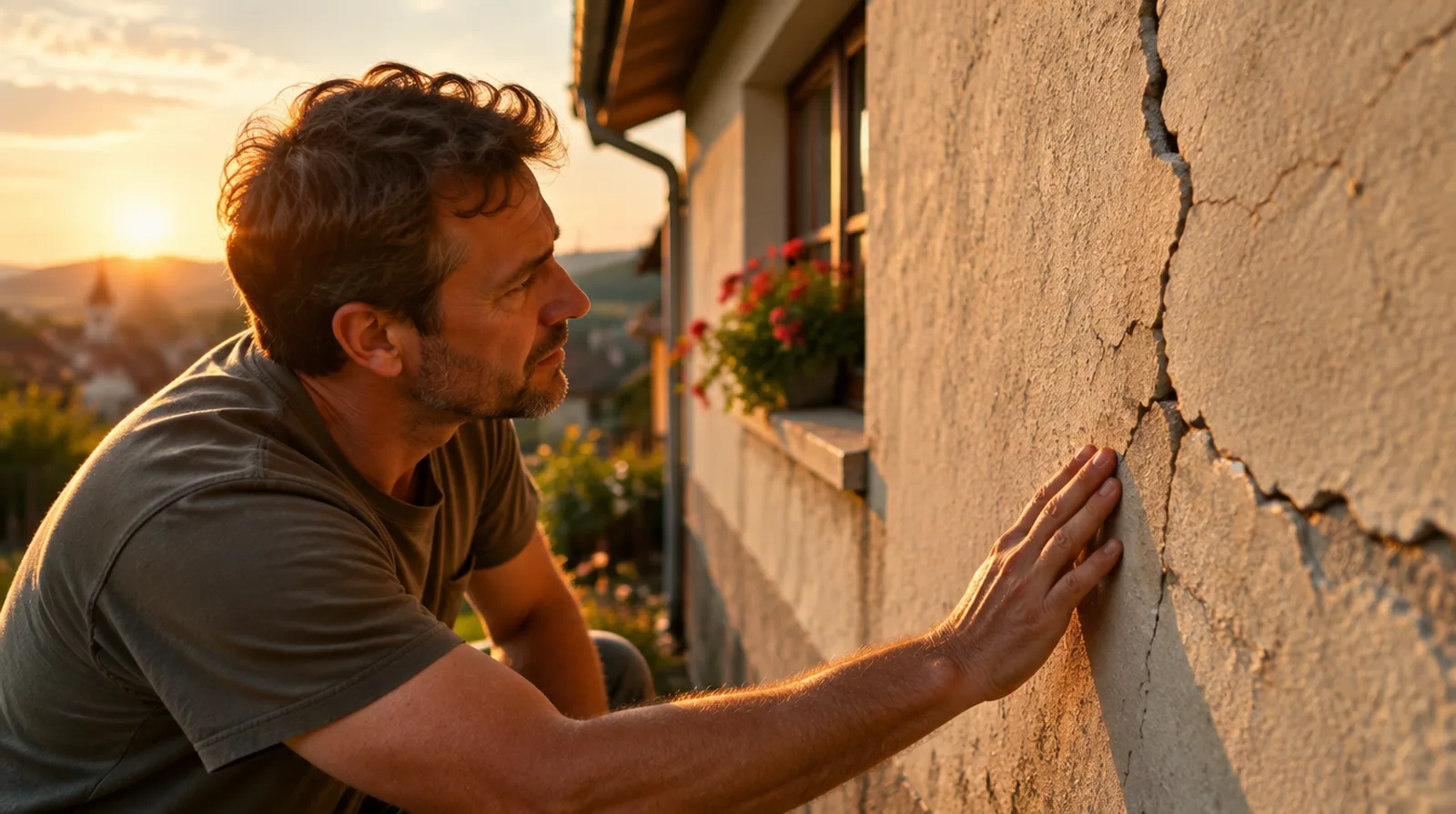
There is normally no policy against drought cracks. These figures show what suitable building cover costs on average, from a published market analysis.
| Example | Typical range |
|---|---|
| Building insurance, base premium without natural hazards | about EUR 241 a year on average |
| Natural hazards add-on, flood risk zone 1 | about EUR 92 a year on average |
| Natural hazards add-on, flood risk zone 2 | just under EUR 200 a year on average |
| Building surveyor's report on the cause of cracks | about EUR 800 to 3,000 |
As of October 2026.
Base premium and add-on come from the market analysis listed.
Surveyor costs and the worked example are guide values from our quoting practice.
Your premium depends on location, construction and value; we obtain the exact quote for you.
Worked example
In autumn diagonal cracks appear above two windows and a patio door sticks. In the utility room water leaks from a broken pipe.
| Expert report on cracks and soil | about EUR 2,000, not insured |
| Stabilising foundations and repairing cracks | about EUR 25,000, not insured |
| Repairing the burst pipe and drying out | about EUR 4,000, assumed here to be an insured pipe breakage |
| Excess on the building policy | EUR 500 |
If the building insurer accepts the burst pipe, it pays about EUR 3,500 after the excess. The report and crack repairs, around EUR 27,000, are your own cost unless there is a construction defect within the five year period.
Clay and loam soils shrink when they dry out in long, hot summers. A house standing on them settles unevenly, and cracks appear in walls, the floor slab and around windows and doors.
Large trees close to the house make it worse, because their roots draw extra water from the soil. Temperature stress alone can also cause fine cracks in render. None of these causes is an insured peril in German building insurance.
German building insurance only pays for named perils: fire, mains water (Leitungswasser), storm and hail, plus further natural hazards (Elementarschäden) if you add that cover. The model conditions of the German insurance association GDV, version VGB 2022 as of June 2026, explicitly exclude damage caused by drought or drying out under natural hazards.
Subsidence does not help with drought cracks either. The model conditions define it as a natural sinking of the ground over natural cavities. Shrinking clay soil creates no such cavity.
A German appeal court, the Higher Regional Court of Koblenz, took the same line in 2011 (case 10 U 1319/10). A house on shrink sensitive clay, dried out by vegetation and trees, had suffered no insured sinkhole, and the claimant withdrew the appeal.
The usual perils stay insured even if a hot summer set them off. If something catches fire in the heat, fire cover pays. If lightning strikes during a heat thunderstorm, fire and lightning surge damage are covered.
If a storm tears tiles off the roof, storm cover pays from wind force 8, which is 62 km/h. Hail is covered too.
If movement of the house breaks a water pipe inside the building, the model conditions can treat this as an insured pipe breakage. For mains water, however, they exclude damage caused by subsidence (A 4.5.5), so whether the insurer pays depends on the cause. Pipes below the floor slab, however, are only covered if this was expressly agreed. The cracks in walls and slab themselves remain uninsured.
| Damage after a hot, dry summer | Building insurance |
|---|---|
| Settlement cracks in walls and slab from dried out clay | no |
| Fine render cracks from temperature stress | no |
| Roof timbers burn after lightning in a heat storm | yes, fire cover |
| Storm gust strips part of the roof | yes, from wind force 8 |
| Hail smashes roof windows and shutters | yes, hail cover |
| Water pipe inside the house bursts | depending on the cause as pipe breakage, subsidence excluded, pipes below the slab only if agreed |
If your house is new and the foundations were not designed or built for the soil on site, there may be a construction defect. Your claim is then against the builder or planner, not the insurer.
Under the German Civil Code (BGB), claims for defects in a building expire five years after formal acceptance of the work (Abnahme). If you find cracks in a young house after a dry summer, get an expert report on the cause quickly and keep an eye on that deadline.
You usually cannot tell from looking at a crack whether drought, a burst pipe, a building site next door or a construction defect caused it. Only a building surveyor or soil expert can prove the cause, and that decides who pays: insurer, builder, neighbour or you.
Hairline cracks in plaster that do not change rarely need a report. If cracks grow wider, move or doors and windows start to stick, have the cause checked before any repair.
If your house stands on sand, gravel or rock, the risk of drought cracks is low. A house with a basement and deep foundations is also less exposed than a shallow building on clay.
The model conditions do not provide drought cover. If a policy goes further, it must say so expressly. More important are prevention, full cover for fire, mains water, storm and hail, and the natural hazards add-on for heavy rain and flooding.
Questions and answers
No.
Heat is not a natural hazard under German policies,
and drought is expressly excluded for natural hazards in the model conditions.
Yes, a fire is covered by fire insurance even if a hot summer contributed.
Intent and gross negligence are governed by your policy.
The model conditions do not provide this.
If a policy covers drought damage, it must say so expressly, so ask before relying on it.
The developer or the construction firm, usually through their liability insurance.
An expert report has to show the building site caused the damage.
Only if pipes below the floor slab are expressly included in your policy.
Under the model conditions they are otherwise excluded.
The building is the landlord's responsibility.
Your contents insurance (Hausratversicherung) only covers your belongings, not the walls.
NAMMERT insurance broker
We compare insurers and come back to you, in English.
Free; the insurer pays our fee.
Thank you, we have your request.
We will be in touch within one working day. If it is urgent: +49 3375 29 12 77.
Does comprehensive car insurance pay if your EV battery breaks?
In Germany, comprehensive car insurance does pay if your EV battery breaks because of an acci …
Does insurance pay if burglars hack my smart home in Germany?
Contents insurance (Hausratversicherung) pays for burglary. If burglars hack your smart lock …
Who pays if a satellite part or space debris hits my house in Germany?
If a satellite part or other space debris hits your house in Germany, your buildings insuranc …
Your broker: Norman Nammert, trading as NAMMERT.
Insurance broker licensed under section 34d(1) of the German Trade Regulation Act.
Broker register no. D-C08Q-TOSD4-37.
NAMMERT Assekuradeur GmbH is a separate company.
It does not arrange your contract.
Statutory disclosure (German) · Updated
Was this useful?