All about this insurance: Buildings insurance
Is buildings insurance mandatory in Germany?
Insurance broker / Insurance questions / Buildings insurance
In short
Yes. Buildings insurance in Germany does pay for frost damage to pipes and heating, as long as pipe water cover (Leitungswasser) is included. It pays for the burst pipe and the water damage to walls and floors. If you neither heated the house nor drained the pipes in winter, the insurer may cut the payout, by 70 percent in one court case about an empty house.
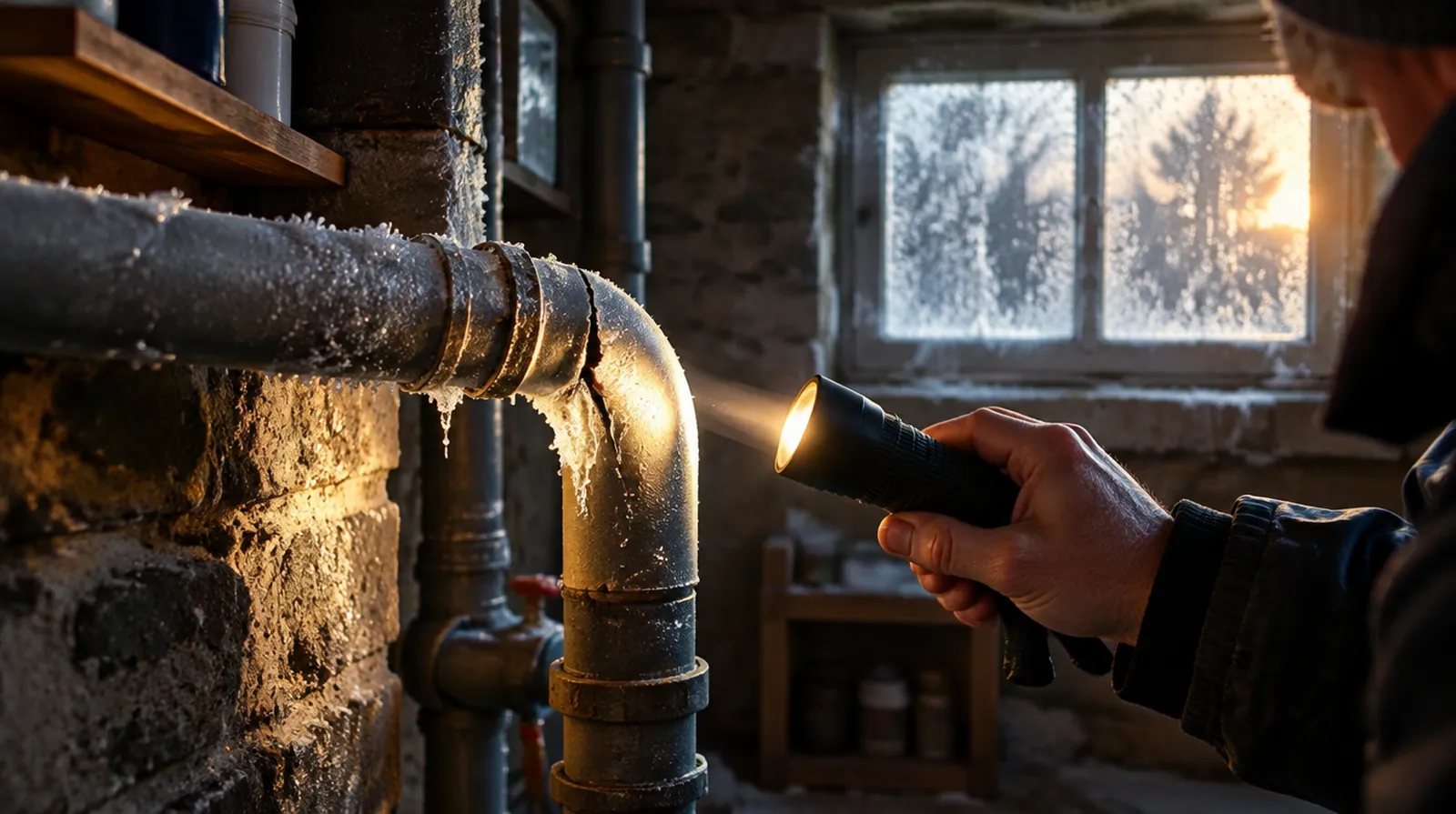
Published figures on pipe water claims and trade prices in Germany, 2024 to 2026.
| Example | Typical range |
|---|---|
| Frost claims on insured buildings per year | up to about 32,000 claims |
| Pipe water damage to residential buildings in 2024 | EUR 4.9 billion |
| Leak detection, depending on the method | about EUR 200 to 600 |
| Building drying up to about 20 square metres | about EUR 400 to 800 |
| Building drying up to about 50 square metres | about EUR 1,000 to 1,500 |
| Cut in the Essen regional court case | 70 percent |
As of October 2026, from insurance industry figures, trade prices and court rulings.
The amounts in the worked example and the vacancy deadlines are guide values from our quoting
practice.
We check what your policy requires in winter and obtain the exact quote.
Worked example
The house has been empty since autumn. The heating runs on frost setting, the water is still on. After a night of hard frost a pipe in the outside wall bursts.
| Leak detection and pipe repair | about EUR 1,000 |
| Drying, screed and tiles in the bathroom | about EUR 9,000 |
| Total damage | about EUR 10,000 |
| With a 50 percent cut for missing precautions | about EUR 5,000 paid |
| Water shut off and pipes drained | full payout minus your deductible |
A plumber would have drained the pipes for a few hundred euros. Without that step, about EUR 5,000 stays with you. Calculation with guide values.
Water expands by up to nine percent when it freezes, enough to split a copper pipe. German buildings insurance pays frost damage through its pipe water module: thawing, repairing the pipe, opening and closing walls, drying, and the damage to screed, plaster and floors.
Most German policy wordings name frost damage to radiators, boilers, taps, washbasins and toilets. Pipes outside the house, such as the line to a garden tap, are often limited or excluded. Your sofa, rugs and appliances soaked by the water are paid by your contents insurance, not by the buildings policy.
| Damage | Which insurance | Note |
|---|---|---|
| Burst pipe inside the house | buildings, pipe water | thawing and repair |
| Wet screed and plaster | buildings, pipe water | drying included |
| Burst radiator | buildings, pipe water | usually named in the wording |
| Garden tap on the outside wall | depends on the wording | often excluded or capped |
| Wet sofa and carpet | contents (Hausrat) | not via the building |
Almost every German buildings policy has safety rules for winter (Sicherheitsvorschriften). You must heat the building and check it often enough, or shut off, drain and keep drained all water pipes. Buildings you do not use must be checked regularly and their pipes shut off and drained.
The frost setting on a radiator thermostat only protects that radiator, not the frost damage risk for pipes in cold outside walls, cellars or lofts. How often you must check depends, according to the Federal Court of Justice, on the type, age and reliability of the heating (case IV ZR 233/06). The law sets no fixed interval.
Most frost damage happens in houses that are empty or only partly used: holiday homes, inherited houses, houses up for sale. If such a house is neither heated nor drained, German courts often see gross negligence. Under section 81 (2) of the Insurance Contract Act (VVG) the insurer may then cut the payout in line with how serious the fault was.
The Essen regional court upheld a 70 percent cut for frost damage (case 9 O 178/09). Apart from one flat the house was empty, the other rooms unheated and the water still on. The one occupied flat did not help the owner.
In many German policies a long vacancy counts as an increase in risk (Gefahrerhöhung) that you must report. The time limit is in your wording, often 60 or 90 days.
Report the vacancy and agree what happens next: pipes drained by a plumber, heating at a fixed minimum temperature and checks at fixed intervals. That costs little compared with an uninsured frost claim.
A lived-in, normally heated house with pipes in inside walls is rarely hit. If a pipe still bursts there, for example because the boiler failed overnight, buildings insurance usually pays the frost damage in full.
The weak spots are pipes in outside walls, garages, cellars and lofts, and garden lines. Check them before the first frost.
Questions and answers
Many wordings only pay once the pipe breaks or water escapes.
Thawing without damage is usually your own cost.
German law sets no fixed interval.
It depends on the heating and your wording.
In hard frost with pipes not drained, experts advise daily checks.
Often not, or only up to a limit.
Draining it before winter is the simpler fix.
The landlord's buildings insurance pays for the building,
your contents insurance for your belongings.
If you did not heat despite a duty to do so, the landlord can hold you liable.
If the heating was serviced and checks were arranged, the insurer usually pays.
It gets critical after a long absence without any checks.
No.
Frost cracks in brickwork, render or paving count as wear and tear, not pipe water damage.
NAMMERT insurance broker
We compare insurers and come back to you, in English.
Free; the insurer pays our fee.
Thank you, we have your request.
We will be in touch within one working day. If it is urgent: +49 3375 29 12 77.
All about this insurance: Buildings insurance
Is buildings insurance mandatory in Germany?
Does buildings insurance in Germany pay for water damage from pipes?
Yes. Water escaping from pipes, called Leitungswasser in German policies, is part of the basi …
Does buildings insurance pay out for gross negligence in Germany?
Usually yes, but only in part. Section 81 subsection 2 of the German Insurance Contract Act ( …
How do I insure a holiday home in Germany?
With buildings insurance that expressly covers homes nobody lives in all year. Standard Germa …
What does buildings insurance cover in Germany?
Buildings insurance (Wohngebäudeversicherung) pays to repair or rebuild your house after fire …
Your broker: Norman Nammert, trading as NAMMERT.
Insurance broker licensed under section 34d(1) of the German Trade Regulation Act.
Broker register no. D-C08Q-TOSD4-37.
NAMMERT Assekuradeur GmbH is a separate company.
It does not arrange your contract.
Statutory disclosure (German) · Updated
Was this useful?