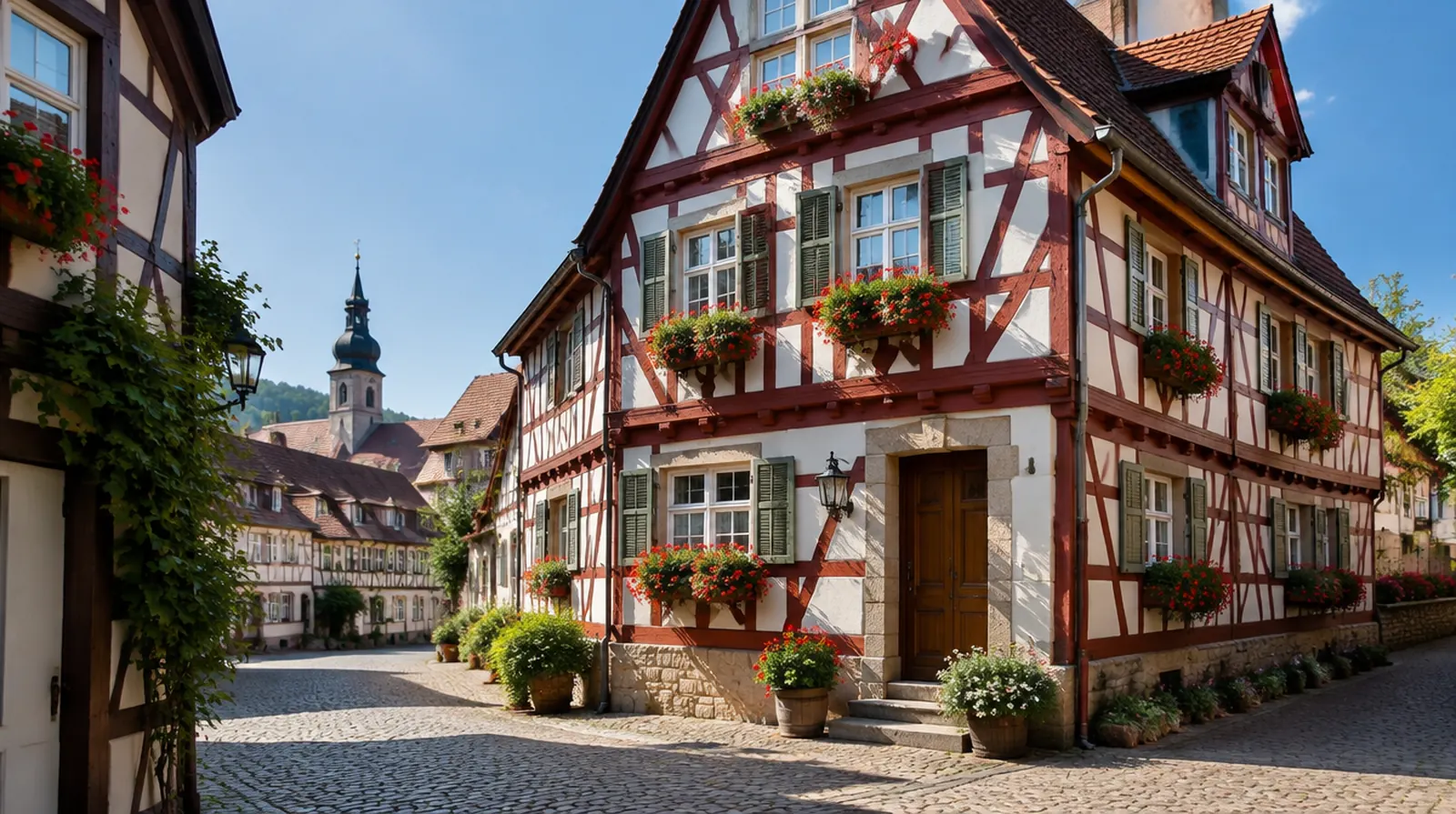
How do I insure a listed house in Germany? With buildings insurance (Wohngebäudeversicherung) whose sum covers rebuilding to heritage standards, not a modern new build. It should also pay the extra costs that the conservation authority's rules cause, without a tight percentage cap. Specialists quote about EUR 450 to 1,800 a year for a mid-sized listed home.
Published figures from providers and guides for listed houses in Germany.
Example
Typical range
Mid-sized listed family home
about EUR 450 to 1,800 a year
Mark-up on the 1914 value for heritage construction
about 20 to 60 percent
Rebuilding cost per square metre, listed house
about EUR 3,500 to 8,000, more for elaborate restoration
Restoration compared with an ordinary repair
about 30 to 80 percent more expensive
Flood zone ZÜRS 3 or 4
about 30 to 80 percent extra on the premium
Guide figures, October 2026.
The 1914 value of 22,000 marks,
the 40 percent mark-up and the premium in the example are guide values from quoting practice
within the published ranges.
We obtain the exact quote for your house.
Worked example
Timber frame house, 160 square metres, single listed building
The valuation form for a comparable standard house gives a 1914 value of 22,000 marks. This is how it becomes a sum that covers heritage rebuilding.
1914 value, standard house
22,000 marks
Heritage mark-up 40 percent
30,800 marks
Sum insured 2026 (30,800 × 2,263.6 ÷ 100)
about EUR 697,000
Extra costs at a 10 percent cap
at most about EUR 69,700
Premium including natural hazards, guide value
about EUR 900 to 1,300 a year
Without the mark-up, the house would be insured for about EUR 498,000, more than a quarter too low, and every claim would be cut accordingly.
Why a listed house needs different cover
In Germany a listed building is called a Denkmal, and the status is shown as Denkmalschutz. After a fire or storm you cannot simply repair it with standard materials. The conservation authority (Denkmalbehörde) often asks for lime plaster, wooden windows built to the old pattern, traditional roof tiles or handmade parts. That takes longer, needs specialist trades and costs a lot more.
Ordinary buildings insurance works on the cost of a new house of the same size and standard. For a listed house that is rarely enough. Two things matter: a sum insured that pays for rebuilding to heritage standards, and enough cover for extra costs caused by official requirements.
Getting the sum insured right
Many German insurers also use the 1914 value (Wert 1914) for listed houses. The standard valuation form does not capture timber framing, stucco, vaults or historic staircases. Specialist providers therefore add about 20 to 60 percent to the value of a comparable standard house, and more for elaborate buildings.
For a special house, a valuation by a surveyor who knows heritage buildings is better than the form. If the sum is considerably too low, section 75 of the German Insurance Contract Act (VVG) lets the insurer pay only in proportion to the real value. A waiver of this underinsurance deduction usually applies only if the sum was set by the insurer's own method.
Item
Standard house
Listed house
Rebuilding cost per square metre
about EUR 2,000 to 3,000
about EUR 3,500 to 8,000
How the sum is set
valuation form
form with mark-up, or a survey
Extra costs from official requirements
often 5 or 10 percent of the sum
ideally without a percentage cap
Trades
any building firm
often restorers and specialists
Extra costs from conservation rules
Many policies separate the damage itself from extra costs that arise only because of official requirements. Simple policies often cap these extra costs at a small percentage of the sum insured, or leave them out.
Look for wording that names extra costs from heritage protection, historic materials and restoration. Also check that planning, surveyor and architect fees are covered, because on a listed house hardly any work may start without agreement from the authority.
Tell the insurer what the house is
If the application asks in writing about listed status, year of construction, building type or a thatched roof, you have to answer truthfully under section 19 VVG. Wrong or missing answers can put your cover at risk when you claim.
Listed status makes the premium higher, but leaving it out is a poor way to save. A house that is only part of a protected ensemble, where just the outside counts, often costs less extra than a single listed building with a protected interior.
When a standard policy can be enough
If only the outward appearance is protected and the inside has been modernised, a good standard policy with a raised limit for extra costs can do. Then the main task is the right sum insured.
With timber framing, thatch, stucco, old windows or protected fittings inside, a policy designed for listed houses is worth it.
Step by step
Ask the conservation authority whether your house is a single listed building or part of an ensemble, and what exactly is protected.
Set the 1914 value with a heritage mark-up, or commission a valuation for rebuilding to heritage standards.
State listed status, construction, roof and year of building in full on the application.
Have extra costs from official requirements, historic materials and planning fees included in writing.
Check cover for natural hazards, especially for old houses near rivers or in old town centres.
Compare quotes with the same scope, not just the premium.
Checklist
Sum insured for heritage rebuilding, not for a new build
Underinsurance waiver confirmed in writing
Extra costs from conservation rules without a tight percentage cap
Planning, surveyor and architect fees included
Clearance and demolition costs high enough
Natural hazards (Elementarschaden) included
Gross negligence covered
Common mistakes
Leaving listed status off the application to save premium
Using the purchase price as the sum insured
Keeping a standard policy with a 5 percent cap on extra costs
Not raising the sum after a renovation with high quality materials
Questions and answers
Frequently asked
Do I have to tell the insurer the house is listed?
Yes, if the insurer asks in writing, and most applications do.
Tell your current insurer too, so the sum and extra cost cover fit.
Is insurance for a listed house compulsory in Germany?
Not by law.
If a bank finances the purchase, it will usually require buildings insurance.
Why is the premium higher than for a normal house?
Repairs with historic materials and specialist trades cost much more,
and the sum insured is higher.
Will the insurer pay for a faithful rebuild?
Only as far as the sum and the extra cost cover reach.
Both should be set for heritage rebuilding.
Does a house in a protected ensemble count as listed?
For the application, yes, so state it.
The mark-up is often lower because usually only the outside is protected.
Do I need a valuation?
With timber framing, stucco, vaults or thatch it makes sense,
because the standard form does not cover these features.