All about this insurance: Pet health insurance
Is pet insurance worth it in Germany?
Insurance broker / Insurance questions / Pet health insurance
In short
Surgery-only cover (OP-Schutz) is cheap and pays only when your pet is operated on, but then it includes the pre-operation check, the anaesthetic and the aftercare. Full cover (Vollschutz) costs about two to three times as much and also pays for treatment, diagnostics and medication. For a healthy pet with savings for small bills, surgery cover is enough.
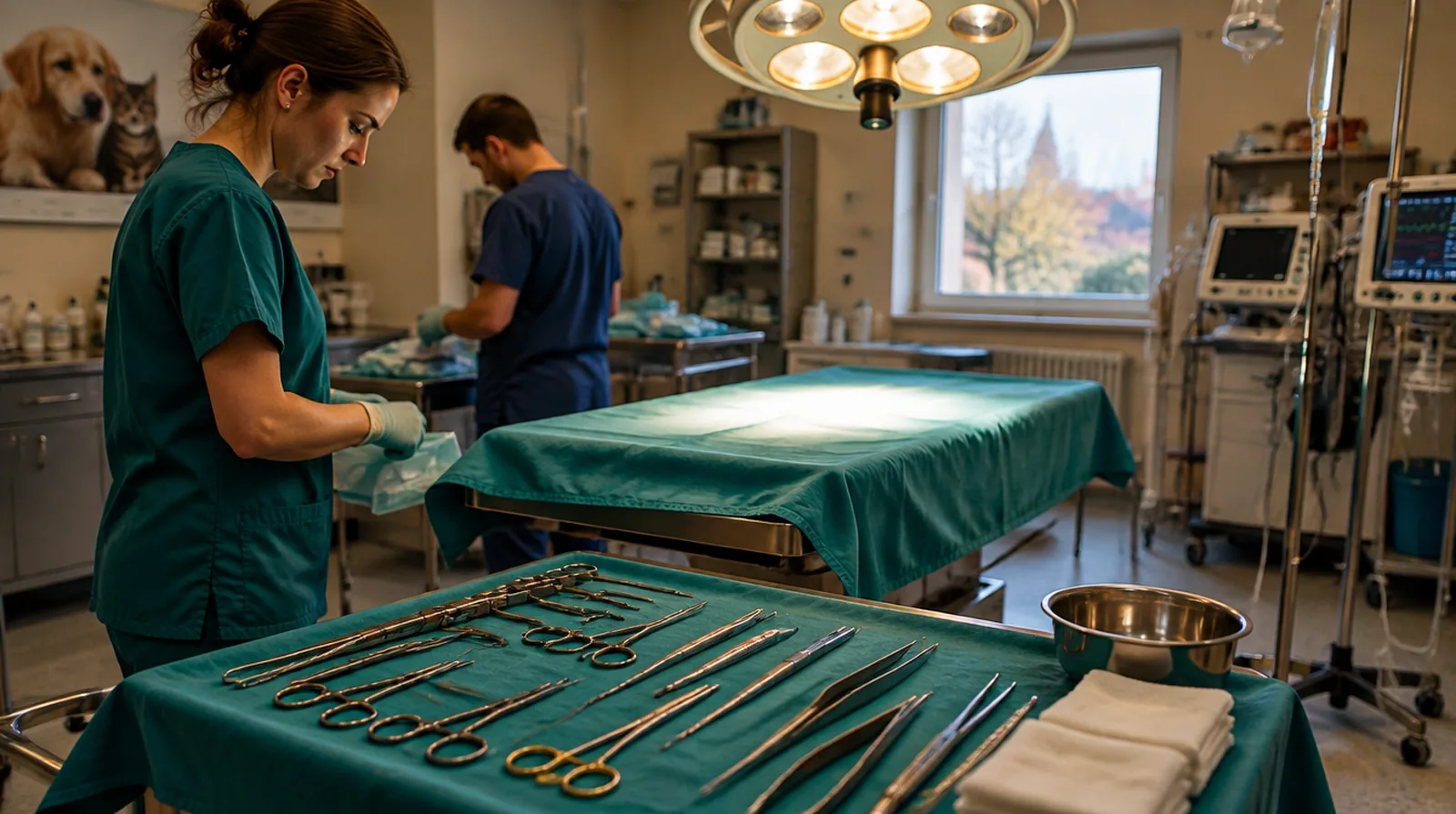
Premiums and treatment costs from published German tariff overviews, tests and price lists, as of September 2026.
| Example | Typical range |
|---|---|
| Surgery cover, young small dog | about EUR 4 to 8 a month |
| Surgery cover, large breed dog | about EUR 7 to 12 a month, up to EUR 30 with good benefits |
| Full cover, dog | about EUR 11 to 35 a month, large breeds up to EUR 70 |
| Surgery cover, cat | about EUR 7 to 25 a month |
| Full cover, cat | about EUR 16 to 50 a month |
| Cruciate ligament tear with diagnostics, surgery and aftercare | about EUR 2,500 to 4,500 |
| Foreign body in stomach or intestine, surgery | about EUR 1,500 to 3,500 |
| Dental treatment with anaesthetic, X-rays and extractions | about EUR 300 to 2,000 |
| Caesarean section | about EUR 1,300 to 2,600 |
| Usual reimbursement rates and deductibles | 80 to 100 percent reimbursement, deductible of EUR 0, 150, 250 or 500 or 20 to 30 percent |
Guide values as of September 2026 from published tariff overviews, tests and cost lists. The chronic course in the worked example is a guide value from our quoting practice, because such annual totals are rarely published. Your premium depends on the animal, its age, breed and the cover chosen; we obtain the exact quote for you.
Worked example
Calculated with surgery cover at EUR 10 a month and full cover at EUR 28 a month, both reimbursing 90 percent.
| Case 1, cruciate ligament tear: bill with diagnostics, surgery and aftercare | about EUR 3,500 |
| Case 1, paid by surgery cover | EUR 3,150 on a premium of EUR 120 a year |
| Case 1, paid by full cover | EUR 3,150 on a premium of EUR 336 a year |
| Case 2, chronic skin condition: examinations, allergy test, check-ups and daily medication over one year | about EUR 1,400 |
| Case 2, paid by surgery cover | EUR 0, because there was no operation |
| Case 2, paid by full cover after a EUR 150 deductible | EUR 1,125 |
In the first case surgery cover does exactly what full cover does and costs EUR 216 less a year. In the second case it pays nothing, while full cover reimburses EUR 1,125. So the choice does not turn on price, but on which of the two courses you think more likely for your pet.
Surgery cover responds when your animal is operated on under anaesthetic. It then pays the examination that leads to the operation, the anaesthetic, the procedure itself, the clinic stay and the aftercare up to a period named in the contract, usually a few weeks to a few months.
Anything that stays short of an operation is not covered. An ultrasound scan, an allergy test, long-term medication for arthritis or dental work without an extraction all fall outside. This is not fine print, it is the core of the product: you are insuring the risk of surgery, not your pet's health.
Full cover contains the operations and adds outpatient treatment: examination, X-ray, ultrasound, laboratory work, medication and often physiotherapy. Many tariffs include a preventive care budget for vaccination, worming and scale removal, typically EUR 50 to 150 a year.
You pay for that through three settings: the reimbursement rate of 80 to 100 percent, the annual limit (Jahreshöchstgrenze) and the deductible (Selbstbeteiligung). Always read those three numbers together. Full cover at 80 percent with an annual limit of EUR 2,000 is weaker on a EUR 3,500 operation than good surgery-only cover with no limit.
| Feature | Surgery cover | Full cover |
|---|---|---|
| Premium for a dog per month | about EUR 4 to 12 | about EUR 11 to 35, large breeds up to EUR 70 |
| Premium for a cat per month | about EUR 7 to 25 | about EUR 16 to 50 |
| Operation, anaesthetic, aftercare | yes | yes |
| Examination and advice without an operation | no | yes |
| X-ray, ultrasound, laboratory without an operation | no | yes |
| Medication for a chronic illness | no | yes |
| Preventive care, vaccination, worming | no | often with an annual budget of EUR 50 to 150 |
| Dental work without extraction | as a rule no | depends on the tariff |
| Suits | healthy pet, savings for small bills | breed with known conditions, predictable costs wanted |
Three courses of illness cost a lot of money and contain no operation. First the chronic condition: allergies, arthritis, thyroid, heart disease or epilepsy are treated for years with medication and check-ups, not with a scalpel. Second the long diagnostic search: when nobody knows yet why the animal limps or vomits, X-rays, ultrasound, laboratory work and referrals add up before anyone decides about surgery.
Third, dental work without extraction. A dental clean-up under anaesthetic with X-rays, where in the end only scaling and polishing happen, does not count as an operation in many contracts. Ask explicitly before you sign from which point teeth count as a surgical procedure, and get the answer in writing.
Choose surgery cover if you can carry small bills of EUR 100 to 500 yourself and only fear the one large one. That fits many healthy mixed-breed dogs and indoor cats. You pay much less premium and keep the protection against the case that really hurts.
Choose full cover if the breed brings known inherited conditions, if the animal already needs the vet regularly, or if you want predictable costs. For a pet prone to allergies, full cover is the only one of the two contracts that pays anything at all.
Pre-existing conditions are excluded in both forms, and both have waiting periods: usually 30 days in general, up to six months for certain illnesses, often none for accidents. Signing up after the first diagnosis no longer helps for that particular illness.
Both also band the premium by age. Moving from surgery cover to full cover after five years is possible, but it is priced at the age you have reached, and everything treated until then stays out. If you think full cover is likely, take it from the start.
Questions and answers
Surgery cover pays only for operations, including the pre-operation check, the anaesthetic and the aftercare. Full cover also pays for treatment, diagnostics and medication without an operation.
Only the examination that leads directly to the operation. X-rays and laboratory work that end in no operation are yours to pay.
It depends on the contract. An extraction usually counts as an operation, scaling under anaesthetic often does not. Ask before you sign.
For a young dog about two to three times as much: roughly EUR 11 to 35 a month against EUR 4 to 12. For cats the gap is similar.
Usually yes, but at the age you have reached and without anything treated until then. If you think full cover is likely, take it straight away.
Healthy animals with no known breed conditions, provided you can carry small bills of EUR 100 to 500 yourself.
Many tariffs include an annual budget of about EUR 50 to 150 for vaccination, worming and scale removal. That is a contribution, not full reimbursement.
NAMMERT insurance broker
We compare several insurers and come back with a proposal. Free for you; the insurer pays our fee. You can write in English.
Thank you, we have your request.
We will be in touch within one working day. If it is urgent: +49 3375 29 12 77.
All about this insurance: Pet health insurance
Is pet insurance worth it in Germany?
How much does dog health insurance cost in Germany?
For a young small dog, full cover (Vollschutz) usually costs EUR 11 to 18 a month, for a young large dog EUR 20 to 35. …
Is dog health insurance worth it in Germany?
It is worth it if you could not pay a vet bill of EUR 2,000 to 4,000 for an operation out of your own pocket. Surgery …
How much does cat health insurance cost in Germany?
Surgery cover for a cat (OP-Versicherung) usually costs EUR 7 to 25 a month, full health cover (Katzenkrankenversicher …
NAMMERT Assekuradeur GmbH, insurance broker licensed under section 34d(1) of the German Trade Regulation Act, broker register no. D-C08Q-TOSD4-37. For boat and yacht insurance we act as underwriting agency, not as broker. Statutory disclosure (German) · Updated
Was this useful?