A guard vessel that became the hazard itself
A tug watching a safety zone around two anchored tankers turned towards a sailing yacht and touched her. The German casualty investigators have now published what they take from it.
Law NAMMERT Assekuradeur GmbH
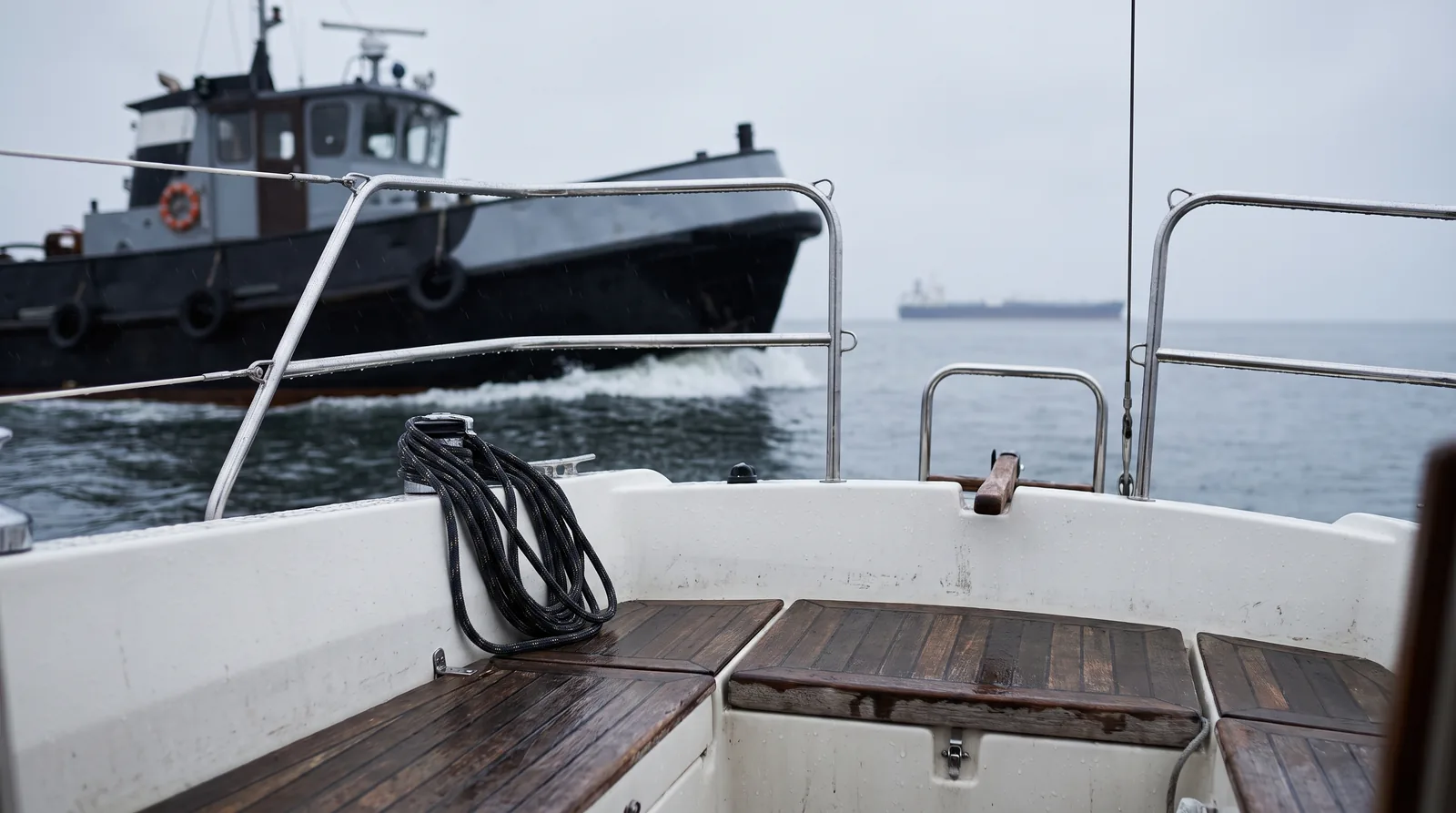
On 28 August 2023 a tug and a 9.60 metre sailing yacht collided on the Nordperd tanker anchorage off the German island of Rügen in the Baltic. Two liquefied gas tankers lay at anchor there and every vessel had to keep a minimum distance of one nautical mile. The yacht was sailing towards the restricted area at five to six knots. The master of the tug, which was working as a traffic safety vessel, picked her up at about 500 metres, saw no AIS signal and turned towards her at ten knots.
What happened next cannot be fully reconstructed, because the yacht carried no AIS transponder and no radar recordings were available. The Bundesstelle für Seeunfalluntersuchung, the German federal bureau of maritime casualty investigation, established that the tug closed to a parallel course eight to ten metres off and only then tried to make contact by shouting. Until that moment the skipper of the yacht had heard no sound or light signal and no call on VHF channel 16, which she had switched on. Both vessels turned to starboard and touched. The yacht suffered light damage to the hull and nobody was hurt.
The full report, number 472/23, was published on 29 April 2026, and the condensed lessons followed on 15 September 2026 as Lessons Learned 26. The central sentence is addressed to guard vessels: a missing answer on the radio is no reason to keep reducing the distance to the other vessel. Recreational craft do not necessarily carry VHF or AIS, so a traffic safety vessel has to be able to act safely without radio contact, and the special task does not replace the steering and sailing rules.
The bureau recommends that the German transport ministry introduce a uniform marking duty for traffic safety vessels under the Seeschifffahrtsstraßen-Ordnung, the traffic rules for German sea waterways, and that an internationally agreed solution be sought through the collision regulations. It proposes a synchronised yellow light and a legible Guard Vessel inscription on both sides. The waterways directorate is advised to set standard procedures for early contact and training standards for the masters involved. The yacht crew received a recommendation of their own: check existing restrictions before setting out.
What this means for owners
The practical point for owners sits in that last recommendation. A restricted area you did not know about is a weak position after a collision, and safety zones around anchorages, cable routes and construction sites appear at short notice through local notices. It mainly concerns sailing yachts and smaller motor boats without AIS or radar in coastal waters used by commercial traffic, because a boat that can neither be seen nor called has to create the distance itself. The question worth putting to your own insurer is a simple one: what does the contract expect from you after a contact at sea, how quickly must it be reported, and what has to be recorded on the spot.
This paragraph is our view as an underwriting agency, not part of the news. What your own policy covers is written in your own terms; when in doubt, call us.
Where this comes from
- Bundesstelle für Seeunfalluntersuchung, Lessons Learned 26 vom 15.09.2026
- Bundesstelle für Seeunfalluntersuchung, Untersuchungsbericht 472/23 vom 29.04.2026
- YACHT vom 22.09.2026
The text above is our own. The sources listed supplied the facts and the figures, not the wording.