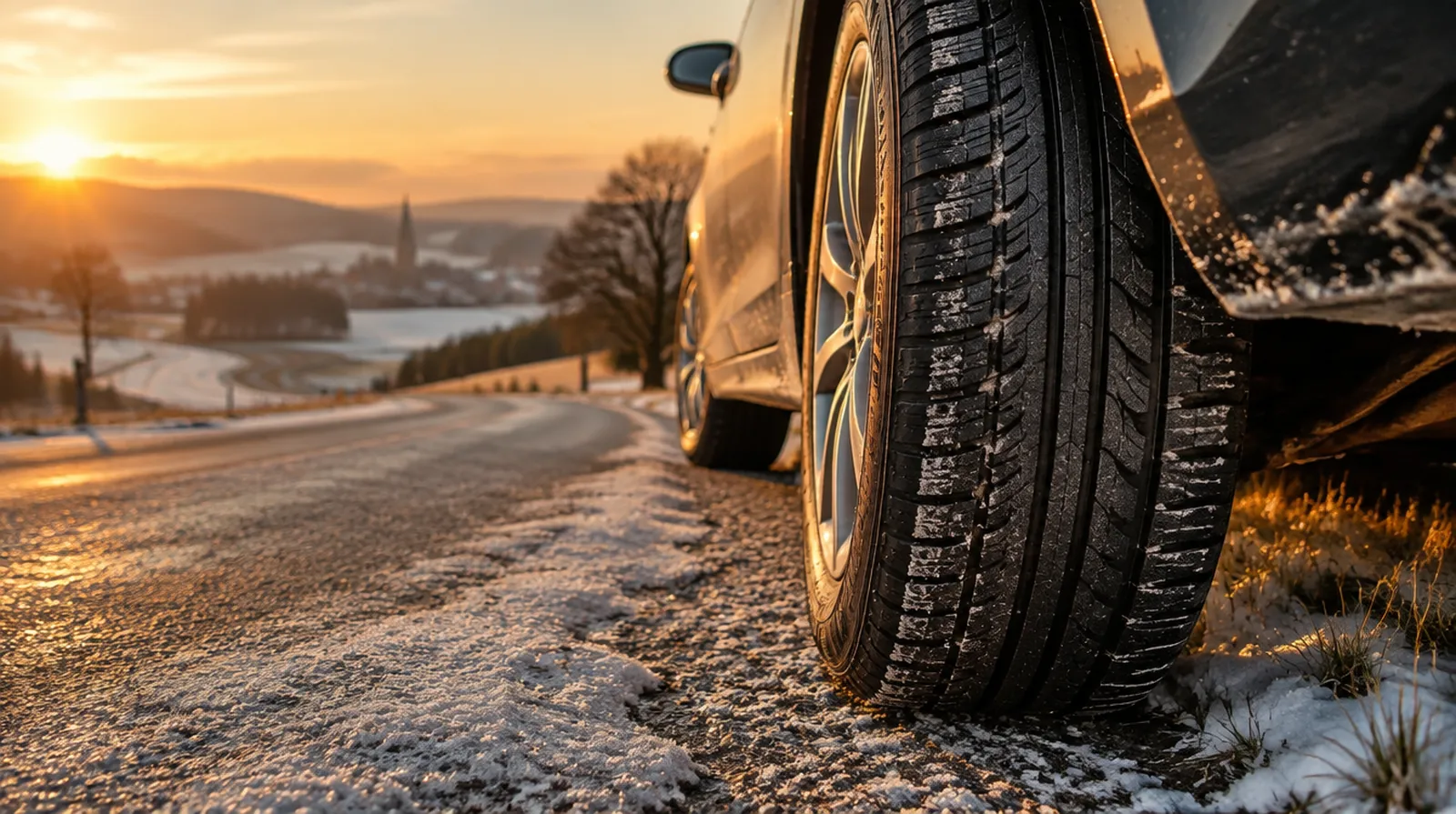
Does insurance pay for an accident with summer tyres in winter?
In short
Does insurance pay for an accident with summer tyres in winter in Germany? Yes for the other side: your liability insurance pays and may not cut for gross negligence. But on ice or snow you may get a bigger share of the blame, and comprehensive cover (Vollkasko) may reduce what it pays for your own car. On top come a fine of EUR 60 to 120 and one penalty point.
Published fines and tyre costs in Germany, 2024 to 2026.
Example
Typical range
Summer tyres in winter conditions
EUR 60 and 1 point
With obstruction, danger or accident
EUR 80, 100 or 120 and 1 point
Set of tyres for a compact car
about EUR 500 to 600
Four new tyres with fitting, Volkswagen
about EUR 530 to 695
Tyre change and storage per visit
about EUR 50 to 100, EUR 100 to 200 a year
As of October 2026, from fine tables, workshop prices and guides.
The cut ratio in the worked example is a guide value from our quoting practice,
courts decide case by case.
We are happy to check whether your policy waives the gross negligence defence;
we obtain the exact quote.
Worked example
Skidding on slush, own car damaged
In January a driver on summer tyres slides on slush into a crash barrier. No other car is involved. He has comprehensive cover with a EUR 300 deductible.
Repair of his own car
EUR 6,000
Crash barrier, paid by liability insurance
about EUR 2,000
Comprehensive cover cut by one third
about EUR 3,800 paid
Comprehensive cover waiving the gross negligence defence
EUR 5,700 paid
Fine with accident
EUR 120 and 1 point
Without the waiver about EUR 2,200 stays with you, with it only the deductible. A set of winter tyres would have cost about EUR 500 to 600. Calculation with guide values.
Liability insurance pays the other side
If you slide into another car on summer tyres in the snow, you are still insured. Your motor liability insurance (Kfz-Haftpflicht) pays the other driver. Under section 103 of the German Insurance Contract Act (VVG) it is only free of liability if you caused the damage on purpose. Gross negligence is not enough.
After the accident your liability no-claims class (Schadenfreiheitsklasse) is downgraded like after any other claim. The wrong tyres do not make the downgrade bigger, but they can raise your share of the blame.
Your share of the blame: tyres count
When two cars collide, courts split the blame in percentages. Summer tyres on ice or snow count against you, because you brake later and steer worse. Even if the other driver failed to give way, part of the damage may stay with you.
What matters is whether the tyres helped cause the accident. On a dry road above freezing they hardly matter, on packed snow they very much do.
Situation
Liability insurance
Comprehensive cover for your car
Dry road, no frost
pays
usually pays in full
Light ice, accident hardly avoidable even with winter tyres
pays
usually pays in full
Snow-covered road, summer tyres clearly a cause
pays, shared blame possible
cut for gross negligence possible
Winter trip into the mountains on summer tyres
pays
cut up to no payment possible
Policy waives the gross negligence defence
pays
pays in full
When comprehensive cover may cut for summer tyres
Damage to your own car is paid by comprehensive cover. If you cause the accident with gross negligence, section 81 (2) VVG lets the insurer reduce the payment in line with how serious the fault was. The Federal Court of Justice has not decided whether summer tyres in winter are grossly negligent, and lower courts differ.
The Higher Regional Court of Frankfurt saw driving to a ski resort on summer tyres as grossly negligent (case 3 U 186/02). The Regional Court of Hamburg made the insurer pay in full, because the skid on snow could have happened with winter tyres too (case 331 S 137/09). So the insurer has to show that the tyres caused the accident.
The German winter tyre rule and the fine
Germany has no fixed winter tyre date. Section 2 (3a) of the road traffic regulations (StVO) requires suitable tyres only in icy, snowy or slushy conditions. Since 1 October 2024 only tyres with the Alpine symbol, a mountain with a snowflake, count. All-season tyres with this symbol are fine.
Driving on summer tyres in such conditions costs EUR 60 and one point. If you obstruct others it is EUR 80, if you endanger them EUR 100, with an accident EUR 120, each with one point.
When you do not need winter tyres
If you only drive on dry roads in winter and leave the car at home when it snows, you may keep summer tyres. Parking on summer tyres is always allowed. The risk is yours: if ice surprises you on the way, the rules above apply.
For low-mileage drivers in the lowlands, all-season tyres with the Alpine symbol are often the cheaper choice, because you skip changing tyres twice a year.
Step by step
Photograph the scene, the road surface and your tyres.
Report the accident truthfully, including the tyres.
Check your policy for a waiver of the gross negligence defence (Verzicht auf den Einwand der groben Fahrlässigkeit).
If the insurer cuts, have it checked whether the tyres really caused the accident.
Fit tyres with the Alpine symbol before next winter.
Checklist
Tyres with the Alpine symbol on all four wheels
At least 4 mm tread recommended for winter
Comprehensive cover with a gross negligence waiver
Tyre change booked in good time in October
Car left at home in icy weather without suitable tyres
Common mistakes
Believing that without winter tyres you have no insurance at all
Keeping old M+S tyres without the Alpine symbol
Hiding the tyres from the insurer
Accepting a cut without checking, although the road was dry
Questions and answers
Frequently asked
Does liability insurance pay if I crash on summer tyres?
Yes.
The other party gets their damage paid.
Liability insurance may only refuse in case of intent.
How much does comprehensive cover cut?
That depends on how serious the fault was.
On light ice often nothing, on a snowy mountain trip it can go up to full refusal.
Is there a fixed winter tyre date in Germany?
No.
The rule applies in icy or snowy conditions.
October to Easter is a rule of thumb, not law.
Are all-season tyres enough?
Yes, if they carry the Alpine symbol.
Plain M+S tyres have not counted since 1 October 2024.
What about driving to Austria or Switzerland?
Other countries have their own rules,
Austria for example from 1 November to 15 April in winter conditions.
Check the rules of your destination before you go.