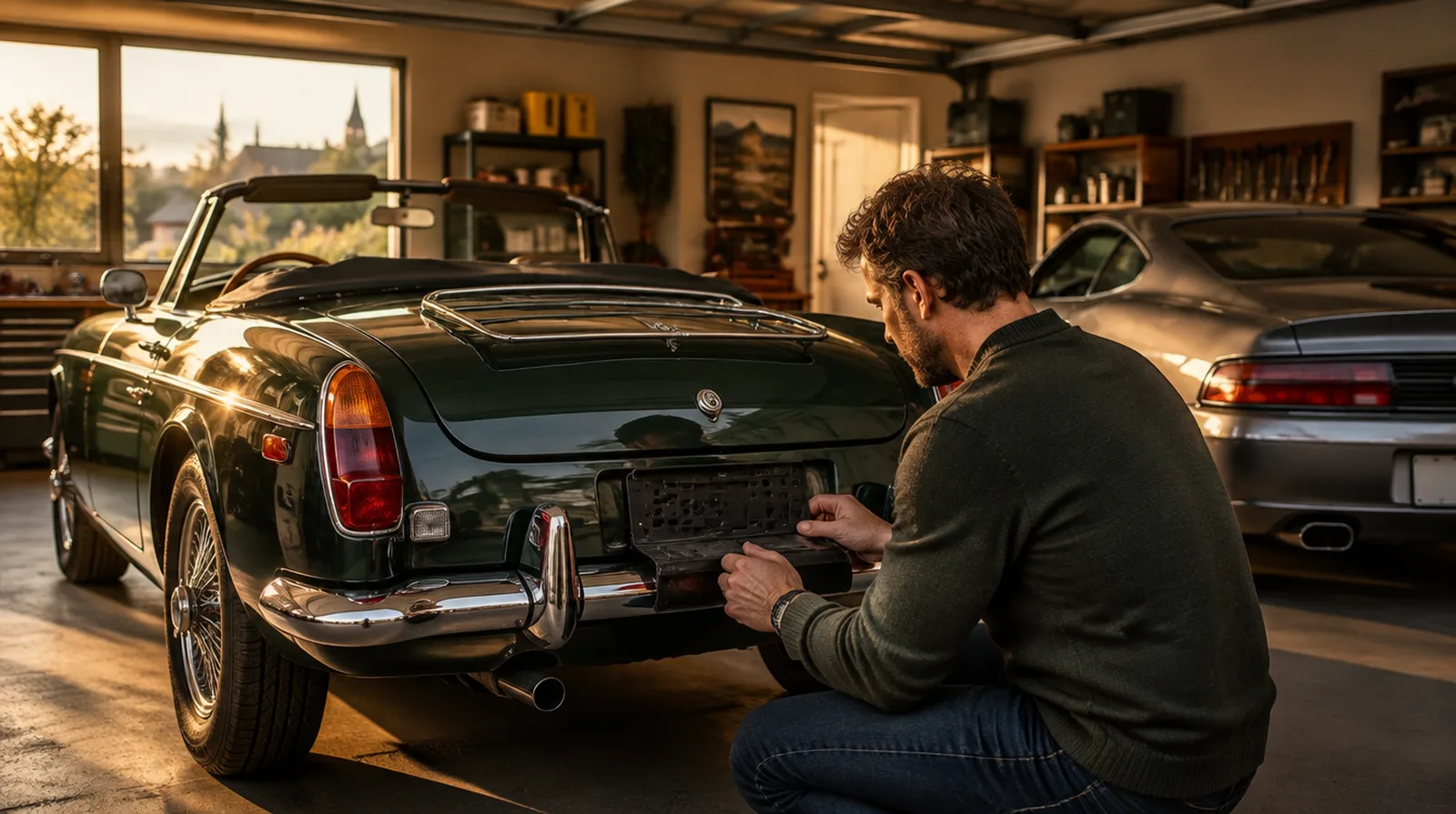
Is an interchangeable number plate worth it in Germany?
In short
Rarely for the money. With an interchangeable number plate (Wechselkennzeichen) in Germany you still pay full vehicle tax on both cars and need two insurance contracts; most insurers no longer give a discount. Registration costs about EUR 85 to 95 once. It is worth it for convenience when you never drive both vehicles at the same time.
Fees and fines from published figures, as of October 2026.
Example
Typical range
Administrative fee for the interchangeable plate
about EUR 65
Plates, depending on region
about EUR 20 to 30
Registration including plates
about EUR 85 to 95 one time
Vehicle tax
100 percent on both vehicles
Parking on a public road with incomplete plate
EUR 40 fine
Fees and fines from public sources, October 2026.
The premiums in the example are guide values from our quoting practice; we obtain your exact quote.
Worked example
Everyday car and convertible on one plate
An estate car for daily use and a convertible for trips, both passenger cars, never driven at the same time. Assumed premiums with liability and partial cover.
Estate car, liability and partial cover
about EUR 600 a year
Convertible, liability and partial cover
about EUR 300 a year
Discount for the interchangeable plate at most insurers
EUR 0
Vehicle tax
unchanged for both
Registration, one time
about EUR 85 to 95
You usually save nothing on premiums, and registration adds about EUR 85 to 95 once. The interchangeable number plate is worth it here only because swapping one plate is easier than handling two registrations.
How the interchangeable number plate works
Since July 2012 two vehicles with the same keeper can share one number plate. It has a large shared part and a small part for each vehicle that stays on the car and shows the last digit and the inspection sticker (HU-Plakette).
Only the vehicle carrying both parts may be driven. The other one has to stand in a garage or on a private parking space.
Combination
Interchangeable plate possible?
Two cars (class M1)
yes
Two motorcycles or quads (class L)
yes
Two light trailers up to 750 kg (class O1)
yes
Car and motorcycle
no
Three vehicles
no, in Germany two at most
Combined with a seasonal plate
no
Why it hardly saves money in Germany
Unlike in Austria, the interchangeable number plate in Germany brings no tax saving. Both vehicles are taxed in full, as if they were registered separately.
Your insurer also counts two vehicles. Each one needs its own liability cover with its own no claims class (Schadenfreiheitsklasse). Most insurers no longer offer a special tariff or discount for the interchangeable plate.
When it is still worth it
If you own two cars but never drive both at once, the interchangeable number plate saves trips to the registration office (Zulassungsstelle) and keeps things simple. A typical case is an everyday car plus a classic car or convertible for weekends.
The parked vehicle stays registered, so partial cover (Teilkasko) still protects it against storm, hail, fire or theft at its parking space.
When a seasonal plate is the better choice
If you only drive the second vehicle in summer, a seasonal plate (Saisonkennzeichen) is usually cheaper than an interchangeable number plate, because tax and insurance are only charged for the season.
The interchangeable plate suits you better if you want to use the second vehicle on short notice all year round.
Limits and downsides
Without a private parking space for the resting vehicle, the interchangeable number plate does not work. Parking it on the street with an incomplete plate costs EUR 40, driving with an incomplete plate EUR 50.
If two people in your household need to drive at the same time, you need two normal registrations instead.
Step by step
Check that both vehicles are in the same class and registered to you.
Make sure you have a garage or private space for the resting vehicle.
Ask your insurer for two eVB numbers (electronic insurance confirmation).
Compare: would a seasonal plate be cheaper for the second vehicle?
Apply at the registration office and register the second vehicle within one year.
Checklist
Both vehicles in the same class
Never both on the road at once
Private parking space available
Two eVB numbers from the insurer
Partial cover for the resting vehicle checked
Seasonal plate compared as an alternative
Common mistakes
Expecting a tax saving like in Austria
Parking the vehicle without its small plate part on the street
Trying to combine a car and a motorcycle
Not checking whether a seasonal plate is cheaper
Questions and answers
Frequently asked
Does an interchangeable number plate save vehicle tax in Germany?
No.
You pay full vehicle tax on both vehicles.
How much do I save on insurance?
Usually nothing.
Most insurers no longer offer a discount for the interchangeable plate;
each vehicle is priced on its own.
Do I need two insurance policies?
Yes.
Each vehicle needs its own liability cover and its own eVB number for registration.
Can I use one plate for a car and a motorcycle?
No.
Both vehicles must be in the same class.
Is the parked vehicle insured?
Yes, it stays registered.
With partial cover, storm, hail, fire and theft at the parking space are covered.
What does it cost?
About EUR 65 in fees, about EUR 85 to 95 including plates, depending on the registration office.