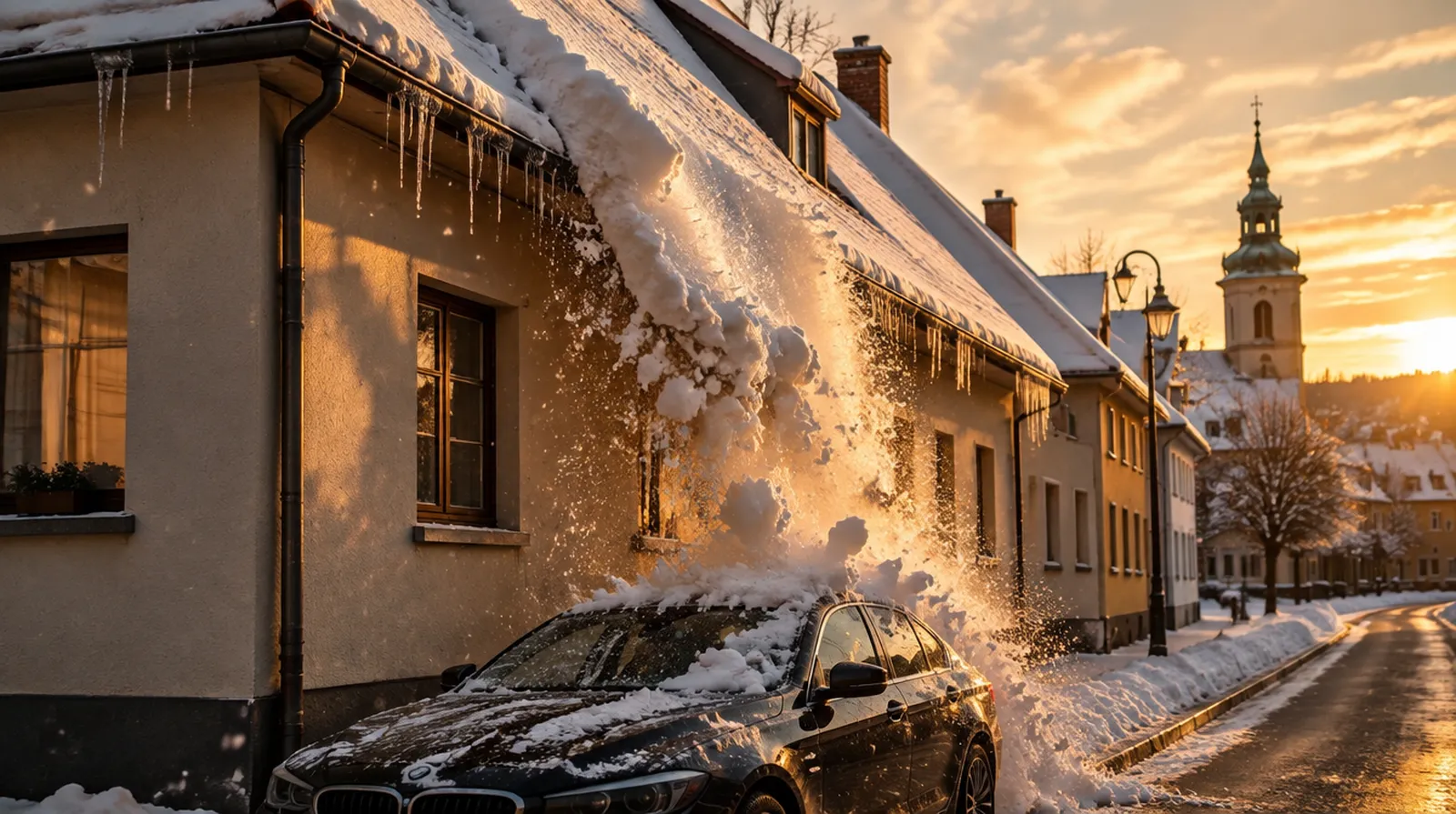
Who pays when snow falls off a roof onto your car in Germany? Usually your partial cover (Teilkasko), but only if the policy names roof avalanches (Dachlawinen). Your no-claims class stays the same. Without that clause only comprehensive cover pays, with a downgrade. The building owner is rarely liable. With liability only, you pay yourself, from a few hundred to over EUR 2,000.
Published repair prices in Germany and amounts from court rulings.
Example
Typical range
Removing one dent up to 2 cm without paint
about EUR 70
Roof with 20 dents up to 3 cm
about EUR 320
New windscreen, depending on model
about EUR 400 to 600, sometimes more
Damage in the Munich court case
EUR 2,034
Usual deductible in partial cover
about EUR 150
As of October 2026, from workshop prices, guides and reports on rulings.
The amounts in the worked example and the cost range in the answer are a guide value from our
quoting practice.
We are happy to check whether your policy includes Dachlawinen; we obtain the exact quote.
Worked example
A sheet of ice on bonnet and windscreen
A compact car is parked overnight on the street in front of an apartment block. In the morning a sheet of ice slides off the roof, the windscreen cracks and the bonnet has several dents.
New windscreen
about EUR 500
Bonnet dent repair, partly repainted
about EUR 800 to 1,200
Partial cover with Dachlawinen, deductible
EUR 150
Paid by partial cover
about EUR 1,150 to 1,550
Without the clause, comprehensive cover with EUR 300 deductible
about EUR 1,000 to 1,400 plus downgrade
With Dachlawinen in your partial cover you pay only EUR 150 and keep your no-claims class. Calculation with guide values.
Partial cover pays only with a clear clause
German partial cover pays for natural events such as storm, hail, lightning and flooding. Snow or ice sliding off a roof onto your car is not automatically included. Many newer policies name roof avalanches (Dachlawinen) explicitly, simple and older ones often do not.
A local court in Halle ruled in 2011 that a roof avalanche is not an avalanche in the sense of old policy wording (case 93 C 3643/10). The driver got nothing, because his contract excluded avalanches and newer wording had never been agreed. New terms do not apply to old contracts on their own.
Your cover
Who pays for your own car
Effect on your premium
Partial cover with Dachlawinen
partial cover, minus deductible
no downgrade
Partial cover without Dachlawinen
nobody from partial cover
none
Comprehensive cover (Vollkasko)
comprehensive cover, minus deductible
no-claims downgrade
Liability only
you, unless the owner is liable
none
Owner breached his duties
his building liability insurance
none for you
When the building owner is liable
In Germany owners do not have to protect everyone from snow falling off a roof in every case. Courts require snow guards or warning signs only if a local bylaw demands them or there are special circumstances: a steep, high roof over a pavement or car park, unusual amounts of snow, heavy traffic.
A local court in Munich dismissed a driver's claim for EUR 2,034 in 2011 (case 275 C 7022/11). The roof was low and gently sloped, the snow was visible. Parking there was at the driver's own risk. If the owner is liable after all, his building or private liability insurance pays.
Your share of the blame when you park there
If you leave your car under a roof that is visibly loaded with snow, that counts against you. Towards the owner it can cost you all or part of your claim.
For your own partial cover the parking spot usually does not matter, as long as you are not grossly negligent. Parking right under an overhanging snow cornice despite a barrier and a warning sign could count as grossly negligent.
When a claim for roof snow damage is not worth it
A small dent without paint damage can often be pushed out for EUR 70 to 85. If the damage is below your partial cover deductible, often EUR 150, a claim brings nothing.
With comprehensive cover a claim can even backfire: the no-claims downgrade often costs more over several years than a repair of a few hundred euros. Do the maths before you report it.
Who hardly needs roof avalanche cover
If your car spends the winter in a garage, under a flat carport or in an open car park, the risk is low. In regions with little snow the clause matters little.
If you live in the Alps, in the low mountain ranges or park in old town streets under steep roofs, check for the clause when you next switch. It rarely costs extra because it is part of the package.
Step by step
Photograph the damage and the roof before moving the car.
Ask neighbours or the property manager to act as witnesses and note their names.
Search your policy terms for Dachlawine, Schneedruck (snow load) or Lawine.
Get a repair estimate and compare it with your deductible.
Report the claim to partial cover or, if the owner clearly breached his duties, write to him.
Checklist
Dachlawinen named explicitly in partial cover
Low deductible in partial cover, about EUR 150
No parking under roofs with visible snow or icicles in winter
Warning signs and barriers taken seriously
Old contracts switched to current terms
Common mistakes
Assuming every partial cover pays for snow falling off a roof
Claiming small damage on comprehensive cover and losing no-claims years
Suing the owner although the snow was visible and no snow guard was required
Driving the car away before photographing the scene
Questions and answers
Frequently asked
Does partial cover always pay for a roof avalanche?
No.
Only if your policy names Dachlawinen.
Older contracts often list only storm, hail, lightning and flooding.
Will my premium go up?
Not with partial cover, it has no no-claims class.
If comprehensive cover pays, it is downgraded.
Does my landlord have to pay?
Only if he breached his duties, for example no snow guard or warning despite a special danger.
Courts reject liability in most cases.
Are snow guards mandatory in Germany?
Only where a local bylaw or building rule requires them or special circumstances apply.
There is no general duty.
What if snow flies off the roof of another car or a lorry?
That is not a roof avalanche but a case for the other vehicle's liability insurance.
Drivers who do not clear their roof can be liable.