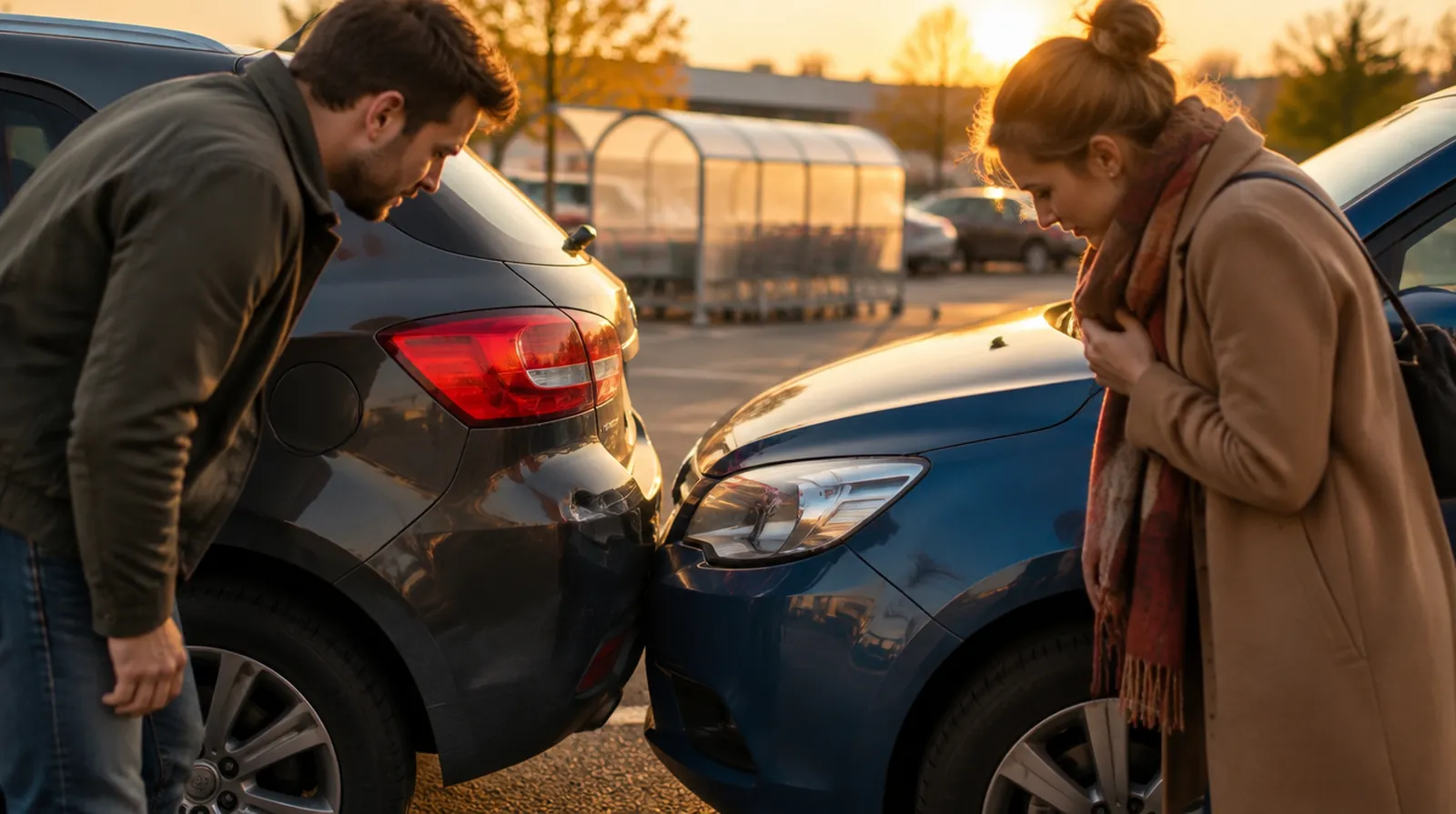
Who is liable for an accident in a car park in Germany?
In short
Who is liable for an accident in a car park in Germany depends on who was moving. If someone reverses into a car that had already stopped, they are usually liable. If both cars were moving and nobody can prove who stopped first, liability is often shared, for example half each. Your own share of the damage to your car is only paid by comprehensive cover (Vollkasko).
What a car park bump costs today, from a German repair cost survey published in February 2026.
Example
Typical range
Rear bump, bumper with sensors, electric SUV
about EUR 2,800 to 2,900
Front bump, bumper and headlight, small car
about EUR 2,900 to 3,000
Front bump, bumper and headlight, mid-size SUV
about EUR 5,800 to 6,000
Front bump with laser headlight, mid-size car
about EUR 7,800 to 8,000
Workshop prices from a market survey published in February 2026, depending on the model.
The deductible and damage amounts in the worked example are guide values from our quoting practice.
Your figure depends on the car, the workshop and your policy.
Worked example
Two cars reverse at the same time, nobody can prove who had stopped
In a DIY store car park you and another driver collide while backing out. Liability is split half and half.
Your damage
EUR 3,000
Damage to the other car
EUR 2,000
Their liability insurer pays you half
EUR 1,500
Your liability insurer pays them half
EUR 1,000
Your remaining EUR 1,500 via comprehensive cover, deductible
EUR 300
With comprehensive cover you pay EUR 300 yourself, without it EUR 1,500. Your liability policy drops a class, and so does your comprehensive cover if you claim on it.
Why a car park is different from the road
The German Road Traffic Regulations (StVO) apply in car parks, but differently from the road. Aisles without a clear road character are for manoeuvring and looking for a space, not for through traffic. The Federal Court of Justice (BGH) therefore relies on the general duty of consideration in section 1 StVO. The strict rules on reversing in section 9 (5) StVO do not apply directly there, but they shape that duty.
For you this means: whoever drives in a car park must always expect cars backing out of a space. You cannot rely on others paying attention the way you could in flowing traffic. According to the BGH, if you drive slowly, ready to brake, and come to a stop before the impact, you have normally done what was required.
Typical situations and how they usually end
If someone reverses and hits a car that had already stopped, the BGH ruling of 26 January 2016 (VI ZR 179/15) says the first appearance speaks against the reversing driver. They then have to prove they were not at fault.
If two cars both reverse out of opposite spaces and it stays unclear whether one had stopped, there is no such presumption (BGH ruling of 15 December 2015, VI ZR 6/15). The court then weighs fault and the general operating risk of both cars. In that BGH case the lower courts had set liability at 50 percent each.
Situation
Who is usually liable
What decides it
You have stopped, the other car reverses into you
the reversing driver, often alone
proof that you had stopped
Both cars reverse at the same time
both, often shared
who stopped first, photos, witnesses, cameras
You drive along the aisle, another car pulls out of a space
the driver pulling out if you had stopped, otherwise often both
whether you drove slowly and stopped in time
You hit a parked car
you alone, your liability insurance pays
only the amount of damage
Who pays what in the end
Liability and insurance are two separate steps. If the other driver is fully liable, their motor liability insurer (Kfz-Haftpflicht) pays your damage and your own policy is not touched. If liability is shared, each liability insurer pays its share of the other car's damage. That counts as a claim on both policies and normally means a drop in no-claims class (Schadenfreiheitsklasse).
The part of your own damage that nobody refunds is only paid by your comprehensive cover, minus the deductible. Partial cover (Teilkasko) pays nothing for a collision. Without comprehensive cover you carry that part yourself.
When a dispute is not worth it
For small damage, going to court over a liability split rarely pays off. Lawyer and expert fees can be higher than the amount at stake. Without witnesses or pictures, a split is often the realistic outcome.
Many insurers let you buy back a claim they have paid, usually within six months. For a small amount paid to the other driver, this can be cheaper than the drop in class.
If you hit a parked car
Wait a reasonable time at the scene. If nobody comes, report the damage to the police without delay. A note under the wiper is not enough. Leaving without these steps risks a case for leaving the scene of an accident under section 142 StGB, with a fine or up to three years in prison.
Step by step
Switch on hazard lights, only move the cars if they block traffic, and photograph their position first.
Take photos of both cars, steering angle, the aisle and the spaces.
Note the other driver's name, number plate and insurer, and ask witnesses for their details.
Ask the operator about cameras early and request that the footage is kept.
Report the accident to your motor liability insurer and do not admit fault at the scene.
Decide on a comprehensive claim for your remaining damage only once the liability split is known.
Checklist
Photos of where both cars came to rest
Details of the other driver and their insurer
Names and phone numbers of witnesses
Note of any cameras in the car park
Deductible and buy-back deadline from your policy
Common mistakes
Moving the cars straight away without photographing their position
Saying at the scene that it was your fault although the course of events is unclear
Trusting that drivers pulling out will see you and driving briskly along the aisle
Leaving only a note after a scrape and driving off
Questions and answers
Frequently asked
Do the same rules apply in a car park as on the road?
The StVO applies,
but in aisles without a clear road character mutual consideration under section 1 StVO comes first.
You must always expect cars pulling out.
Who is liable if I had stopped and the other car reversed into me?
Then the first appearance speaks against the reversing driver.
You do need to be able to show that you really had stopped.
Will I drop a no-claims class if liability is shared?
Normally yes, because your liability insurer pays part of the other car's damage.
Buying back the claim can pay off for small amounts.
Does partial cover pay my share?
No.
A collision with another car is only covered by comprehensive cover.
Is a note enough if I scraped a parked car?
No.
You must wait a reasonable time and then report the damage without delay,
for example to the police.
Otherwise you risk a case under section 142 StGB.
Do I need the police after an accident in a car park?
For pure damage to the cars and when you agree on the details, not necessarily.
With a dispute, injuries or an absent owner it makes sense.