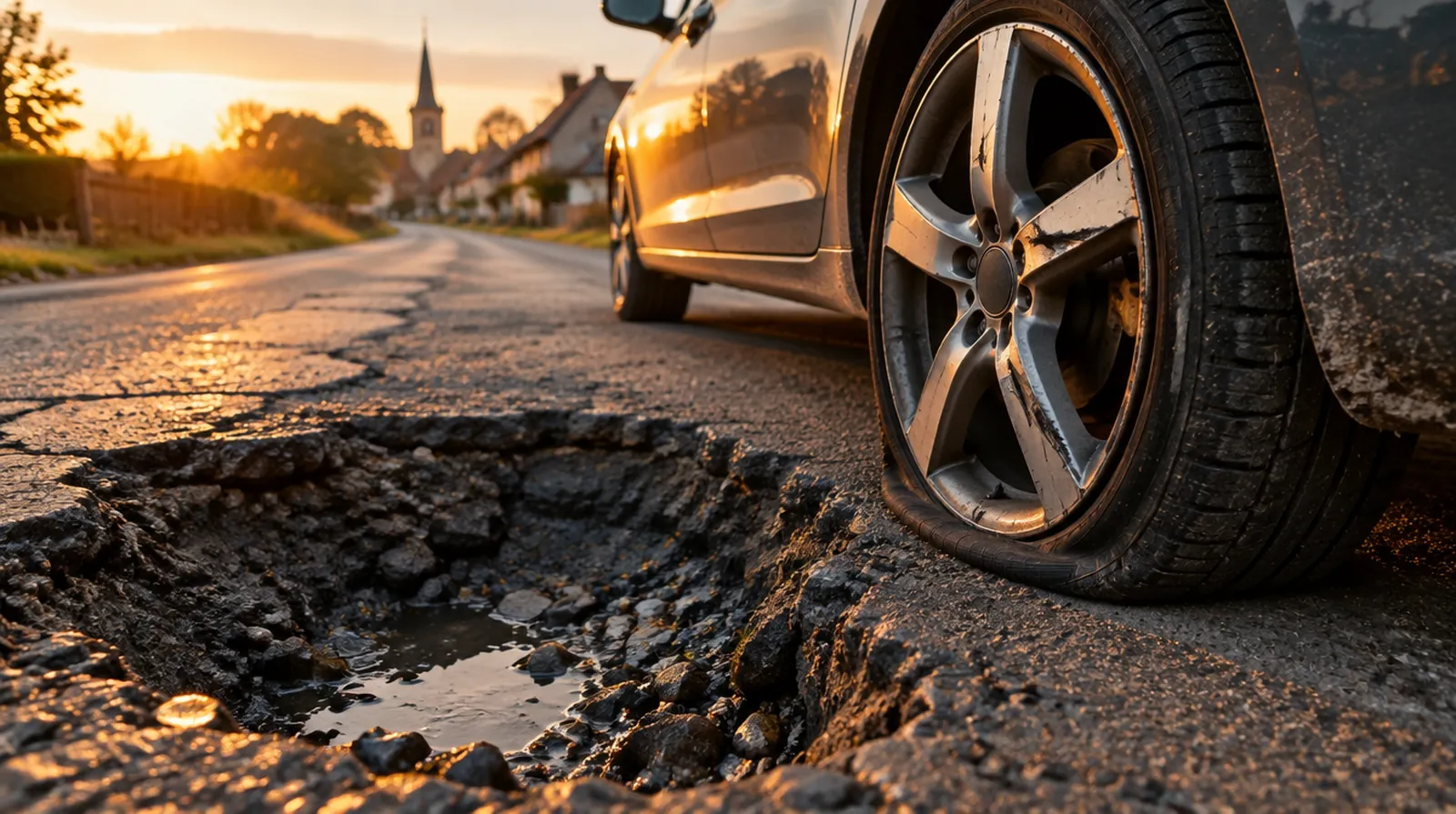
Who pays for pothole damage to my car in Germany? Usually only your comprehensive cover (Vollkasko), minus the deductible and with a no-claims downgrade. Liability and partial cover do not pay. The road authority is rarely liable, for example if a hole without a warning sign could not be seen. An alignment alone costs about EUR 50 to 150, a new control arm per axle EUR 400 to 1,000.
Publicly quoted German workshop prices for typical damage after a pothole, tyres not included.
Example
Typical range
Wheel alignment, depending on the car
about EUR 50 to 150
Toe adjustment after the alignment check
usually EUR 70 to 150
Refurbishing or repainting a rim
under EUR 100 to about EUR 300 per rim
Replacing control arms, per axle
about EUR 400 to 1,000
Damages awarded against a town, Meiningen Regional Court 2006
EUR 403.63
Guide values as of October 2026 from publicly quoted workshop prices and guides.
The deductible in the worked example is a guide value from our quoting practice.
We are happy to work out what a downgrade would cost under your policy.
Worked example
Compact car, deep pothole at night on a town road
After the impact the car pulls to the right and the rim is dented. This is what the bill looks like.
Front control arms, both sides
about EUR 400 to 1,000
Wheel alignment
about EUR 50 to 150
Refurbishing the rim
about EUR 100 to 300
Comprehensive deductible, assumed
EUR 300
Damage about EUR 550 to 1,450, comprehensive cover pays about EUR 250 to 1,150. At the lower end, paying yourself is often cheaper because of the downgrade.
Which insurance pays for pothole damage
A pothole is not an accident with another person, so your motor liability does not help: it only pays for damage you cause to others. Partial cover does not pay either, it is meant for theft, wildlife, glass and natural hazards.
That leaves comprehensive cover. It pays for damage to rims, axles, steering and suspension. Many insurers, however, treat damage to the tyre alone as wear and tear and do not pay. And every comprehensive claim usually moves you down in your no-claims class (Schadenfreiheitsklasse).
Who
Pays for the pothole?
Catch
Motor liability
no
only damage to others
Partial cover
no
only theft, wildlife, glass, natural hazards
Comprehensive cover
yes
deductible and downgrade, tyre damage alone often not
Road authority
rarely
you must prove suitable speed and a hazard you could not see
When the town, state or federal government pays
Whoever is responsible for a road must keep it safe: the federal government for motorways, the states for state roads, districts and independent cities for district roads, municipalities for local roads. This duty is limited, though. If there is a warning sign or a low speed limit, the authority has usually done enough.
German traffic rules also require you to drive at a speed that lets you react to the road surface (§ 3 para. 1 StVO). If you were too fast, you will usually get nothing. Courts rarely side with drivers: in 2006 the Meiningen Regional Court awarded a driver EUR 403.63 because the town of Suhl had not secured damaged roads well enough.
Claim on comprehensive cover or pay yourself
Do the maths before you report. The deductible comes off the bill, and your premium often rises for several years afterwards. For a new rim or an alignment alone, a claim rarely pays off.
If the suspension is damaged, the bill quickly reaches four figures. Then comprehensive cover usually pays much more than the downgrade costs.
When a claim against the authority makes no sense
It is not worth going after the municipality if there was a warning sign, the hole was easy to see or the damage is below a few hundred euros. The burden of proof is on you, and without legal expenses insurance you carry the cost risk yourself.
It can be worth trying for a deep hole without any warning, at night or behind a crest, if you have photos and ideally a witness. Report the damage in writing to the responsible authority.
Step by step
Stop safely, switch on the hazard lights and check the car for visible damage.
Photograph the pothole with something for scale, the surroundings, any warning signs and the damage, and note place and time.
Call the police if the damage is serious or the hole endangers others.
Have suspension and alignment checked at a workshop and get a cost estimate.
Find the responsible road authority and report the damage in writing if there was no warning sign.
Claim or pay yourself: weigh deductible and downgrade against the bill.
Checklist
Photos of the hole with a scale and of the whole spot
Date, time, exact location and your speed noted
Witnesses with phone numbers
Workshop cost estimate
Check whether your policy includes comprehensive cover and how high the deductible is
Common mistakes
Driving on with a bent rim or a crooked steering wheel
Reporting the damage under partial cover, which does not pay for it
Claiming a small amount on comprehensive cover and forgetting the downgrade
Asking the municipality for money without photos of the spot
Questions and answers
Frequently asked
Does partial cover pay for a pothole?
No.
Pothole damage falls under comprehensive cover.
Partial cover pays for things like theft, wildlife collisions, broken glass and natural hazards.
Will I be downgraded after a pothole claim?
On comprehensive cover, usually yes.
That is why paying small amounts yourself often makes sense.
Is the town liable if there was no warning sign?
Not automatically.
You must show that you drove at a suitable speed and could not see the hole.
That rarely succeeds.
Does insurance pay for a damaged tyre?
Many insurers do not pay for tyre damage alone because they see tyres as wear parts.
Comprehensive cover does pay for rims, axles and steering.
Can I keep driving with a bent rim?
Better not.
An alloy rim with a crack or excessive deformation must be replaced,
otherwise the tyre may fail while driving.
Do I have to call the police?
It is advisable for larger damage or if the hole endangers others.
Otherwise photos and your account are enough for comprehensive cover.