Magazine / Magazine
Boat damaged at the yard during winter work: hull cover or repair contract
A mast buckles on the crane, grinder sparks burn holes in the cushions, a forklift dents the hull. Whether hull cover or the yard pays depends on the peril, the contract and the photos.
10 October 20267 min readNAMMERT Assekuradeur GmbH
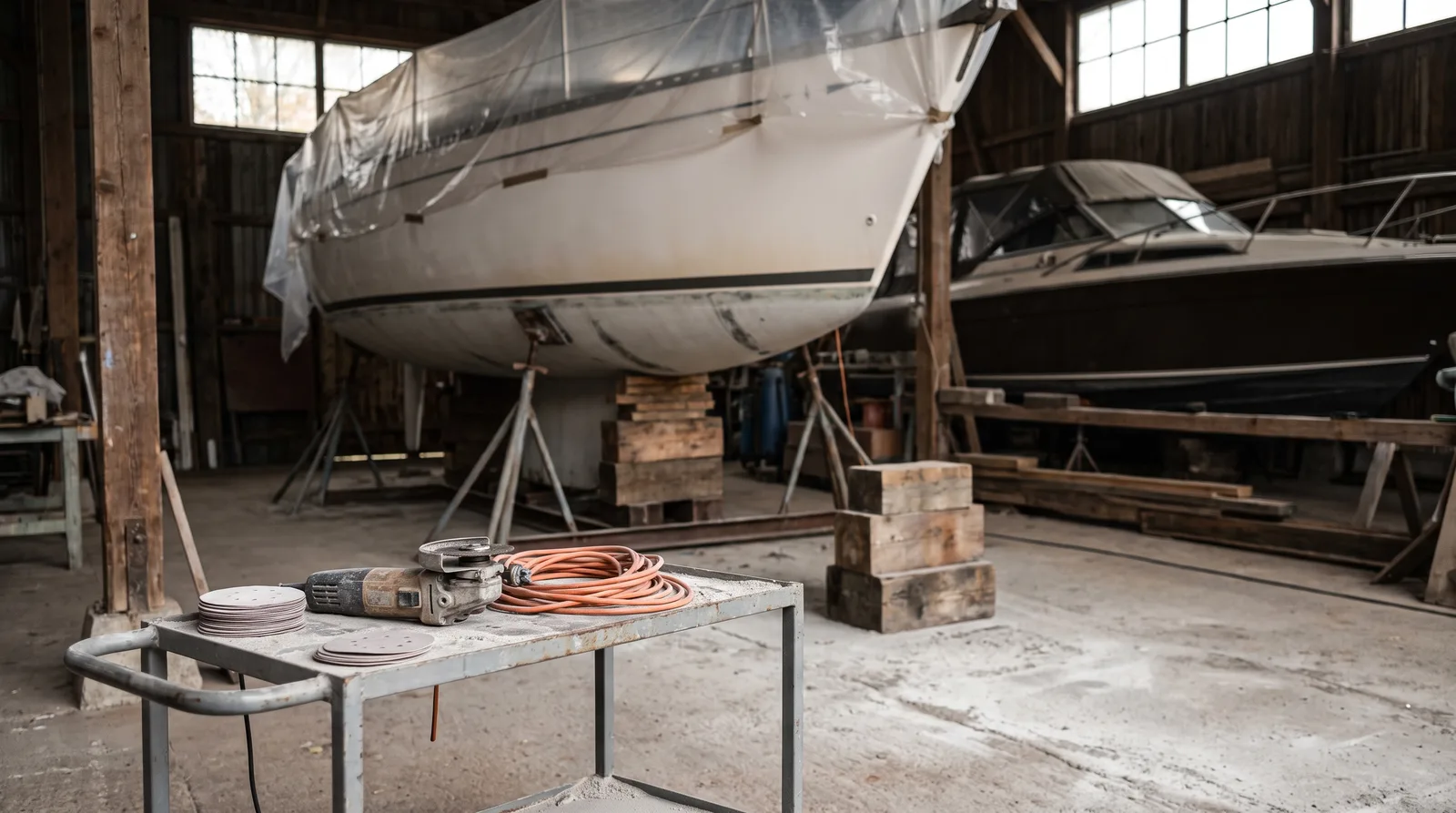
From October to March boats sit in sheds, and that is when the work gets done: engine service, antifouling, gelcoat, upholstery, wiring, rigging. A boat damaged at the yard during winter work is a pattern that returns every season in claims handling. A forklift moves a motor boat and pushes a dent into the hull. A sailing yacht has its mast stepped and the mast buckles on the crane. Someone grinds on the next boat and sparks burn holes into the cushions of a catamaran or the teak deck of a classic. The owner then asks one question: is this for my hull cover or for the yard under the repair contract?
Location is rarely the problem. A typical German hull wording, used here as the example, keeps cover in force during repair, inspection or overhaul at a place that is objectively suitable for watercraft, and a boatyard shed meets that test. Some contracts, however, run only for the sailing season and leave the winter months without cover at all, which happen to be exactly the months when yards do their work. Find out which kind of contract you hold before you sign the job sheet, not after the forklift has done its damage.
What matters next is what happened, not who did it. In the German example a person the owner has engaged to look after the boat, expressly including the repairer, counts as authorised, so the malicious damage clause, which is written for strangers, does not fit. The other named perils remain. Fire is usually listed, often defined as fire with flames, and some wordings add scorch damage to upholstery while others do not. Accident cover, where a policy has it, often includes the breaking of masts and collision with fixed objects, which names the buckled mast. Whether a forklift running into the hull counts as such a collision is rarely spelled out; the sequence of events decides.
Not every dispute with a yard is an insurance matter. Poor workmanship itself, antifouling that peels after three weeks or a through-hull fitting that leaks after replacement, is a defect in the work, and putting it right is the yard's duty under the repair contract. Exclusions also apply in the shed as anywhere else: wear and tear, design, manufacturing or material defects at the part itself, often with resulting damage to other parts treated differently, and poor maintenance. Loss of use is a separate point. Many hull wordings state plainly that they do not pay for the weeks a boat cannot be used.
If the hull insurer pays, the yard is not off the hook. Under German law the owner's claim against the yard passes to the insurer to the extent it has paid, and the owner must hand over the documents needed to pursue it. The deductible stays with the owner, who can claim that part from the yard directly. That is why the liability terms in the job sheet and in the yard's conditions deserve a careful read before signing: a clause that limits the yard's liability for damage to the boat can weaken the claim that the owner or the insurer needs later. Disputes about the quality of the work belong to legal expenses cover for contract matters, where a policy includes it.
For the claim, the day you find the damage matters most. Do not let the yard quietly repair its own damage before it has been recorded, however kindly the offer is meant. Photograph the spot with a folding rule for scale, the surroundings, the forklift or crane and the work that was going on that day, and ask the yard for a written account with date and names. Report the loss to your insurer promptly, and report a fire to the police as well. Cover an open deck or a torn canvas to limit further damage, and give the insurer the chance to inspect before repairs start, even if the same yard is to carry them out.
Half an hour before winter does the most good. Put in writing which jobs are ordered and confirm who moves the boat and with what. Photograph the boat from all sides when you hand it over, on deck and below, on a sailing yacht also the mast foot and shrouds, on a motor boat the cushions and the helm. Ask whether anyone will be grinding or welding next to your boat and how neighbouring boats are covered when they do. And look carefully at collection before you sign that everything is in order: damage spotted in the shed is easier to settle than damage that turns up in May at the pontoon.
Worth checking
Common questions
The yard damaged my boat. Is that a hull claim?
It can be, if a named peril applies, such as fire or, where the policy has accident cover, a buckled mast. The insurer may then pursue the yard. Poor workmanship on its own is a matter for the repair contract instead.
Is it malicious damage if a yard worker damages my boat?
Usually not. Wordings such as the German example treat people engaged to look after the boat, including the repairer, as authorised. The question is whether fire, accident or another named peril applies.
Am I covered in the yard over winter?
That depends on the contract. Many wordings keep cover running ashore during repair, but a seasonal policy may not run in winter at all. Check the period of cover before you leave the boat at the yard.
Related