Mooring with shore lines in Croatia: the new anchoring distance and liability
Croatia has changed the rules for mooring with a bow anchor and shore lines. The distance from shore is measured where the chain enters the water. A dragging anchor raises questions about your policy.
19 November 20267 min readNAMMERT Assekuradeur GmbH
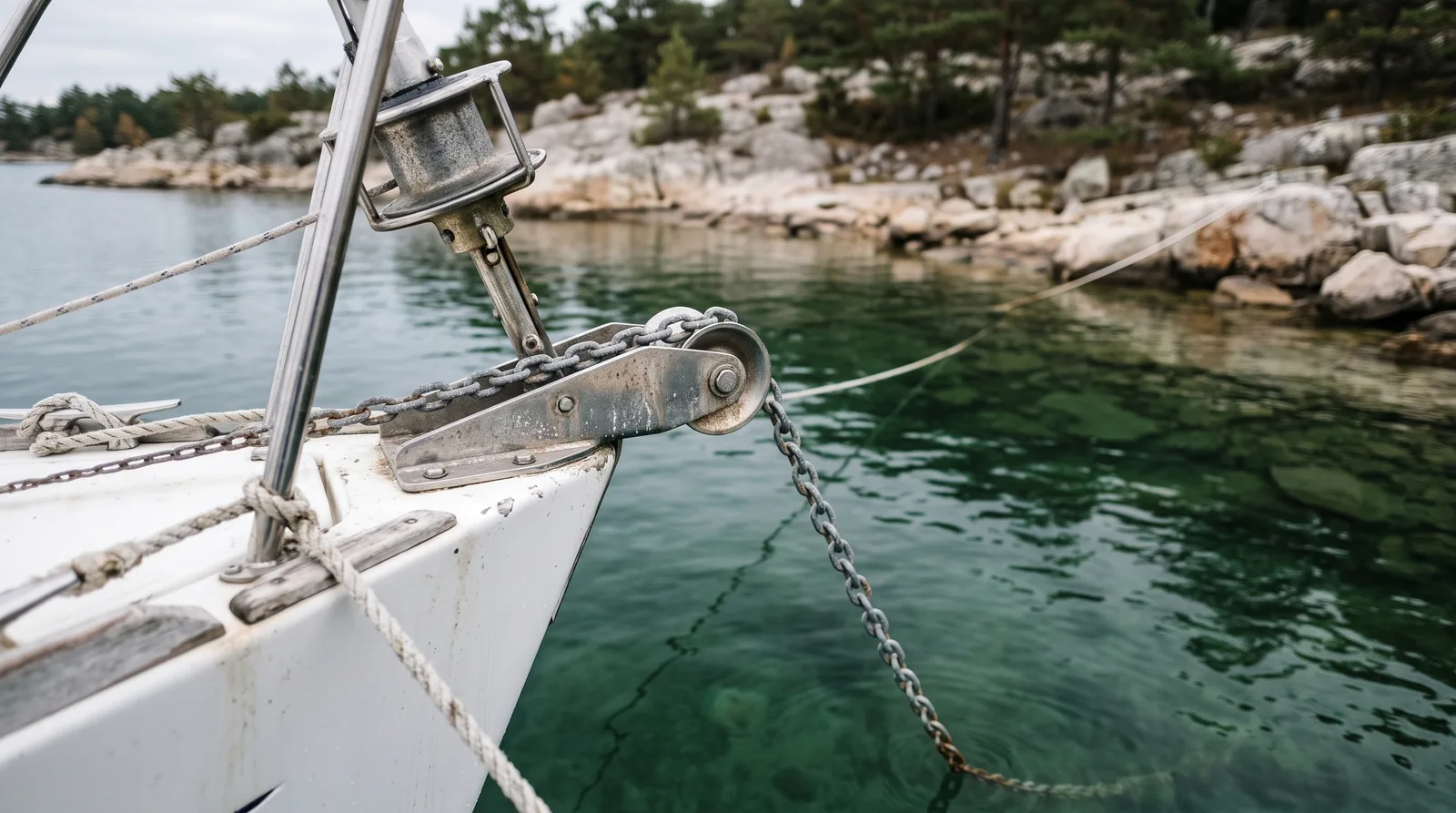
Mooring with shore lines is a common way to spend the night in a Croatian bay: a bow anchor out front and the stern tied to a rock, a pine tree or a ring ashore. Since April 2026 the new anchoring rules allow the point where the anchor chain or rope enters the water to lie up to 70 metres from the shore; the previous limit was 50 metres. According to ADAC Skipper, a German boating guide, writing on 22 July 2026, only that entry point counts, not the position of the anchor on the seabed. What the new distance means for liability when something goes wrong in the bay is not set out in any regulation. It is set out in your own insurance contract.
The other prohibitions remain and belong in the same calculation. Anchoring is not allowed within 50 metres of the boundary of designated bathing areas, within 150 metres of officially designated natural beaches, in protected areas and restricted zones, over underwater cables and pipelines, and anywhere the authorities have banned it. In mooring fields the operator's rules apply. Checks are concentrated between May and September, and breaches carry substantial fines. The source gives no amounts, so neither do we. Anyone planning next summer's cruise over the winter should read the local notices rather than relying on what was true last year.
This concerns every boat that spends nights in Adriatic bays: a privately owned sailing yacht, a charter yacht, a catamaran or a motor yacht with a cabin. For these boats the new figure changes more than the list of fines. Entering the water further out means longer shore lines and more chain, and in a busy bay more lines and chains lie side by side. When the wind swings across the bay, the whole arrangement starts to work. If an anchor drags, the boat drifts onto its neighbour or onto the rocks, and a shore line stretched across the entrance becomes a trap for a tender. These are the incidents in which the insurance contract suddenly matters.
When another boat is damaged, the question is third party liability. Look at whether your policy covers legal liability arising from owning, possessing and using the boat, and whether that liability cover applies in Croatian waters. A sound liability section also pays for defending claims that turn out to be unfounded, which matters when two chains have crossed and each skipper blames the other. Who is at fault in that situation depends on local law and on what actually happened. That cannot be answered in advance, and this article does not try. Most policies exclude damage caused intentionally; check what else they exclude.
Damage to your own boat is a matter for the hull cover, and wordings differ widely here. Some hull policies name accident as an insured event and spell out stranding, grounding and collision with fixed or floating objects. Others only list named perils such as natural forces, fire, explosion and theft, with storm defined from a fixed wind force, often Beaufort 8. Under a wording of the second kind, a boat that drags its anchor in a Force 6 and lands on the rocks has not suffered an insured event at all. Check the cruising area as well: a policy written for northern European waters does not automatically extend to the Mediterranean.
Two kinds of clause relate directly to rules like the Croatian one. Many hull wordings exclude damage caused by breaches of official regulations. The word that matters is caused: a breach on its own should not remove cover; it must have led to the damage. Read your clause to see whether it says caused or merely mentions the breach, because that difference decides cases like a chain entering the water at 75 metres. Gross negligence clauses work differently: many allow the insurer to reduce payment in proportion to fault, and some waive the reduction up to a share of the sum insured. Look for the figure and for the exceptions, which commonly include theft, drugs and alcohol.
The second kind concerns the boat left alone in the bay while the crew is ashore. Several wordings exclude damage if the boat lies unmanned off an open coast for longer than a set number of hours, typically 24 or 48, and nobody is ready to move it if danger threatens. Whether a bay with shore lines counts as an open coast depends on where it is. Find the hour limit in your policy before you plan a day inland, and arrange for someone nearby who can move the boat.
The new rule does not change what an insurance contract covers. It does change what will be asked after an incident: where did the chain enter the water, how long were the lines, how strong was the wind, who was on board. Owners who can answer with photos and notes are in a better position for both liability and hull claims. And anyone who reads their schedule before next season will see whether cruising area, accident cover and the unmanned clause match the way they actually sail in the Adriatic.
Worth checking
Common questions
Who pays if my anchor drags and I damage the boat next to me?
That is a classic third party liability claim. Check that your policy covers legal liability from using the boat in Croatian waters. Whether and how much you owe is decided under local law; good liability cover also defends unfounded claims.
Do I lose hull cover if my chain enters the water more than 70 metres from shore?
Not automatically, if your exclusion only applies to damage caused by a breach of official regulations. Then the breach must have led to the damage. The fine itself is always yours to pay.
Is a boat on the rocks after a dragging anchor insured under every hull policy?
No. Policies that name accident usually include stranding and collision. Named perils wordings may only respond to storm from a set wind force, so a dragging anchor in a moderate breeze can fall outside them.
Related
