Magazine / Magazine: Boat and season
Sea-Doo RXT-XRS 300 insurance check: the details a jet ski policy should contain
We have not ridden the Sea-Doo RXT-XRS 300, and this is not a test report. Part one of this insurance check covers the details a jet ski policy should contain.
16 October 20267 min readNAMMERT Assekuradeur GmbH
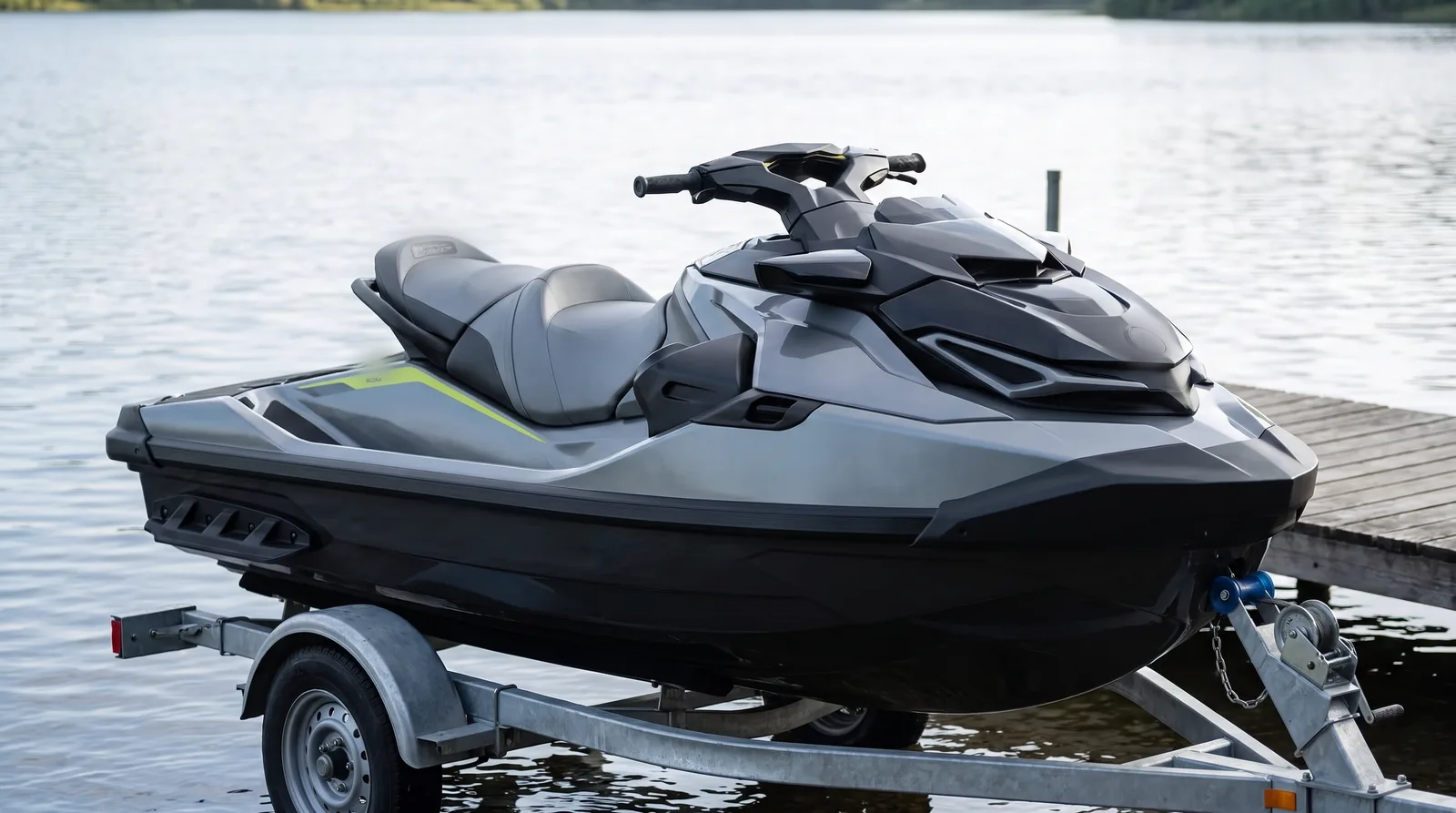
To be clear from the start: nobody on our side has ridden the Sea-Doo RXT-XRS 300. This insurance check is not a ride test and says nothing about handling, comfort or build quality. It looks at the jet ski from the angle an insurance intermediary can judge: the details a policy should contain and the clauses worth reading before you sign. The model appears in our own records, and our catalogue lists it at a length of roughly three and a half metres. The series has four parts: the policy, the insured value, typical damage, and life on the trailer, at the ramp and in winter storage.
Start with the name, because it is rarely consistent. Our records hold several spellings for this model, among them RXT-X 300, RXT 300, RXT 300 RS and RXT 300 XRS. The bill of sale, the dealer invoice and the registration papers often describe the same craft differently, and that is normal rather than a mistake. What matters for any policy is that the craft can be identified beyond doubt. That is why the hull identification number and the engine number belong in the proposal, copied from the craft itself. After a theft, the hull number is often the only reliable way to match a recovered jet ski to its owner.
Every question on the proposal deserves a complete and accurate answer. Most hull wordings carry a duty of disclosure, and wrong answers on facts that matter to the risk can allow the insurer to withdraw from the contract. Take engine data from the manufacturer's papers or the invoice rather than estimating it. If something changes later, such as a modification to the engine, many wordings treat it as an increase of risk that has to be reported. Part two of this series explains how modifications affect the insured value.
The most important entry is the type of craft. Many hull wordings treat a jet ski differently from a motorboat and attach a separate jet ski clause, which changes the rules on deductibles, on securing the craft against unauthorised use and on exclusions for engine and hull. Some personal accident covers also distinguish, for example with a higher head injury benefit for riders who wore a helmet. If your jet ski is declared as a motorboat, you may end up with rules that do not fit the craft, in either direction. Check that the schedule names a jet ski explicitly.
Next comes the question of who may ride. Liability wordings usually require an authorised rider, someone using the craft with the owner's knowledge and consent and holding the licence the authorities demand for that craft and those waters. Hull wordings commonly exclude damage caused because an unqualified person rode without the required licence. If you lend the jet ski to a friend, ask to see the licence first. Hiring it out occasionally is another matter: many policies cover private hire only if it was declared, kept within a limit of days per year and based on a proper rental agreement. Passengers are covered in part three.
The cruising area is set out in the schedule, often in steps from inland waters to coastal seas, the Mediterranean, the Atlantic and worldwide. A jet ski kept on a lake that goes to the Adriatic in summer needs the Mediterranean in the policy. When comparing levels of cover, the main difference is usually between named hazards such as storm, fire and theft of the whole craft, and broader cover that adds collision, grounding, theft of parts and vandalism. Finally, resale: in Germany, hull cover passes to the buyer by law, while liability cover ends with the sale. Part two deals with the value, part four with trailer and travel.
Insurance checkPart 1 of 4
Sea-Doo RXT-XRS 300: an insurance check
All parts at a glance
- Sea-Doo RXT-XRS 300 insurance check (Policy)
- Sea-Doo RXT-XRS 300 insurance check (Value)
- Sea-Doo RXT-XRS 300 insurance check (Damage)
- Sea-Doo RXT-XRS 300 insurance check (On the move)
Worth checking
Common questions
Which spelling of the model name should go into the policy?
The one in your documents. Variants such as RXT-X 300, RXT 300 RS or RXT 300 XRS describe the same model. What makes the craft identifiable are the hull and engine numbers, so enter both.
Can I hire my jet ski out to friends now and then?
Only if your policy allows it. Many wordings cover occasional private hire only when it was declared, stays within a limit of days per year and rests on a proper rental agreement. Ask before the first rental.
What happens to the insurance when I sell the jet ski?
Under German law, hull cover passes to the buyer, who may cancel within a month. Liability cover ends with the sale. Rules in other countries can differ, so check your own contract.
Related
