German agency: extreme water levels set to multiply
The North Sea and the Baltic are warming measurably, sea level is rising, and climate simulations point to far more frequent extreme water levels. For berth holders that is a planning question, not a distant one.
Technology NAMMERT Assekuradeur GmbH
On 21 September 2026 the Bundesamt für Seeschifffahrt und Hydrographie, the German federal maritime and hydrographic agency, published new measurement series ahead of the ExtremWetterKongress held in Hamburg on 23 and 24 September. The surface of the North Sea has warmed by 1.4 degrees since 1969 and the Baltic by 2.0 degrees since 1990. For 2025 the agency reports a mean surface temperature of 11.6 degrees in the North Sea, the highest in the series, and 9.7 degrees in the Baltic.
Extremes are increasing alongside the averages. The Heligoland station recorded 66 days of marine heatwaves in 2026 up to 1 September, meaning spells of at least five days with water unusually warm for that place and season. On 1 July the water there stood almost 4 degrees above the average.
The second strand concerns water level. At Cuxhaven the sea has risen by more than 25 centimetres since 1900 and at Warnemünde by just under 20 centimetres, with up to a further metre considered possible by 2100. Because storm surges then start from a higher baseline, the agency's climate simulations suggest that today's extreme water levels could occur three to five times as often by the end of the century.
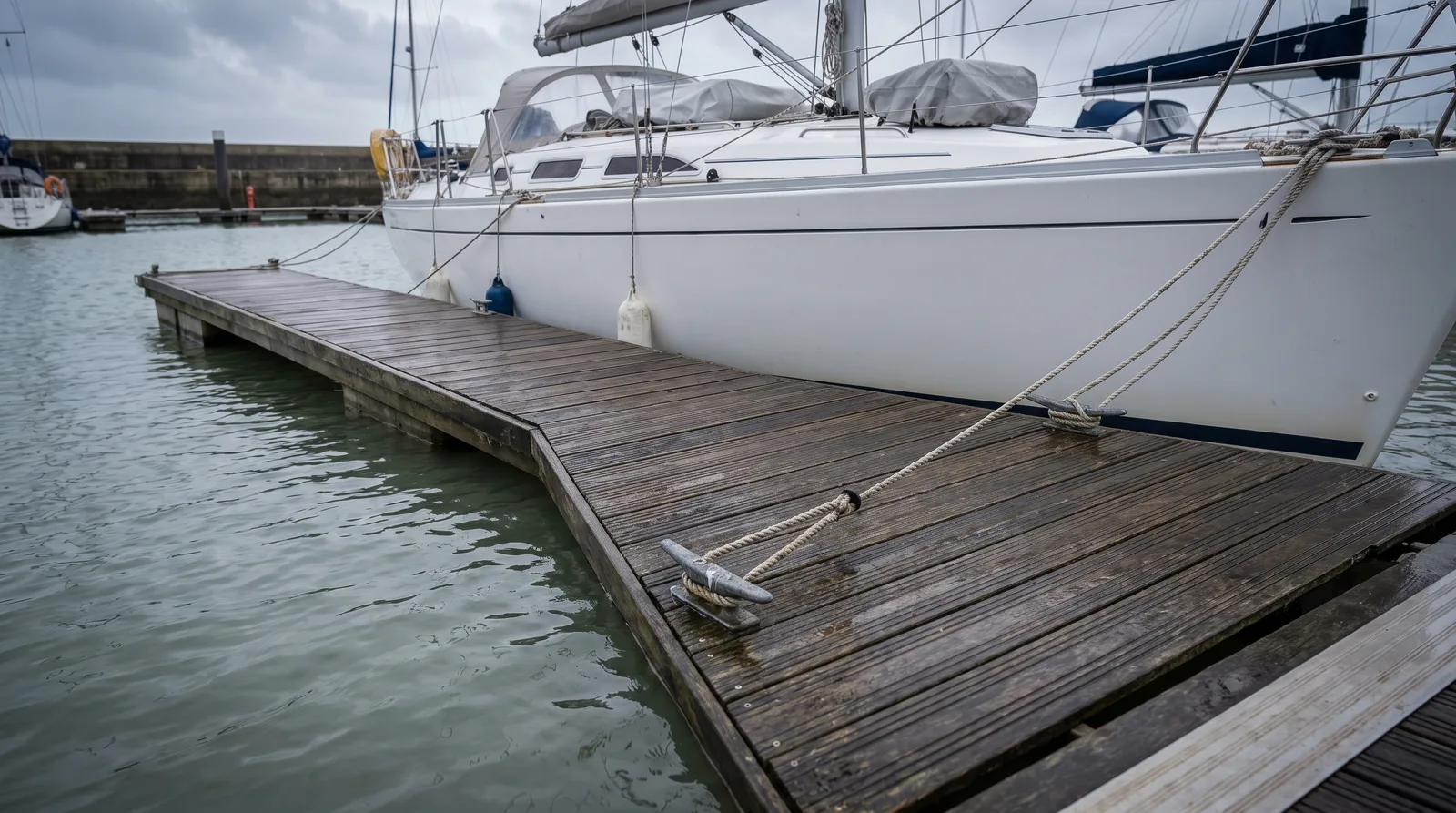
For owners the useful part is not the climate debate but the change in frequency. A berth that used to be flooded once every few years will be reached more often under otherwise identical weather. That bears on pontoon height, on the length of mooring lines, on where shore power connections sit, and on how high a boat is chocked up in winter storage.
What this means for owners
After a storm surge the argument is rarely about the weather and almost always about preparation at the berth. Mooring lines cut too short, so that a rising tide lifts the boat onto the pontoon, produce damage that no one can attribute to nature. The question worth putting to your own insurer well before the season ends is how it treats surge damage where the mooring arrangement itself contributed, and what it expects of an owner who leaves a boat afloat through the winter. Sailing yachts and motorboats lying permanently at floating pontoons are the most exposed, together with boats stored ashore close to the shoreline.
This paragraph is our view as an underwriting agency, not part of the news. What your own policy covers is written in your own terms; when in doubt, call us.
Where this comes from
- Bundesamt für Seeschifffahrt und Hydrographie, Pressemitteilung vom 21.09.2026
- YACHT, Wärmere Nordsee, höhere Wasserstände: was die BSH-Daten für 2026 zeigen
The text above is our own. The sources listed supplied the facts and the figures, not the wording.