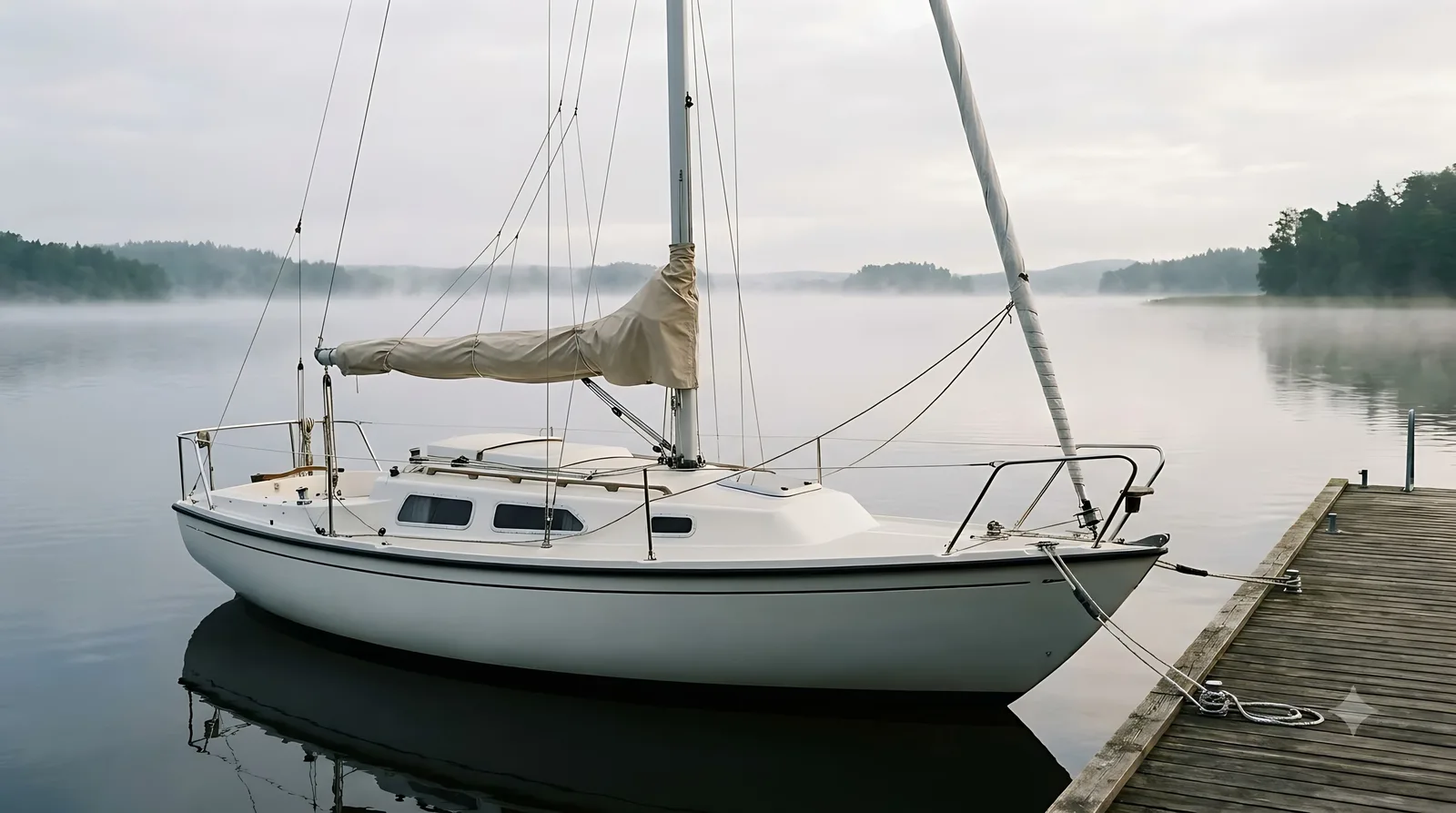
Etap 22 insurance check: what the policy should say about this sailing boat
Part one of a four part insurance check on the Etap 22. Nobody sailed the boat for this series; it looks only at what a policy for it should say.
11 October 20267 min readNAMMERT Assekuradeur GmbH
Boat tests often run as a series: one boat, several articles, a different angle each time. This series borrows the format and nothing else. Nobody at NAMMERT has sailed a single metre in an Etap 22, so there is nothing here about how the boat sails, how it is built or how good it is. This is an insurance check. It asks what a policy for this boat should say, which clauses decide a claim, and which questions an owner should put to a broker or insurer before the season, whoever the insurer is.
The Etap 22 is a sailing boat, more precisely a small cabin sailboat, listed in the NAMMERT master data at 6.6 metres. Boats of this size are often trailed and often no longer new. That is why the series has four parts: this one on the contract, the second on setting the value of an older sailing boat, the third on the typical claims for this type of boat and how wordings treat them, and the fourth on trailers, cranes, winter storage and trips abroad.
Start with the description of the boat. In some documents the model appears as 22 I, in others as Etap 22. Neither is wrong, as long as it is clear which boat is meant. A hull policy insures a specific vessel, and most wordings oblige the owner to answer the proposal questions correctly; a wrong answer can give the insurer the right to withdraw from the contract or to reduce a payment. Lay the bill of sale, the boat papers and the policy schedule side by side and compare type, model name, length and hull identification number. Photograph the number on the hull itself. After a theft the police will ask for it, and so will the insurer.
A small cabin sailboat often carries an outboard on the transom, and that engine is easy to forget. In many hull wordings an outboard is only insured when it is declared with its own sum insured on the schedule. Some wordings add a security condition: no payment for damage to the outboard unless it was secured with a locking bolt or a comparable device, or kept in a locked building. Look also for the clause on mechanical breakdown. Wear and internal failure of an engine are often excluded from hull cover and only come back through a separate machinery extension, if one exists.
Next, who may helm the boat. Liability wordings usually require an authorised skipper, meaning someone using the boat with the owner's knowledge and consent and holding whatever licence the authorities require for that boat and that water. Hull wordings often exclude damage caused by an unqualified person without the required licence. Whether a licence is needed is decided by the law of the water you sail on, not by the policy. Check too whether the owner's duties after a claim extend to anyone the boat is lent to, and whether handing it over for money counts as an increase of risk that has to be agreed in advance. For personal accident cover, read who counts as an insured person: the owner only, the family, or everyone on board.
The cruising area on the schedule is the second line that has to match the season. Typical wordings offer inland waters, then the North Sea and the Baltic, then the Mediterranean, then the European Atlantic coast and finally worldwide. For a boat that spends one summer on a lake and the next on the Adriatic, the furthest destination decides. Check how the policy treats a trip beyond the agreed area. Some require prior written agreement, some allow a short extension of a few weeks per year, and without either the boat may be uninsured from the moment it crosses the line.
Finally the scope of cover and club racing. Read the list of insured events: storm, fire and theft of the whole boat make a narrow cover, while accident cover adds grounding, collision, dismasting and torn sails. Find the racing clause before the first club race of the season. Some wordings exclude every race including practice, some include club racing only, some include races of any kind. The question of liability on the race course is dealt with in the third part of this series.
Insurance checkPart 1 of 4
All parts at a glance
- Etap 22 insurance check
- Etap 22 insurance check
- Etap 22 insurance check
- Etap 22 insurance check
Worth checking
Common questions
My papers say 22 I, the policy says Etap 22. Does that matter?
Not as long as it is clear which boat is meant. What counts is that type, length and hull identification number on the schedule match the papers. If in doubt, send a copy of the papers to the broker or insurer and ask for the description to be aligned.
Is the outboard part of the boat in a hull policy?
Often not. Many wordings insure an outboard only when it is declared with its own sum insured, and some require a locking bolt or storage in a locked building. Look for both points in the wording before the season starts.
Can a friend take my sailing boat out?
Usually yes, if the friend uses the boat with your consent and holds any licence the law requires for that water. Read whether the policy extends your duties after a claim to the person you lend it to, and whether lending for money must be agreed.
Related