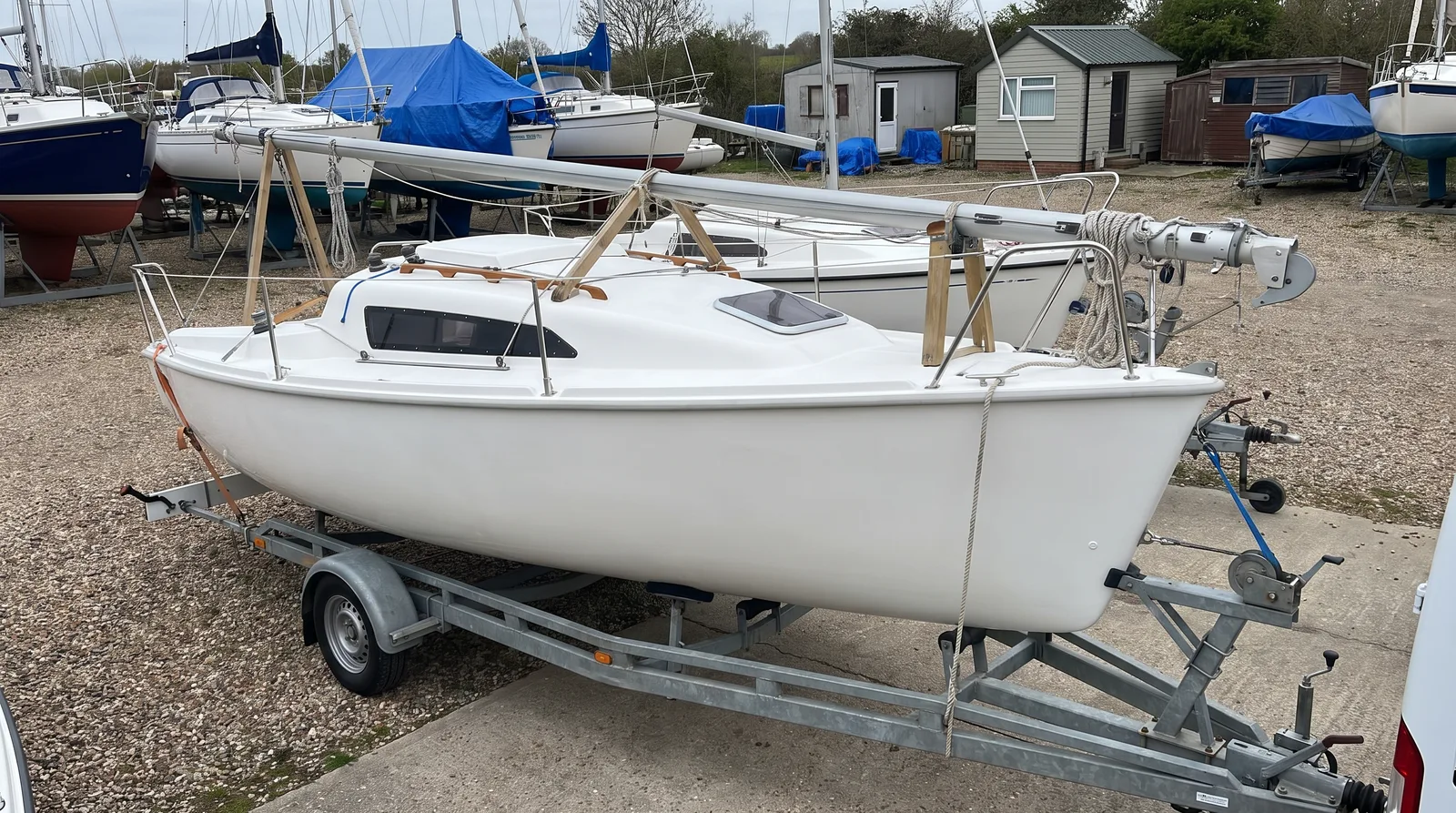
Etap 22 insurance check: on the road with trailer, crane and winter storage
The last part of the Etap 22 insurance check leaves the water: what to look for in a policy for a trailed sailing boat on the road, at the crane, ashore and abroad.
11 October 20267 min readNAMMERT Assekuradeur GmbH
The fourth and last part of this insurance check on the Etap 22 leaves the water. As in the first three parts, this is not about sailing but about cover, in the places where a small sailing boat spends a good part of its year: on the trailer, at the crane, on the slipway, on the mooring and in winter storage. On the road and at the ramp, owners face questions that have nothing to do with sailing, and the answers sit in different clauses of the wording from the accident cover on the water.
Start with the trailer. In many hull wordings a trailer is only covered when declared with its own sum insured. Look for the theft conditions, because they are often precise: a chain or steel cable with a lock, or a comparable device, against unauthorised uncoupling while attached to the car, and a hitch lock or wheel clamp when parked uncoupled. Some wordings add conditions for the theft of the trailed boat itself, such as a hitch lock and a chain between boat and trailer. Check too which events are covered for the trailer and whether a deductible applies to it.
On the road, cover usually continues during transport by suitable means. The typical boundary is an exclusion for improper loading and securing. A lowered mast that slides forward under braking is exactly that case, as is a boat not sitting properly on its supports. On the liability side, read whether the policy includes the use of a trailer and whether it only applies where the towing vehicle's motor liability insurance does not. In many countries the car's motor insurance is the first port of call while towing.
Before the trip the mast comes down, and before the water the boat is craned or slipped. Many wordings name hauling out and launching explicitly, often on condition that it happens at a place objectively suitable for boats. A paved slipway or a crane area meets that more easily than a bank without a ramp. When the mast is lowered, loose parts such as shrouds or spreaders should be packed, covered and lashed or kept inside the locked boat, since theft of loose parts is a common exclusion. For personal accident cover, check whether slipping and maintenance count as use of the boat.
On the mooring, one clause is worth looking for. Damaging a rented jetty while berthing is damage to a rented object, and liability wordings commonly exclude claims for rented property. Some wordings make an exception for jetties used for mooring and for rented storage spaces of the boat. Where that sentence is missing, ask the broker or insurer, or check the marina contract. For the hull cover, ashore the place often has to be objectively suitable for boats as well.
In winter storage three questions come together. First the place: theft and malicious damage ashore are often excluded when the boat stands on an unfenced, unlocked site or in an unlocked building. Second the weather: frost, ice and snow are usually excluded as weather exposure unless caused by a storm. Third the period: a seasonal policy may leave the boat entirely uninsured over the winter, including storage, craning and yard work. Read the dates on the schedule before the boat goes onto its cradle.
That leaves trips abroad and away regattas. Anyone towing to an Italian lake or the Adriatic checks the cruising area from the first part of this series: inland waters may be in the smallest area, the Mediterranean only in a larger one. Read whether liability cover includes claims abroad. For an away regatta, the hull racing clause applies just as at home. Before every trip it is worth checking that trailer and outboard are listed with their own sums on the schedule.
Insurance checkPart 4 of 4
All parts at a glance
- Etap 22 insurance check
- Etap 22 insurance check
- Etap 22 insurance check
- Etap 22 insurance check
Worth checking
Common questions
Is the trailer covered automatically?
Often not under hull cover. Many wordings cover a trailer only when declared with its own sum insured. Liability while towing usually falls first on the car's motor insurance; some boat liability wordings add cover where that does not apply.
Is my boat covered in winter storage under a seasonal policy?
That depends entirely on the dates and the wording. Some seasonal policies leave the boat without any cover over the winter, including storage, craning and yard work. Read the period of cover on the schedule before the boat is laid up.
Am I covered when I tow the boat to the Adriatic?
On the water only if the Mediterranean is part of the agreed cruising area. On the road, many wordings cover transport by suitable means, but exclude damage from improper loading and securing.
Related