Magazine / Magazine: Boat and season
New Year fireworks in the marina: what a stray rocket means for hull cover on a boat
Over New Year most boats sit alone under a cover while fireworks go up around them. Three questions decide how a hull wording treats the result: was there a fire, was it deliberate, where was the boat.
23 November 20267 min readNAMMERT Assekuradeur GmbH
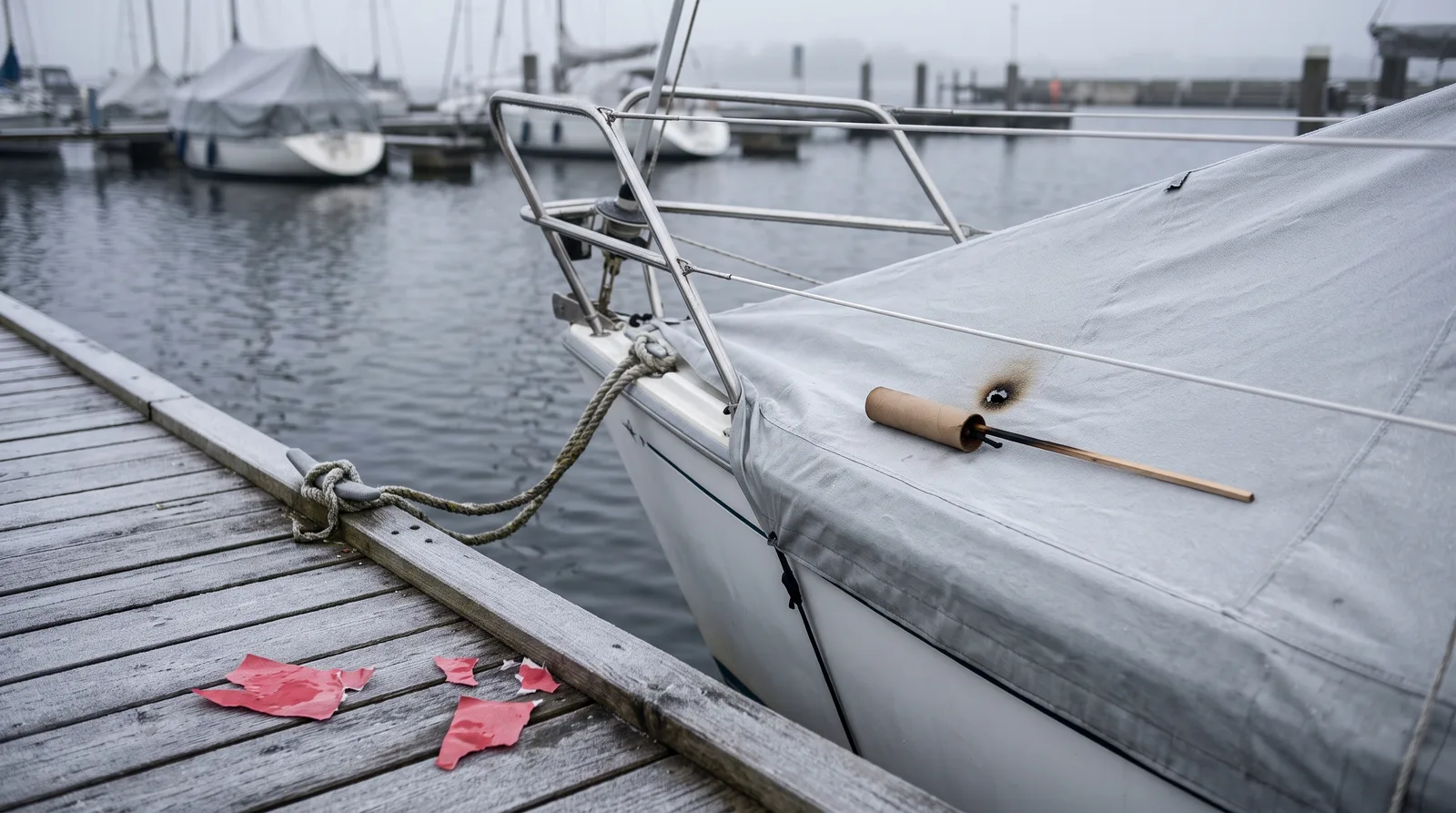
Over New Year most boats sit alone, afloat in the marina or ashore in winter storage, while fireworks go up all around them. December is the month to prepare for that night. Otherwise the first visit of the year may start with a stray rocket lying burnt out on the winter cover, a hole melted into the canvas or soot on the deck. It concerns every sailing yacht and motorboat on a berth and every trailer boat or jet ski parked in an open yard. What such a rocket means for hull cover on a boat comes down to three questions: was there a fire, was it deliberate, and where was the boat kept.
The rules on fireworks differ from country to country, and a marina may add its own. Germany is a useful example because the national rule is short. Under the First Ordinance to the Explosives Act (1. SprengV), consumer fireworks of category 2 may be let off by adults aged 18 or over only on 31 December and 1 January (section 23(2)), and they are sold to consumers as a rule from 29 to 31 December (section 22(1)). Letting them off in the immediate vicinity of churches, hospitals, children's homes, homes for the elderly and buildings or installations that are particularly sensitive to fire is prohibited (section 23(1)), and the local authority may extend that ban (section 24(2)). Whether a boat shed counts is for the authority to say, not the owner. Harbour and yard rules can be stricter still, so read them before the night.
In the wording of a hull policy, start with the definition of fire. Many contracts insure fire as a named peril and define it as a flame that has left its intended place and can spread by itself. A rocket that sets the cover alight and the fire then reaches the boat usually meets such a definition, whoever lit the rocket. A scorch hole in the canvas with no spreading flame often does not. Some wordings add scorch damage, sometimes only for upholstery and furniture, so check which parts of the boat that sentence names and whether the winter cover is listed as part of the insured inventory.
The second point is intent. Look for a clause on malicious damage or vandalism by third parties. Some contracts include it, basic ones often do not. A firecracker thrown into the cockpit on purpose is one thing, a rocket that came down by chance is another, and whether the second falls under a malicious damage clause is decided case by case. For a boat stored ashore, check the exclusion that often goes with this clause: theft and malicious damage may be excluded when the boat stands in a yard that is not fenced and locked or in a building that is not locked. Ask the yard how the site is secured at night before the boat goes there.
After a loss, the morning of 1 January matters most. Hull wordings commonly make it a duty to report a claim without delay and to report fire, explosion and vandalism to the police, in a harbour also to the harbour office. The insurer will normally want to inspect the damage before repair. Leave the remains of the rocket where they are until they are photographed, then keep them together with the damaged cover. Check the deductible as well: where it is deducted from every claim, a small hole in a cover may leave little to pay out. If the person who fired the rocket is known, that person is liable under the general law.
Finally, the owner's own conduct. Letting off fireworks from the jetty or from the deck and setting fire to the boat raises the question of gross negligence, and many contracts allow the insurer to reduce payment in that case, some with a waiver up to a stated share of the sum insured and none where alcohol is the cause. If the rocket hits the neighbouring boat, it is doubtful whether that is still use of the boat in the sense of a boat liability policy, so the first question goes to personal liability insurance. Distress flares are not fireworks anywhere. In Germany the deliberate misuse of distress signals is a criminal offence under section 145 of the Criminal Code, and a red flare over the water can start a search.
Worth checking
Common questions
Is fire caused by a New Year rocket an insured event under a hull policy?
Check whether fire is a named peril and how the wording defines it. Where fire means a flame that spreads by itself, a cover set alight by a rocket usually qualifies, whoever lit it. A scorch hole without a spreading flame often does not.
What should I check if the boat is stored ashore in an open yard?
Look for an exclusion of theft and malicious damage for boats kept on land that is not fenced and locked. Ask the yard how the site is secured at night, and keep the answer in writing with the storage contract.
Can I use old distress flares as fireworks?
No. Flares are distress signals, and in Germany their deliberate misuse is an offence under section 145 of the Criminal Code. Expired flares go back to the dealer or an approved collection point.
Related
